
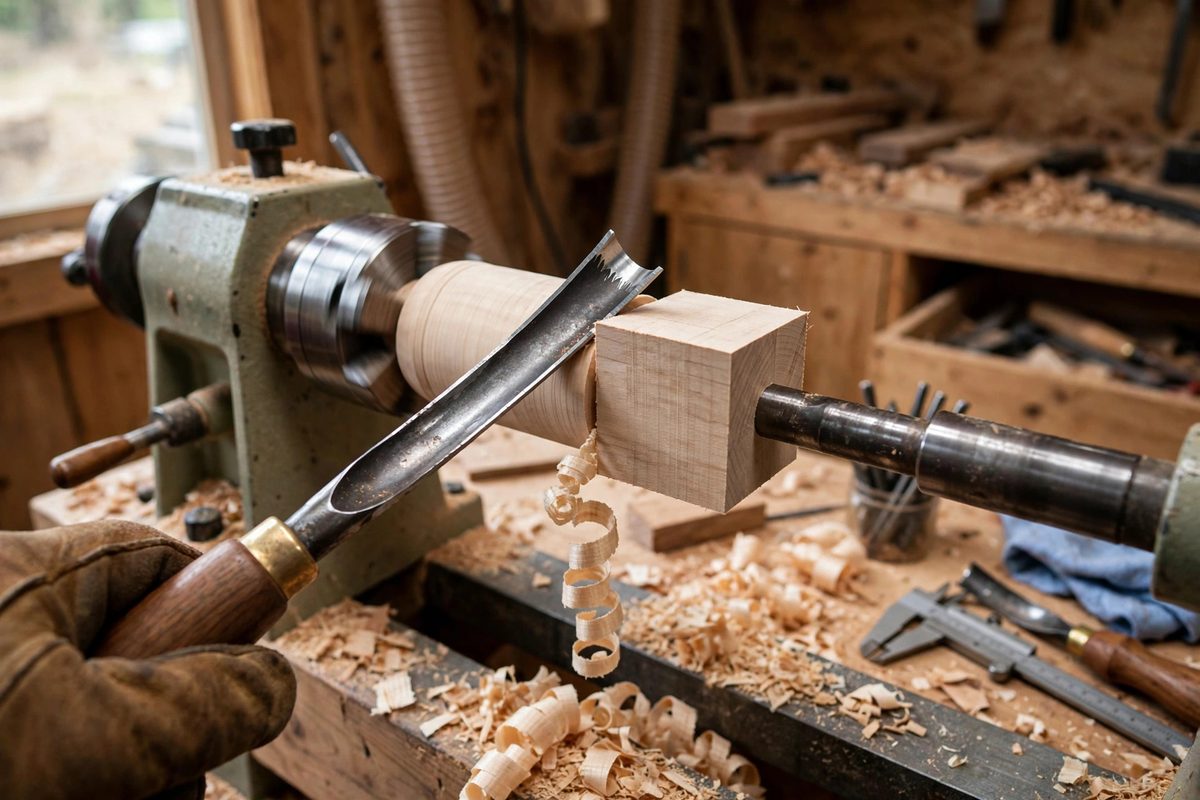
The roughing gouge is the first tool to touch most spindle blanks, hogging square corners into cylinders. Its bevel angle and the skew of that bevel across the flute determine how it cuts: cleanly peeling shavings or scraping, chattering, and catching. Understanding the dynamics of the bevel skew turns roughing from a wrestling match into a controlled operation.
What the Bevel Does in a Cut
In a proper gouge cut, the bevel rubs the wood just behind the cutting edge, supporting the edge and controlling the depth of cut. This bevel contact is what makes a gouge cut feel smooth and sound like a clean hiss; without it, the edge digs uncontrolled and catches. The bevel angle sets the geometry: a lower bevel angle presents the edge more aggressively, cutting faster but demanding more skill, while a higher angle is more forgiving but cuts slower and can scrape rather than slice. For roughing gouges, the bevel typically sits in the mid-40s in degrees, a compromise between hogging efficiency and control. The key insight is that the bevel is a depth stop and a stabilizer, not just a sharpened edge.
Skew: The Bevel Is Not Square
Look at a roughing gouge from the side and the bevel is often ground with a slight skew: one wing of the flute leads the other. This skew is partly a product of sharpening technique and partly intentional, and it changes the cutting dynamics. A skewed edge meets the wood progressively rather than all at once, which lowers the cutting force at entry and gives a smoother start to the cut. It also biases the cutting action slightly to one side, which experienced turners exploit to steer the cut. However, excessive or asymmetric skew makes the tool cut unevenly, with one wing doing all the work; that wing then dulls faster and the tool starts to vibrate. The goal is a bevel that is symmetric or only slightly skewed, with both wings sharing the cut.
Dynamics of the Roughing Cut
Roughing is interrupted cutting: the gouge meets each corner of the square blank in turn, which hammers the edge four times per revolution. The bevel's job in this chaos is to re-establish support instantly after each impact. A bevel angle that is too acute for the interrupted cut lets the edge dig into each corner, producing the catches that launch blanks; a bevel that is too obtuse bounces over the corners, chattering. The sweet spot lets the bevel ride the just-cut surface between impacts, keeping the edge engaged without digging. This is why roughing technique emphasizes a firm tool rest position close to the work, a controlled feed rate, and letting the bevel do the supporting. Forcing the tool or holding it without bevel contact turns the dynamics against you.
Sharpening to Maintain the Geometry
Every sharpening changes the bevel, so sharpen with the dynamics in mind. Grind the bevel to the target angle consistently, using a jig or a practiced platform technique; freehand grinding that wanders between angles produces a bevel that is effectively multi-faceted, and each facet changes the cutting behavior. Keep the wings even: grind each side of the flute equally so the skew stays symmetric. Hone the edge lightly after grinding to remove the burr; a wire edge on a roughing gouge breaks off immediately in the interrupted cut and leaves a ragged edge. Check the bevel by reflecting light off it: a clean, single-angle bevel shows one even reflection, while a wandering bevel shows patchy reflections.
Reading the Cut and Adjusting
The shavings and the sound tell you everything. Clean, continuous shavings peeling off with a steady hiss mean the bevel geometry and your presentation are right. Dust instead of shavings means the edge is dull or the bevel is rubbing without cutting; catches mean the bevel lost contact or the angle is too aggressive for the cut. If the tool chatters, check the tool rest distance first, then the bevel angle; chatter is often the bevel bouncing because the angle is wrong for the wood or the edge is unevenly skewed. Adjust one variable at a time. The roughing gouge is a simple tool, and its dynamics reward the turner who reads the feedback instead of muscling through.
The roughing gouge cuts on its bevel as much as on its edge: the bevel angle sets aggression, the skew sets entry smoothness, and the interrupted cut demands consistent geometry. Sharpen symmetrically, present with bevel contact, and read the shavings. The blank becomes a cylinder almost by itself.
Related Guides
- Bevel Edge Angle Consistency on Turned Bowls: The bevel on a turning gouge, the ground surface just behind the cutting edge, is the turner's autopilot: when the bevel rubs the wood, it steadies
- Bevel Rubbing Mechanics on End Grain Hollows: Hollowing end grain on the lathe, boring into the end of a spinning blank to make a box, goblet, or hollow form, is where bevel rubbing either saves
- Shear Scraping Outside Curves on End Grain Goblets: An end grain goblet, turned with the grain running vertically through the form, presents the turner with end grain across the entire outside curve