
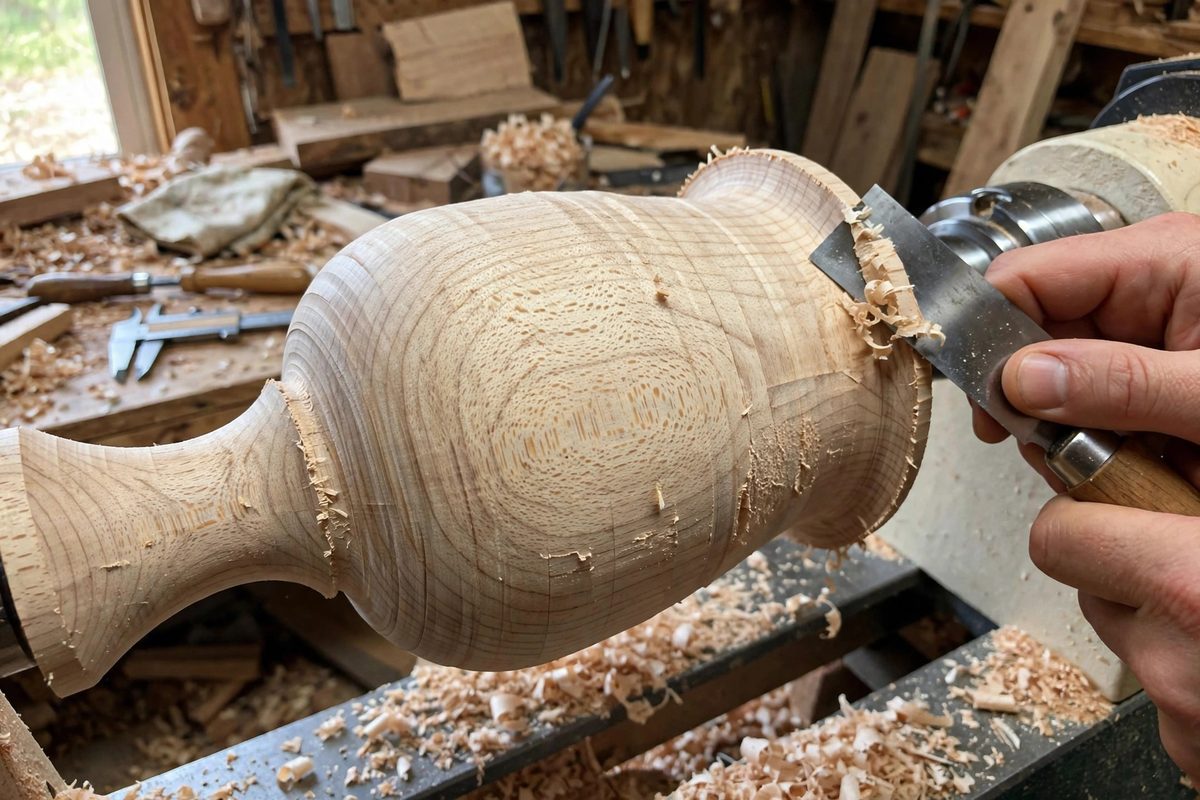
An end grain goblet, turned with the grain running vertically through the form, presents the turner with end grain across the entire outside curve. End grain tears under tools that would slice side grain cleanly. Shear scraping, presenting the scraper at a skewed angle so it slices rather than scrapes, is the technique that leaves the outside curve smooth enough to finish directly.
Why End Grain Tears
End grain is a bundle of fiber ends, and a tool presented square to it crushes and tears the fibers instead of severing them. On a goblet's outside curve, the grain direction changes continuously along the profile, so some part of every cut is working against the fiber orientation. A conventional scraping cut, tool flat on the rest and square to the work, drags across those fiber ends and leaves a torn, fuzzy surface. The tear-out then requires heavy sanding, which rounds the crisp curve you just shaped. Shear scraping changes the cutting geometry so the edge slices the fibers at an angle, severing them cleanly.
The Shear Scraping Setup
Present the scraper to the work at roughly a forty-five degree skew angle, with the tool's edge trailing the rotation, so the cutting happens at the leading corner of the skew. Raise the tool handle so the edge meets the wood at a shearing angle rather than flat; the exact presentation is learned by feel, but the principle is that the edge should slice across the fibers, not drag along them. Use a freshly sharpened scraper with a keen burr; a dull scraper tears even in shear mode, and the burr is what does the fine cutting. Light cuts only, the tool removes whisper shavings, not ribbons.
Working the Outside Curve
Follow the goblet's curve with the tool, keeping the skew angle consistent as the profile changes; the tendency is to flatten the angle on the steep parts of the curve, which returns the cut to tearing. Move the tool rest to keep it close to the work throughout, since a long overhang vibrates and the vibration shows in the surface. Work from the larger diameters toward the smaller, which generally cuts with the grain flow on the outside of an end grain form. Take the final passes at a higher lathe speed with the lightest possible touch; the last pass determines the surface the finish will show.
Reading the Surface
A good shear scrape leaves a surface that looks almost sanded, with a slight sheen and no visible tear. If torn patches appear, they mark where the angle flattened or the burr dulled; resharpen and rework just those areas rather than re-cutting the whole curve. Check the surface in raking light before sanding, because raking light reveals tear that overhead light hides. The goal is to sand starting at a fine grit, removing only the faintest tool marks, not to sand out tear that should never have been there.
Safety on Thin Goblets
Goblets get thin, and thin end grain work is fragile. Keep the tool rest close, take light cuts, and never force the tool; a catch on a thin goblet wall breaks the piece and can throw fragments. Wear a face shield, as with all turning, and keep the lathe speed appropriate to the diameter and the wall thickness. The shear scrape's light touch is inherently safer than heavy scraping cuts, which is one more reason to master it: the technique that gives the best surface also treats the fragile work most gently.
Skew the scraper to a shearing angle, keep the burr keen, follow the curve with light passes, and read the surface in raking light. The end grain goblet's outside curve will come off the tool ready for finish, with the crisp profile intact.
Related Guides
- Bevel Rubbing Mechanics on End Grain Hollows: Hollowing end grain on the lathe, boring into the end of a spinning blank to make a box, goblet, or hollow form, is where bevel rubbing either saves
- Bevel Edge Angle Consistency on Turned Bowls: The bevel on a turning gouge, the ground surface just behind the cutting edge, is the turner's autopilot: when the bevel rubs the wood, it steadies
- Bevel Skew Angle Dynamics in Roughing Gouges: The roughing gouge is the first tool to touch most spindle blanks, hogging square corners into cylinders. Its bevel angle and the skew of that bevel