
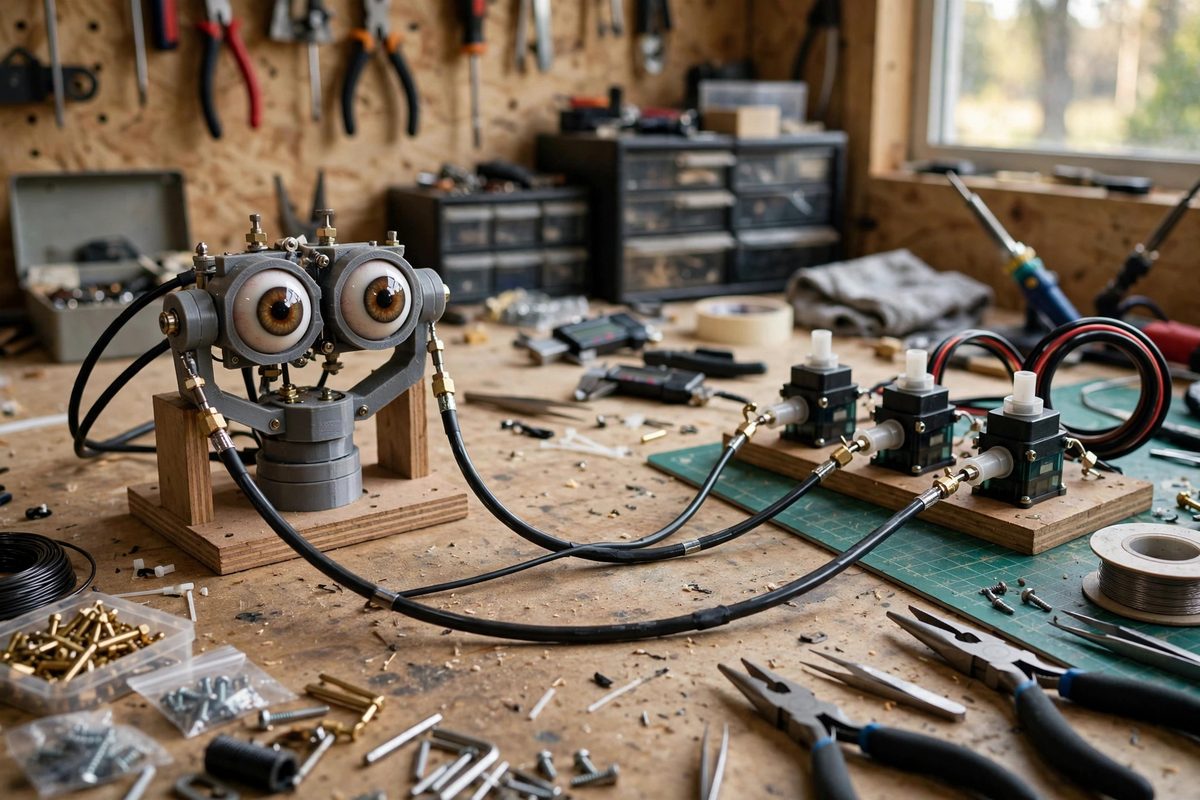
Animatronic puppet eyes need to move fast, precisely, and in a tiny space, but servos are bulky and their vibration shows in the performance. Bowden cables, the same push-pull cable system used in bicycle brakes, solve the packaging problem: the servos live in the body or off-stage while the cables transmit motion to the compact eyeball mechanism. Routing those cables correctly is the difference between snappy, silent eyes and a sluggish, chattering mess.
Why Bowden cables suit eyeballs
An eyeball mechanism needs two axes of motion, pan and tilt, in a package roughly the size of the eye itself. Mounting two servos directly at the eye crowds the head, adds weight where the puppet is most delicate, and transmits servo noise straight to the audience's focus point. Bowden cables decouple the actuator from the mechanism: the servo pulls the inner cable, the outer housing guides it around bends, and the eyeball yoke moves. The head stays light and quiet, and the servos can be mounted where there is room, even outside the puppet with long cable runs.
Routing principles
Every bend in a Bowden cable adds friction, and friction is the enemy of precise eye motion: it causes lag, stick-slip chatter, and lost motion. Route with the fewest, gentlest bends possible; each bend should have the largest radius the puppet's interior allows, never kinked or sharply turned. The outer housing must be anchored at both ends, at the servo and at the eye mechanism, so the inner cable's motion translates fully instead of pushing the housing around. Between anchors, the housing can float, but it must not be able to snag, compress, or shift during performance.
Cable and housing selection
Use low-friction housing, lined if possible, and a smooth inner cable sized to the load; eyeball mechanisms are light, so fine cables suffice, but too fine stretches under load and introduces lag. Pre-stretch new cables under tension before final installation, since initial stretch shows up as calibration drift in the first hours of use. Keep the cable run as short as practical; long runs multiply friction and stretch. Where the cable exits the housing at the eye end, guide it cleanly to the yoke attachment with no sharp edges to fray against.
Attachment and geometry at the eye
The cable attaches to the eyeball yoke at a point offset from the pivot, forming a lever arm: the farther from the pivot, the more motion per cable travel but the less force. For eyes, favor a moderate lever arm that gives the full range of eye motion within the servo's travel, with force to spare; eyes are light and speed matters more than torque. Attach with a ball link or a smooth pivot, never a rigid clamp that binds as the angle changes. Set the neutral position with the servo centered, so equal cable travel remains in both directions.
Calibration and maintenance
After installation, calibrate the servo endpoints to the eye's mechanical limits, leaving a small margin so the servo never slams the yoke against its stops; stalled servos overheat and strip gears. Run the eyes through their full range repeatedly and watch for chatter, lag, or asymmetry, all signs of friction or binding in the routing. Lubricate the cable lightly with a dry lubricant if needed, and inspect periodically for fraying at the attachment points, where fatigue concentrates. A well-routed Bowden eye system runs for years with only occasional checks.
Gentle bends, anchored housings, right-sized cables, clean pivots, and calibrated endpoints. The audience sees living eyes; they never suspect the servos hiding in the torso.
Related Guides
- Servo Cable Tension Geometry for Animatronic Jaws: An animatronic jaw looks simple until you build one: a hinged lower jaw, a servo, and a cable connecting them. Then you discover that the jaw either
- Dual-Axis Gimbal Geometries for Animatronic Eye Blinks: An animatronic eye that can look around needs two axes of rotation, pan and tilt, and a blink mechanism on top of that. The geometry of how those
- Dual Servo Gimbal Geometries for Lifelike Jaw Motion: A puppet jaw that just flaps open and shut reads as a puppet. A jaw that opens, shifts slightly sideways, and settles with a hint of asymmetry reads
- Dual Servo Gimbal Geometries for Animatronic Eyelids: Animatronic eyelids sell the illusion of life more than any other single mechanism: a blink is the gesture audiences read as consciousness. A