
An animatronic jaw looks simple until you build one: a hinged lower jaw, a servo, and a cable connecting them. Then you discover that the jaw either slams, stalls the servo, moves too little, or goes slack at the worst moment. The difference between a jaw that snaps and chatters realistically and one that fights itself is cable tension geometry: where the cable attaches, how it routes, and how the leverage changes through the jaw's travel. Get the geometry right and a tiny servo performs beautifully; get it wrong and no amount of programming fixes it.
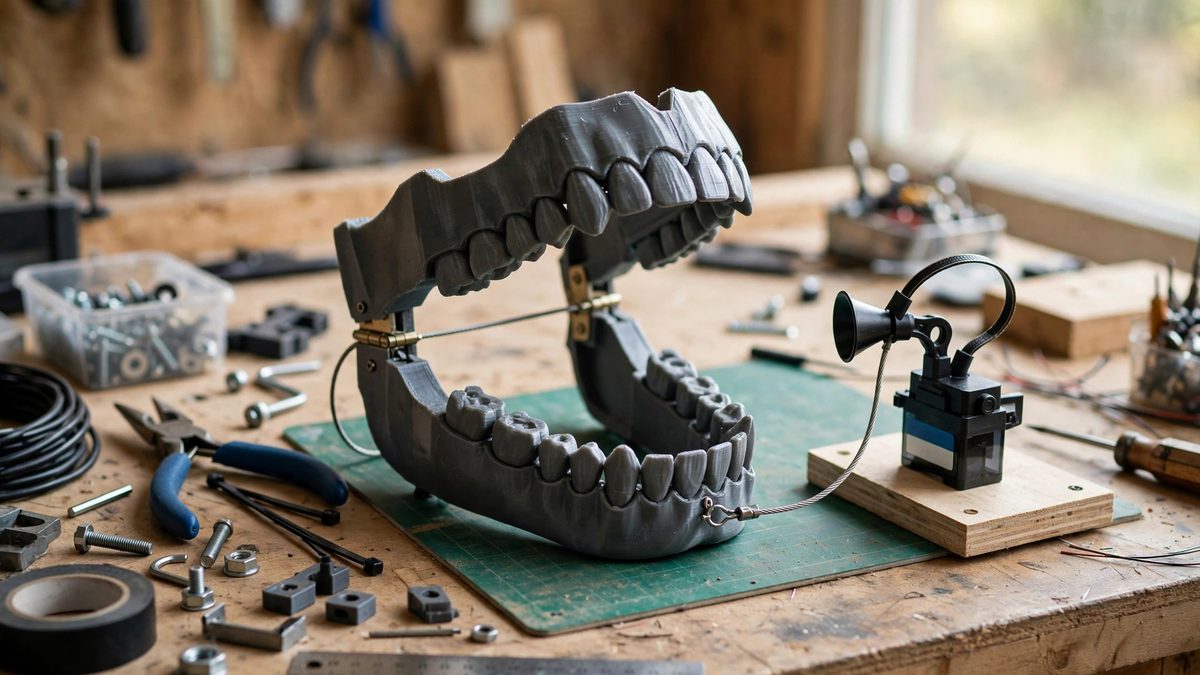
The lever system you are actually building
A cable-driven jaw is a lever problem. The jaw pivots on its hinge, the cable attaches to the jaw at some distance from the hinge, and the servo pulls the cable. The attachment distance is the jaw's lever arm: attach close to the hinge and a small cable movement produces a large jaw rotation, but with little force; attach far from the hinge and you get more force but less movement per unit of cable travel. The servo side has its own lever: the servo horn radius determines how much cable the servo pulls per degree of rotation. The ratio between these two levers sets the jaw's character. For a talking jaw, you typically want moderate speed and enough force to close firmly without slamming, which means sizing the levers so the servo works in the middle of its travel rather than at the extremes. A servo straining at its endpoint overheats and strips gears; a servo cruising mid-travel lasts.
Cable routing and the tension path
The cable must travel from the servo horn to the jaw attachment in a clean, low-friction path. Every bend in the routing adds friction, and friction is the enemy of both responsiveness and servo life: the servo wastes torque overcoming it, and the jaw's motion gets mushy. Route the cable as straight as possible, and where bends are unavoidable, guide them through smooth eyelets, PTFE tubing, or small pulleys rather than letting the cable saw across sharp edges. Keep the cable under light, constant tension throughout the jaw's travel. Slack is catastrophic in a cable drive: when the servo reverses, it must first take up the slack before the jaw moves, producing a dead zone that reads as laggy, unconvincing motion. A light return spring on the jaw, or a second opposing cable in a pull-pull arrangement, maintains that constant tension.
Pull-pull versus spring return
Two architectures dominate jaw drives. Spring return uses one cable to close (or open) the jaw and a spring to return it; it is simple and works well for jaws that rest in one position and actuate briefly, like a talking mouth that is mostly closed. Pull-pull uses two cables in opposition, one to open and one to close, both under tension; it gives positive control in both directions and crisper motion, at the cost of more complex routing and adjustment. For most puppet and costume jaws, spring return is the pragmatic choice: fewer cables to route through a crowded head, easier tensioning, and perfectly adequate performance. Size the spring to be just strong enough to return the jaw reliably without fighting the servo; an oversized spring is just a load the servo carries on every actuation, heating it and draining the battery.
Setting travel limits mechanically
Never rely on software alone to limit the jaw's travel. Set mechanical stops, small blocks or screws that the jaw contacts at full open and full closed, so that even a programming error cannot drive the mechanism past its safe range. Then set the servo's endpoints in software to stop just short of the mechanical limits, so normal operation never bangs into the stops. This two-layer approach protects the servo gears, the cable attachments, and the jaw hinge from the number one killer of animatronics: an overdriven servo straining against a hard stop. Test the full travel by hand before powering the servo, feeling for binding or tight spots through the whole range; any roughness felt by hand becomes servo-stalling friction under power.
Tuning for lifelike motion
Once the geometry is right, the performance comes from motion programming. Real jaws accelerate and decelerate; they do not move at constant velocity. Ease the servo into and out of each movement, overlap jaw motion slightly with head motion, and add tiny random variations to repeated motions like talking, because mechanical repetition reads as robotic. Keep the jaw's resting position slightly open rather than clamped shut; a jaw at rest with a hint of openness looks alive, while a clamped jaw looks like a trap. And listen to the mechanism: clicking, buzzing, or straining sounds mean the geometry is fighting somewhere, usually a cable rubbing or a lever ratio that asks too much of the servo. The ear is a fine diagnostic instrument for cable drives.
Levers sized for mid-travel servo operation, a clean low-friction cable path under constant tension, mechanical stops before software limits, and motion with easing: that geometry turns a servo and a string into a jaw that talks.
Related Guides
- Dual Servo Gimbal Geometries for Animatronic Eyelids: Animatronic eyelids sell the illusion of life more than any other single mechanism: a blink is the gesture audiences read as consciousness. A
- Dual Servo Gimbal Geometries for Lifelike Jaw Motion: A puppet jaw that just flaps open and shut reads as a puppet. A jaw that opens, shifts slightly sideways, and settles with a hint of asymmetry reads
- Dual-Axis Gimbal Geometries for Animatronic Eye Blinks: An animatronic eye that can look around needs two axes of rotation, pan and tilt, and a blink mechanism on top of that. The geometry of how those
- Bowden Cable Routing for Compact Eyeball Servos: Animatronic puppet eyes need to move fast, precisely, and in a tiny space, but servos are bulky and their vibration shows in the performance. Bowden