
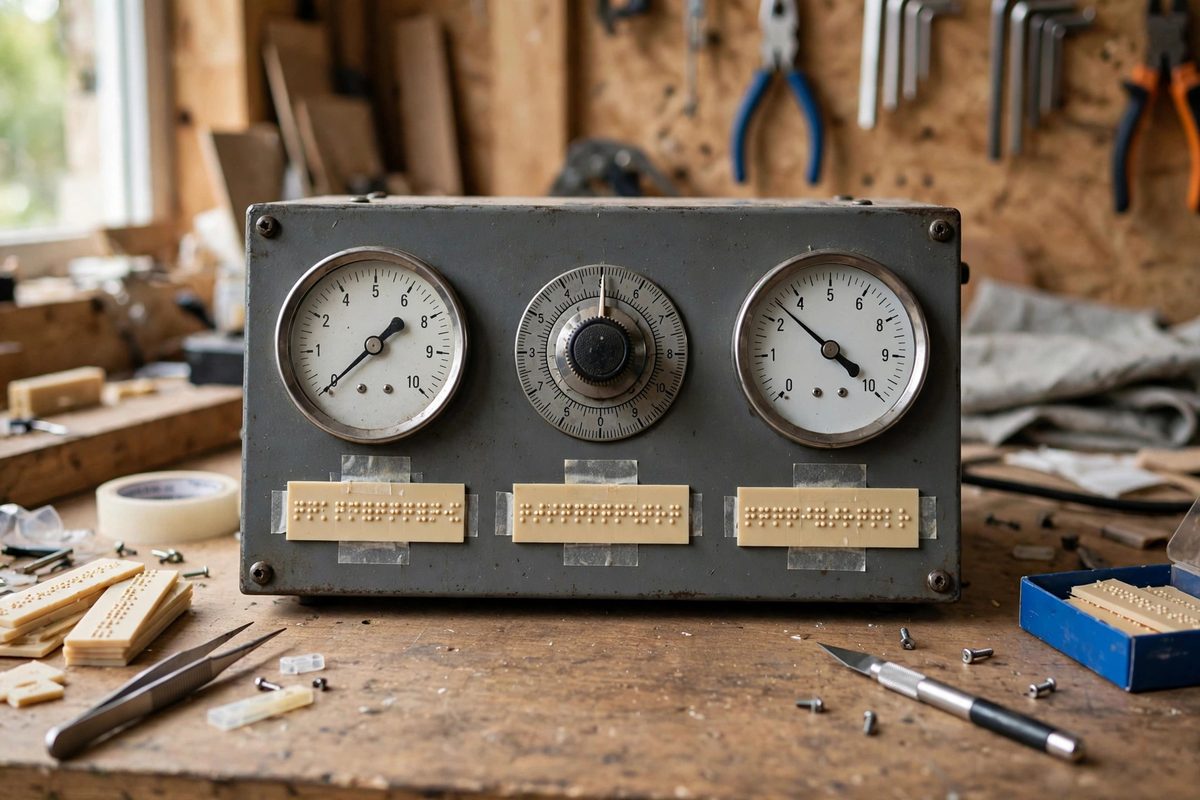
Machine dials, knobs, and gauges are almost entirely visual: numbers, tick marks, and needle positions that assume a sighted operator. For a blind or low-vision maker, those interfaces are walls. Braille indexing strips, simple tactile markers added to existing dials, open those machines up without replacing a single component.
The problem with visual-only dials
Consider the common calibration interfaces: a table saw blade-height crank with no detents, a drill press speed dial with printed numbers, a router depth adjustment measured in sixteenths. Every one of them requires the operator to see a position. A blind maker can feel the crank turning but has no reference for where it is. The strip's job is to add that reference: tactile landmarks that map to known settings, so the operator can find, count, and return to positions by touch.
Designing the strip
A braille indexing strip is a thin, durable band that mounts beside or on the dial, carrying raised dots or ridges at each meaningful position. Use braille numbering where the operator reads braille, or simple raised tick marks where they do not; the system should match the user, not an abstract standard. Space the marks to match the dial's real detents or measurement points, and make the zero or home position unmistakable, perhaps with a longer bar or a distinct texture. The strip must survive the environment: shop dust, oil, vibration, and cleaning. Laminated or embossed plastic holds up; paper labels do not.
Attachment that stays put
A strip that shifts is worse than no strip, because it lies. Attach with strong adhesive rated for the machine's temperature and vibration, on a clean, flat surface adjacent to the moving indicator. Where the dial itself rotates, mount the strip on the fixed housing and put a single tactile pointer on the rotating part, so the pointer's position against the strip reads the setting. Test the bond under real vibration before trusting it; a strip that migrates after an hour of running teaches the wrong positions.
Calibrating with a sighted helper
The initial calibration is a two-person job the first time: a sighted helper sets the machine to each known position while the blind operator places or verifies the corresponding tactile mark. Walk through the full range of the dial, mark every position that matters in practice, and skip the ones that never get used; a strip cluttered with irrelevant marks is hard to read by touch. Document the mapping in the user's preferred format, braille notes or a voice recording, so recalibration after a strip replacement does not start from zero.
Maintenance and verification
Strips wear. Check them periodically by feel for flattening dots, peeling edges, or shifted positions, and replace on a schedule rather than waiting for a failure mid-cut. Keep a spare strip and the calibration notes with the machine. If the machine itself is serviced in a way that moves the dial, recalibrate the strip before the machine goes back into use. The strip is a measuring instrument; treat it with the same respect as a square.
Beyond dials: the wider principle
The same thinking extends to other visual interfaces: tactile markers on fence rails at common rip widths, a raised index on a miter gauge, a textured strip marking the safe zone on a tool table. Each addition is small, cheap, and reversible. Together they turn a shop that assumed sight into one that works by touch, which benefits everyone: even sighted makers appreciate a tactile detent they can feel without looking up from the work.
Braille indexing strips are a small build with an outsized effect: calibrated marks, solidly mounted, verified by feel, maintained like any instrument. They do not change the machine; they change who can run it well.
Related Guides
- High Contrast Textures for Low Vision Tools: Makers with low vision do not need separate tools so much as tools they can perceive: markings readable without perfect eyesight, controls
- High-Tack Silicone Sleeves for Weak Grip Tool Handles: Many hand tools assume a strong grip: slender screwdriver handles, slick chisel handles, thin awl shafts that demand constant squeezing to control
- High-Friction Silicone Gripping Sleeves for Pliers: Standard plier handles assume a strong, dry grip. For anyone with reduced hand strength, arthritis, or a condition that makes sustained squeezing
- High-Tack Gripping Sleeves for Weak Hand Strength: Many tools assume a strong, steady grip, and for makers with arthritis, nerve damage, or simply aging hands, that assumption shuts the shop door