
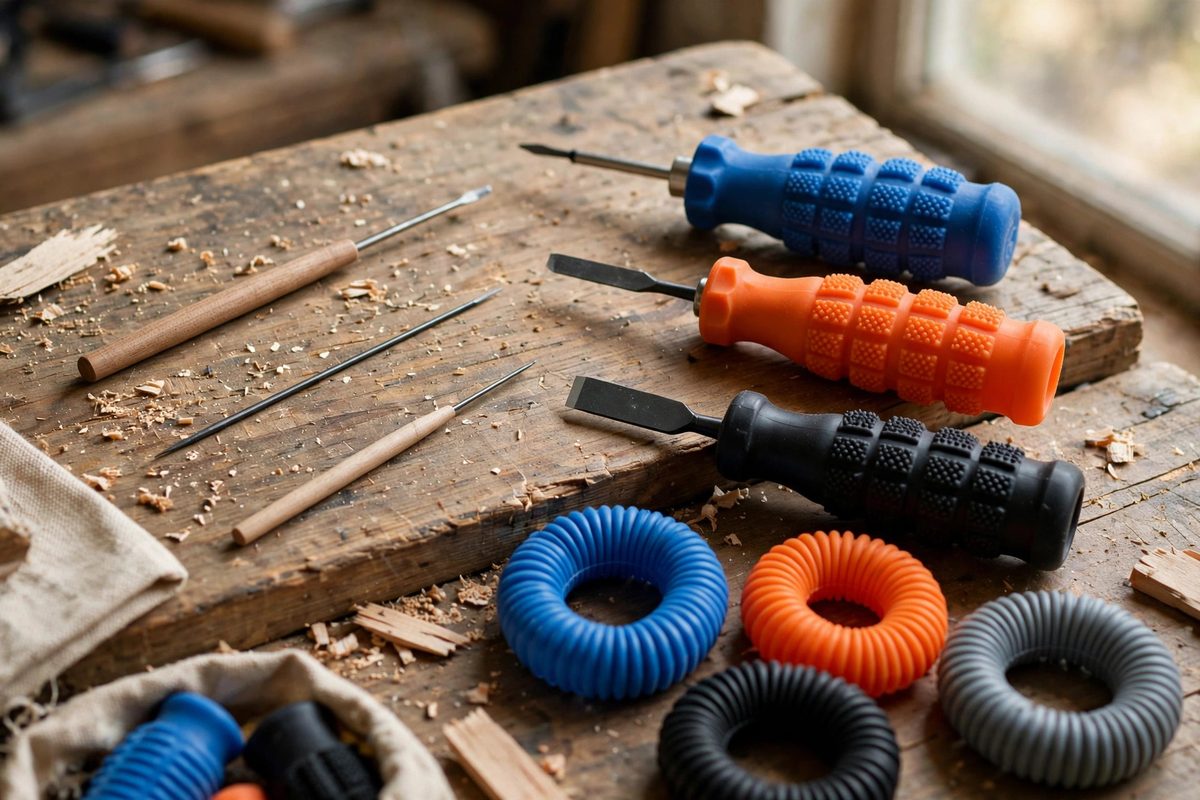
Many hand tools assume a strong grip: slender screwdriver handles, slick chisel handles, thin awl shafts that demand constant squeezing to control. For makers with weak grip, whether from arthritis, injury, age, or neurological conditions, that assumption turns ordinary tools into exhausting or unusable ones. High-tack silicone sleeves, slipped over existing handles, change the grip physics: they increase friction so less squeeze force is needed, and they build up the diameter so the hand works in a stronger position. It is a small adaptation with an outsized effect on who can comfortably use the shop's tools.
The Grip Force Problem
Controlling a tool requires friction between hand and handle sufficient to resist the working forces: torque on a screwdriver, push force on a chisel, pull on a saw. Friction equals the normal force, the squeeze, times the friction coefficient. Tool handles are typically smooth plastic or varnished wood with modest friction coefficients, so the required squeeze is high. A healthy hand produces that squeeze unconsciously; a weakened hand cannot, and the tool slips, which the user compensates by squeezing harder, which fatigues the hand faster, in a downward spiral that ends the work session early. The physics offers two levers: raise the friction coefficient, or reduce the required squeeze by improving the hand's mechanical advantage. Silicone sleeves pull both levers at once.
Why High-Tack Silicone Works
Silicone's surface has a naturally high friction coefficient against skin, higher than hard plastics or varnished wood, and the "high-tack" formulations amplify this with a slightly adhesive surface feel. The effect on required grip force is direct: doubling the friction coefficient halves the squeeze needed for the same control. Silicone also deforms under pressure, conforming to the hand's shape and increasing the contact area, which distributes the force and reduces pressure points that cause pain in arthritic hands. Unlike foam grips, silicone does not compress permanently: it rebounds, maintaining its cushioning and tack over long use. And it is washable and chemically stable, surviving the shop environment without degrading into the sticky residue that cheap rubber grips become. The material choice matters because the adaptation must last: a grip aid that needs frequent replacement gets abandoned.
Sizing for Hand Mechanics
Handle diameter profoundly affects grip strength: the hand generates maximum grip force at a moderate diameter, roughly the size of a comfortable fist, and force falls off for both thinner and thicker handles. Most stock tool handles are thinner than optimal, especially for weakened hands. The sleeve should build the handle up toward the user's optimal diameter, which varies by hand size: measure what feels strong, not what looks right. The sleeve's wall thickness provides both the diameter increase and the cushioning; a few millimeters of silicone transforms a skinny screwdriver handle. Length matters too: the sleeve should cover the full gripping area without overhanging onto working parts, and it should not rotate on the handle under torque, which means sizing it for a snug stretch fit. For tools used with high torque, consider sleeves with internal texture or a two-layer design that grips the handle mechanically as well as frictionally.
Fitting and Securing Sleeves
The sleeve must stay put during use: a sleeve that slides or spins is worse than none, because it adds unpredictability. A stretch fit, sleeve bore slightly smaller than the handle, provides reliable retention for most tools through friction alone. For high-torque applications, add mechanical retention: a small wrap of self-fusing silicone tape at each end of the sleeve, or a sleeve design with end collars that seat against handle features. Avoid permanent adhesives unless the adaptation is truly permanent: needs change, tools get replaced, and a sleeve glued on cannot transfer. Test the secured sleeve under real working loads before trusting it: torque a screwdriver hard, push a chisel, and verify the sleeve does not migrate. Inspect periodically, because even good fits loosen as materials age, and a loose sleeve discovered mid-cut is a safety issue.
When Sleeves Are Not Enough
Sleeves help many grip limitations, but they have boundaries worth respecting. They do not help where the limitation is wrist strength or shoulder mobility rather than grip: a sleeve cannot push the saw. They add diameter, which can be counterproductive for users with small hands or limited finger flexion, where the stock thin handle was actually appropriate. They do not fix tools whose fundamental ergonomics are hostile: a tool requiring sustained high force may need redesign or replacement rather than a grip aid. And they are a personal adaptation: what fits one user's hand and condition may not suit another's, so involve the user in sizing and material choice rather than prescribing. The goal is the user's comfortable, sustained use, and the honest assessment includes recognizing when a different tool, not a better grip, is the answer.
High-tack silicone sleeves are a simple, dignified adaptation: more friction means less squeeze, better diameter means a stronger hand position, and the tools stay the user's tools. Fit them snugly, size them to the hand, and respect their limits. The shop gets more accessible one handle at a time.
Related Guides
- High-Tack Gripping Sleeves for Weak Hand Strength: Many tools assume a strong, steady grip, and for makers with arthritis, nerve damage, or simply aging hands, that assumption shuts the shop door
- High-Friction Silicone Gripping Sleeves for Pliers: Standard plier handles assume a strong, dry grip. For anyone with reduced hand strength, arthritis, or a condition that makes sustained squeezing
- High Contrast Textures for Low Vision Tools: Makers with low vision do not need separate tools so much as tools they can perceive: markings readable without perfect eyesight, controls
- Braille Indexing Strips for Machine Calibration Dials: Machine dials, knobs, and gauges are almost entirely visual: numbers, tick marks, and needle positions that assume a sighted operator. For a blind or