
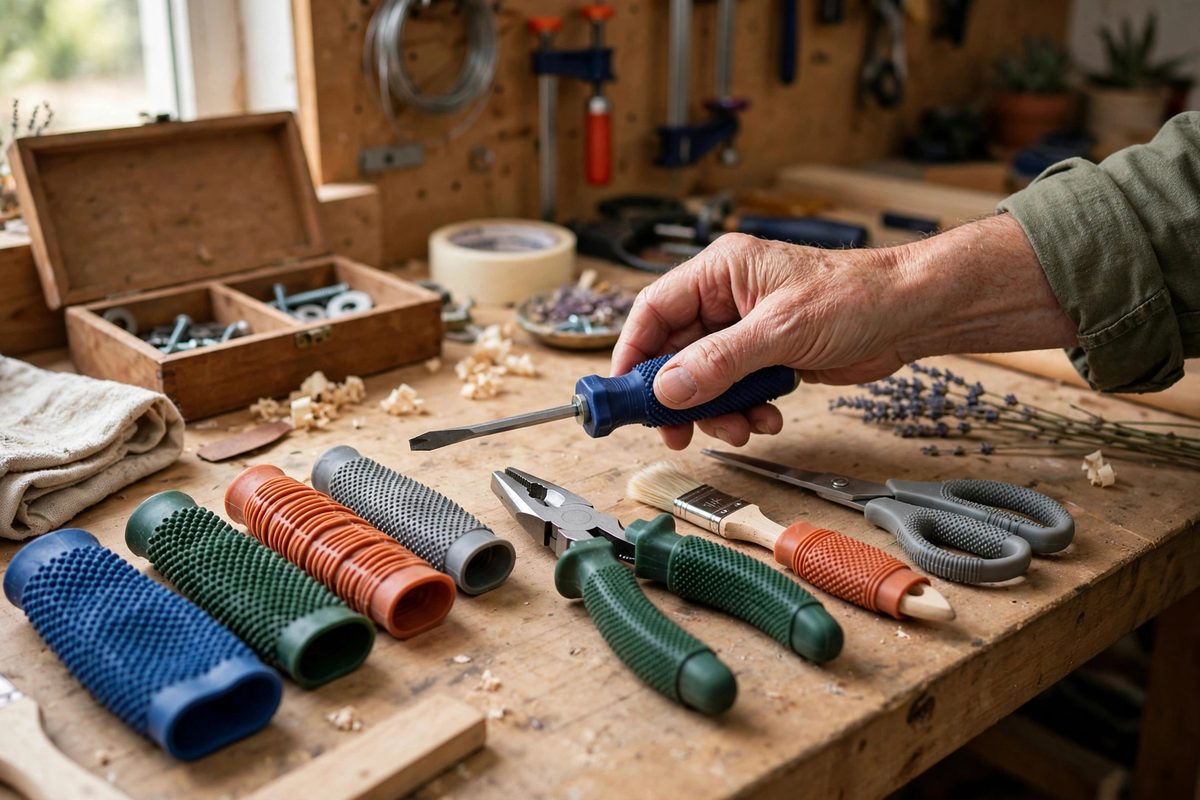
Many tools assume a strong, steady grip, and for makers with arthritis, nerve damage, or simply aging hands, that assumption shuts the shop door. High-tack gripping sleeves are one of the simplest adaptations available: a sleeve of grippy material slipped over a tool handle that multiplies the friction between hand and tool, so a light squeeze does the work that used to require a death grip. They are cheap, they fit almost anything, and they can keep a maker working comfortably for years.
How Friction Replaces Force
Grip works through friction: the tool stays in your hand because friction between your skin and the handle resists the tool's tendency to slip or twist. Friction equals the squeeze force times the friction coefficient of the surfaces. A high-tack sleeve raises that coefficient dramatically, which means the same holding power comes from much less squeeze. This is the entire principle: you are not making your hand stronger, you are making the handle grippier, so your existing strength goes further. For someone whose grip tires after ten minutes, cutting the required squeeze force can be the difference between finishing a project and giving up halfway.
Materials That Actually Grip
Not all rubber is equal. The best sleeve materials are soft, slightly tacky elastomers: silicone, thermoplastic rubber, and certain neoprene blends. Silicone has the advantage of staying tacky across temperature changes and resisting oils and sweat, which matters because a sleeve that gets slippery when your hands perspire defeats its purpose. Look for sleeves with a textured surface, ribs, or a diamond pattern: texture adds mechanical grip on top of the material's tackiness, and it gives wet or oily hands something to bite into. Avoid hard plastics marketed as grips; they may look ergonomic, but without tackiness they do nothing for weak hands.
Sizing and Fitting Sleeves to Tools
A sleeve that spins on the handle is worse than no sleeve, because now you are fighting two slipping surfaces. Size the sleeve to fit snugly: it should go on with effort, often with a little soapy water as lubricant, and then grip the handle firmly once dry. For tapered handles, choose a sleeve with matching taper or enough stretch to conform. For tools with irregular handles, heat-shrink tubing in a tacky formulation can be an alternative, since it conforms to any shape. Trim the sleeve so it does not cover controls, triggers, or adjustment mechanisms, and make sure it does not interfere with the tool's balance or your hand position during use.
Where Sleeves Make the Biggest Difference
Sleeves shine on tools that require sustained grip against torque or vibration: screwdrivers, hand saws, chisels, files, and rotary tools. They also help on tool handles that are smooth by design, like polished metal file handles or hard plastic screwdriver grips, where the original surface offers almost no friction. Power tool handles benefit too, particularly on tools like jigsaws and sanders where you guide rather than force the tool: a tacky sleeve lets you steer with a relaxed hand instead of white-knuckling the body. Start with the tools you use most and the ones that hurt the most; the improvement is usually obvious within minutes.
Maintenance and Replacement
Tacky materials collect dust, sawdust, and grime, and a dirty sleeve loses its grip advantage. Wash sleeves periodically with mild soap and water, and let them air dry: most materials regain their tack once clean. Inspect for tears, hardening, or permanent deformation, and replace sleeves that have lost their tackiness, because a slick worn sleeve gives a false sense of security. Keep a few spare sleeves in common sizes on hand; they are inexpensive, and having them ready means you will actually replace a worn one instead of tolerating it.
Part of a Bigger Adaptation Strategy
Sleeves work best combined with other low-effort adaptations. Larger-diameter handles reduce the squeeze needed for the same torque, so a sleeve over a built-up handle is doubly effective. Ratcheting mechanisms, power assist, and jigs that hold the work instead of your hand all reduce grip demands further. And pacing matters: even with perfect grips, alternating tasks and taking breaks protects hands that tire easily. The goal is not to power through pain but to set up the shop so the work fits the hands doing it.
High-tack gripping sleeves are a small change with an outsized effect. They ask nothing of your strength and give back control, comfort, and longer sessions. For any maker whose hands are the limiting factor, they are one of the first adaptations worth trying.
Related Guides
- High-Tack Silicone Sleeves for Weak Grip Tool Handles: Many hand tools assume a strong grip: slender screwdriver handles, slick chisel handles, thin awl shafts that demand constant squeezing to control
- High-Friction Silicone Gripping Sleeves for Pliers: Standard plier handles assume a strong, dry grip. For anyone with reduced hand strength, arthritis, or a condition that makes sustained squeezing
- High Contrast Textures for Low Vision Tools: Makers with low vision do not need separate tools so much as tools they can perceive: markings readable without perfect eyesight, controls
- Braille Indexing Strips for Machine Calibration Dials: Machine dials, knobs, and gauges are almost entirely visual: numbers, tick marks, and needle positions that assume a sighted operator. For a blind or