
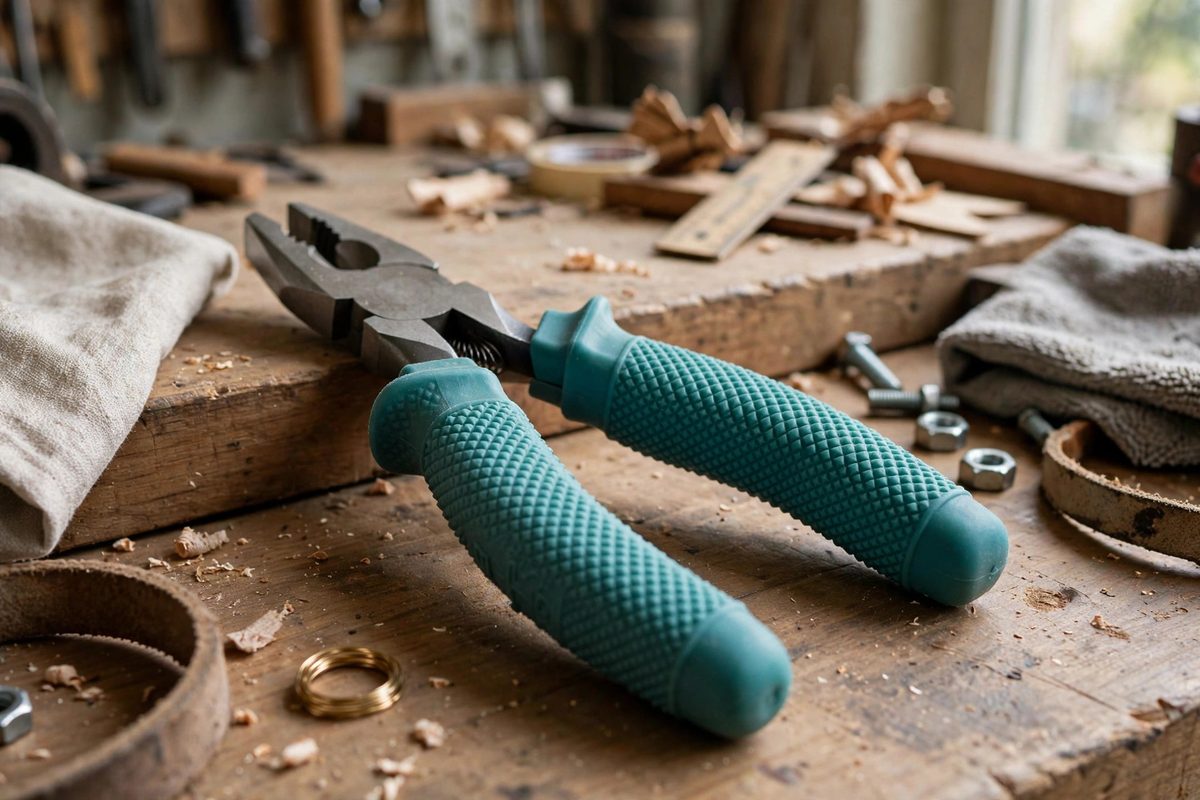
Standard plier handles assume a strong, dry grip. For anyone with reduced hand strength, arthritis, or a condition that makes sustained squeezing painful, those smooth plastic-dipped handles are a barrier: the tool slips, the hand compensates by squeezing harder, and the harder squeeze accelerates fatigue and pain. High-friction silicone sleeves slipped over plier handles attack the problem at its root. By dramatically increasing grip friction, they let a lighter grip do the same work, reducing the force the hand must produce and the pain it must endure.
The friction insight
Gripping a tool is a friction problem. The hand must generate enough normal force, squeeze, that friction between skin and handle resists the torque and pull of the work. Standard handle coatings are relatively slippery, especially with any moisture, so the required squeeze is high. Silicone has a naturally high coefficient of friction against skin, several times that of hard plastic, which means the same holding power comes from a fraction of the squeeze force. This is not a marginal comfort tweak. For a user whose maximum comfortable grip force is limited, cutting the required squeeze in half can be the difference between using the tool and not using it. The physics is simple, which is why the improvement is so reliable.
Choosing sleeve material and form
Purpose-made silicone grip sleeves come in various diameters and wall thicknesses; choose a sleeve that fits the handle snugly without excessive stretching, since an overstretched sleeve thins out and loses its cushioning. Wall thickness matters for comfort: a thicker sleeve spreads pressure over more of the hand, reducing the peak pressure on arthritic joints, but too thick a sleeve enlarges the grip diameter past what a small hand can close around. This is a fitting problem, not a more-is-better problem. Textured sleeves add mechanical grip on top of the material friction and help in wet or oily conditions. For pliers with shaped or flared handles, look for sleeves designed to conform, or consider self-fusing silicone tape wrapped to build up a custom grip, which conforms to any shape and bonds to itself into a solid sleeve.
Fitting sleeves to pliers
Installation is straightforward but deserves care. Clean the handles first so the sleeve grips the handle itself and does not migrate; any oil under the sleeve becomes a lubricant exactly where you do not want one. Warm the silicone slightly to ease it on, and work it down the handle evenly rather than stretching one section. Position the sleeve to cover the full gripping area with a little extra at the ends where the hand's pressure concentrates. For self-fusing tape, wrap with consistent overlap and tension, stretching the tape as you go since the stretch activates the fusing, and finish the end with a full wrap that locks the tail. Test the fit by using the pliers hard: the sleeve must not rotate or walk along the handle under torque. A sleeve that migrates is a distraction and a hazard.
Ergonomic details beyond friction
Friction is the headline, but the sleeve's other properties matter too. The slight cushioning of a silicone sleeve damps the vibration and impact that pliers transmit, which matters for users whose joints punish every shock. A sleeve also insulates thermally; bare metal or thin-dipped handles in a cold shop draw heat from the hand and stiffen already-stiff joints. Consider the grip diameter holistically: the ideal diameter lets the fingers wrap with a slight overlap, engaging the hand's stronger grip posture. Users with different hand sizes may need different sleeve thicknesses on the same pliers, which is an argument for the adjustable approach of tape build-up over one-size sleeves. Small customizations compound into large usability differences.
Maintenance and replacement
Silicone is durable but not immortal. Inspect sleeves for tears, thinning, and hardening; a torn sleeve exposes the slippery handle beneath at exactly the spot the hand loads most. Silicone resists most shop chemicals but degrades with certain solvents, so keep aggressive solvents off the grips. Self-fusing tape wraps can be peeled and redone when worn, which makes them practically free to maintain. Keep spare sleeves or a roll of tape in the kit so a worn grip gets replaced the same day it is noticed. An adaptive tool with a degraded grip is worse than a standard tool, because the user has calibrated their effort to assistance that is no longer there.
Part of a broader approach
Grip sleeves are one element of making hand tools accessible. They pair well with other adaptations: pliers with longer handles for mechanical advantage, spring-loaded handles that open automatically, and task lighting that reduces the fumbling that costs grip effort. The principle behind all of them is the same: meet the user's actual biomechanics instead of demanding the user meet the tool's assumptions. A five-dollar sleeve that keeps someone working comfortably in their shop is among the highest-value modifications in the adaptive toolkit.
High-friction silicone sleeves multiply what a limited grip can do by attacking the friction equation directly: less squeeze needed, less pain produced, more work accomplished. Fit them snugly to clean handles, size the diameter to the hand, maintain them as they wear, and combine them with the other small adaptations that keep hands working. Accessibility in the shop is often just physics applied with empathy.
Related Guides
- High-Tack Gripping Sleeves for Weak Hand Strength: Many tools assume a strong, steady grip, and for makers with arthritis, nerve damage, or simply aging hands, that assumption shuts the shop door
- High-Tack Silicone Sleeves for Weak Grip Tool Handles: Many hand tools assume a strong grip: slender screwdriver handles, slick chisel handles, thin awl shafts that demand constant squeezing to control
- High Contrast Textures for Low Vision Tools: Makers with low vision do not need separate tools so much as tools they can perceive: markings readable without perfect eyesight, controls
- Braille Indexing Strips for Machine Calibration Dials: Machine dials, knobs, and gauges are almost entirely visual: numbers, tick marks, and needle positions that assume a sighted operator. For a blind or