
The bridle joint, an open mortise that receives a full-width tenon, is the workhorse joint for carcass rails and frame corners where the joint will be seen. Its strength comes from the large glue surface and the mechanical interlock, but both depend on the tenon thickness ratio: how the rail's thickness is divided between the tenon and the two cheeks of the open mortise. Get the ratio right and the joint is strong, stable, and clean-looking; get it wrong and the cheeks split, the tenon wobbles, or the joint looks clumsy.
Anatomy of the joint
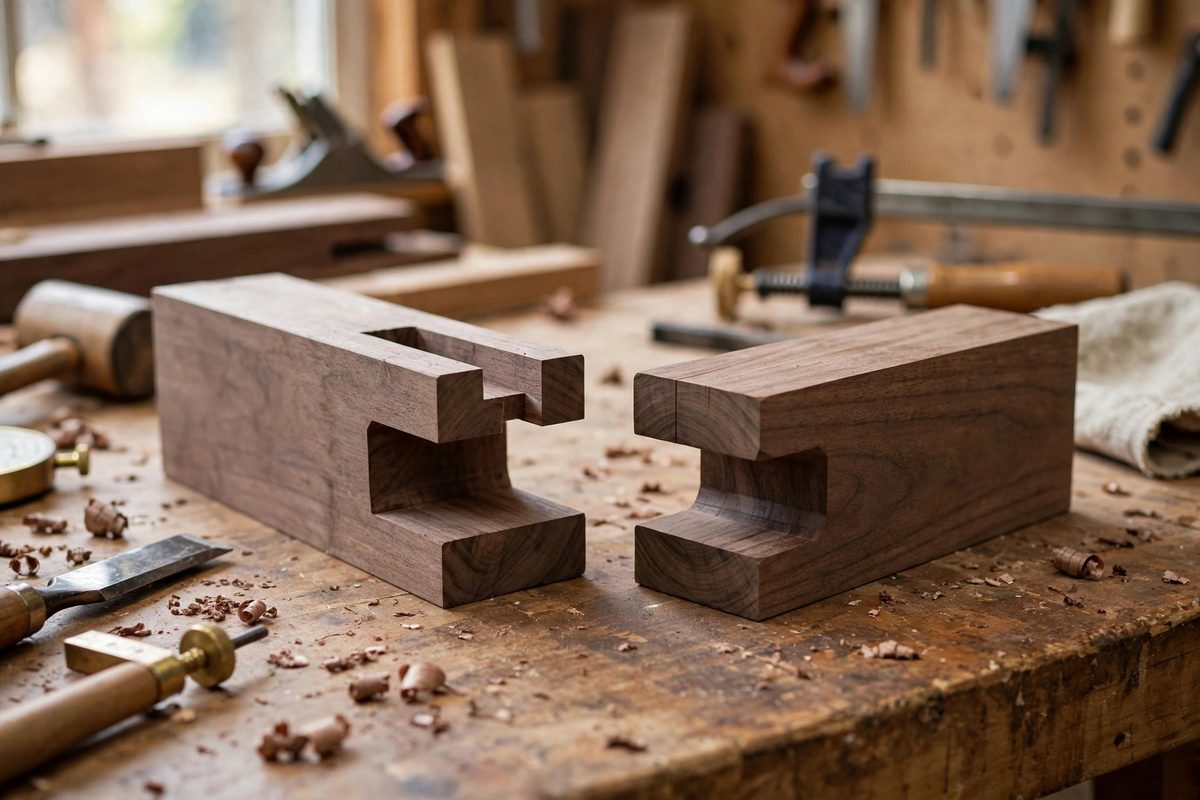
In a bridle joint, the end of one member is slotted to form an open mortise, two cheeks with a gap between them, and the mating member is cut down to a tenon that fits the slot. Unlike a closed mortise-and-tenon, the bridle's mortise is open on one end, which makes it easy to cut and fit but means the cheeks have no end grain tying them together; their strength comes entirely from their thickness and the glue bond to the tenon.
Carcass rails typically meet stiles or legs in this joint at the corners of casework, where the joint is visible and must look as good as it holds. The proportions are therefore both structural and aesthetic: a tenon too thin looks spindly and glues poorly, while cheeks too thin look fragile and split under clamping pressure.
The thickness ratio
The time-tested division splits the member's thickness into thirds: the tenon takes the middle third, and each cheek of the open mortise takes an outer third. This equal-thirds ratio balances the joint's competing needs. The tenon is thick enough to resist bending and to offer substantial long-grain glue surface on both faces; the cheeks are thick enough to resist splitting when the joint is assembled and clamped, and to look proportional in the finished piece.
This ratio assumes members of roughly equal thickness meeting at the joint, which is the normal carcass case. When the members differ significantly in thickness, divide based on the thinner member's thickness: the tenon thickness follows the rail, and the mortise cheeks are cut to match, keeping the thirds relationship on the member that governs the fit.
When to deviate from thirds
Equal thirds is the starting point, not a law. In softwoods or brittle species, slightly thicker cheeks, with a correspondingly thinner tenon, resist the splitting that soft fibers invite; the joint loses a little tenon strength but gains reliability. In dense hardwoods with strong glue bonds, the tenon can take a slightly larger share, improving the mechanical interlock where the wood can support it.
Consider the load direction too. A bridle joint loaded in racking stresses the cheeks in bending, favoring thicker cheeks. One loaded mostly in tension or compression along the rail stresses the tenon and the glue lines, where tenon thickness matters more. Most carcass rails see a mix, which is why the balanced thirds ratio survives as the default: it is the best compromise for the loads the joint actually experiences.
Cutting and fitting to the ratio
Lay out the thirds carefully with a marking gauge from both faces, so any slight variation in stock thickness splits evenly rather than biasing one cheek. Cut the open mortise with a saw, staying just outside the lines, and pare to the gauge lines with a chisel; the cheek faces must be flat and parallel, since the tenon beds against them along its full length. Cut the tenon to match, testing the fit frequently: the tenon should enter with firm hand pressure, not mallet force, and seat fully without rocking.
The open end of the mortise is the joint's vulnerable point during assembly: the cheeks can spread or split if the tenon is oversized and forced. Fit conservatively, easing the tenon's leading edges slightly so it starts without wedging the cheeks apart. A well-fit bridle joint needs only light clamp pressure to close; heavy pressure signals a fit problem, not a clamping problem.
Glue-up and grain direction
Glue all mating surfaces: both tenon cheeks and the mortise cheeks, plus the tenon's end grain where it beds against the mortise bottom, though end grain contributes little strength. Assemble with the grain directions correct, the rail's grain running into the joint, and check the assembly for square before the glue grabs. The bridle joint's open construction makes it easy to verify full seating visually, which is one of its quiet virtues.
Thirds as the baseline, adjusted for species and load, cut cleanly and fit by hand pressure. The bridle joint has held carcasses together for centuries on exactly these proportions.
Related Guides
- Drawbore Mortise and Tenon Pin Shear Stress: Drawboring is the traditional trick of offsetting the peg hole in the tenon slightly toward the shoulder, so driving the peg pulls the joint tight
- Blind Mitered Dovetail Layout on Curved Carcass Edges: The blind mitered dovetail joins two case sides at a corner so the outside shows only a clean miter while the inside hides interlocking dovetails
- Half-Blind Dovetail Depth Setting on Drawer Boxes: Half-blind dovetails are the classic drawer joint for one reason: they are strong, and the mechanical interlock hides the joint from the front of the
- Mitering Secret Compartment Keyways in Hardwood Chests: A secret compartment is only as good as its invisibility, and invisibility lives in the details. The keyway, the hidden slot or channel that lets the