
A diver watch's water resistance lives or dies at its seals, and the caseback O-ring is the largest of them. The O-ring seals by being squeezed between the caseback and the case, and the amount of that squeeze, the compression, must fall within a specific window. Too little compression and water finds a path; too much and the O-ring deforms, extrudes, or takes a permanent set that ruins the seal. Understanding the compression limits turns caseback installation from guesswork into a controlled process.
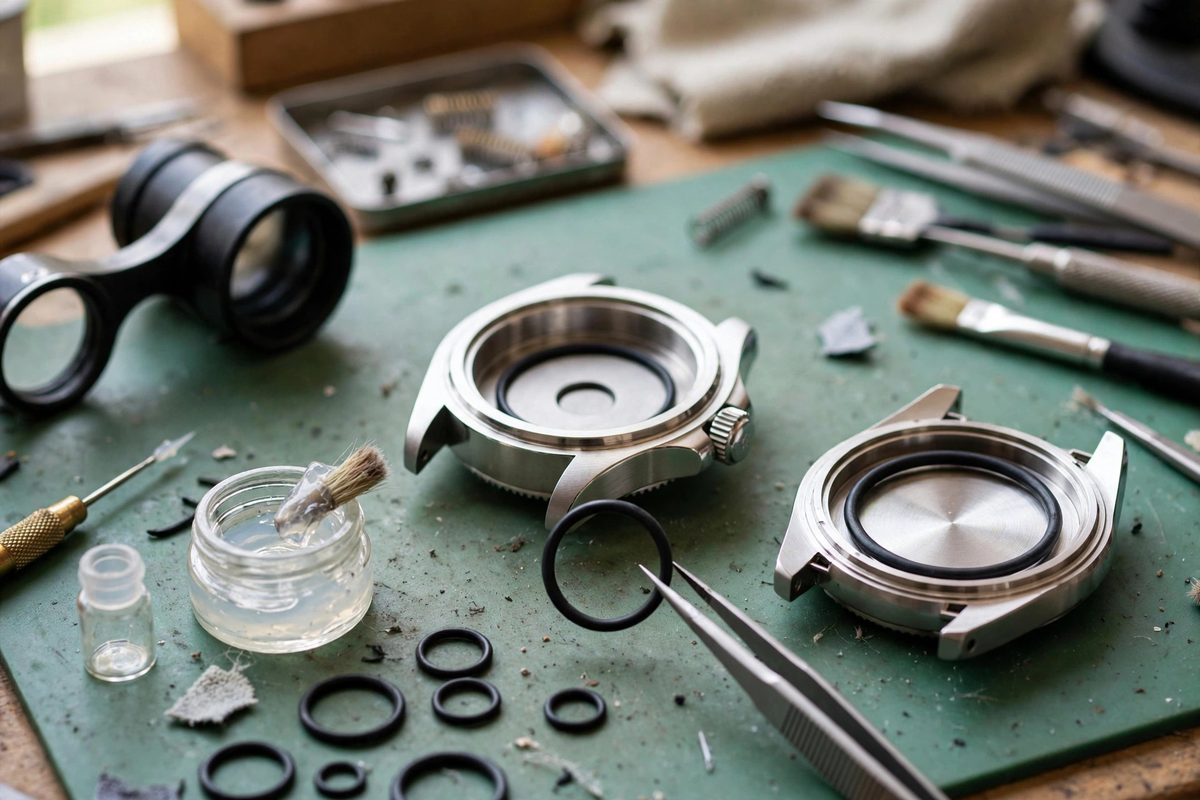
How O-Ring Compression Seals
An O-ring seals because elastic deformation presses the rubber against both sealing surfaces with enough contact pressure to block water. The compression is the percentage by which the O-ring's cross-section is squeezed: a ring with a one-millimeter cross-section compressed into a 0.8-millimeter groove space is at 20 percent compression. Below the minimum, contact pressure is too low and the seal weeps; above the maximum, the rubber is overstressed, extrudes into the gap between the parts, and eventually cracks or takes a permanent flat set. For static seals like a caseback, the workable range is typically around 15 to 30 percent compression, with the sweet spot depending on the rubber compound and the groove design. The case designer sets this geometry; the watchmaker's job is to preserve it.
What Controls Compression in Practice
Three things determine the actual compression: the O-ring's cross-section, the groove depth, and how far the caseback closes. Using the correct replacement O-ring is critical, because a ring that is slightly too thick over-compresses and one slightly too thin under-compresses; O-rings that look identical can differ by tenths of a millimeter. The groove must be clean and undamaged; corrosion, old rubber residue, or a nick in the groove wall changes the effective depth. And the caseback must close fully to its designed position: a screw-down back tightened to its stop, a snap back seated completely. A caseback that is not fully closed leaves the O-ring under-compressed no matter how perfect the ring and groove are.
Installing Without Damaging the Seal
Lubricate the O-ring lightly with silicone grease before installation; the lubricant lets the ring slide into place instead of twisting or pinching, and it fills microscopic surface imperfections. Seat the ring fully in the groove with no twists, checking by running a fingertip around it. When closing a screw-down caseback, turn it slowly and feel for smooth engagement; a sudden increase in resistance partway down often means the O-ring has popped out of the groove and is being pinched. Back off and reseat it rather than forcing it. For snap backs, press evenly with a case press, keeping the back parallel to the case so the ring compresses uniformly. An O-ring pinched at one point is a failed seal, even if the rest of the circumference is perfect.
Inspection and Replacement Intervals
O-rings age. Rubber hardens, takes a compression set, and loses elasticity, especially with exposure to heat, sunlight, and chemicals like sunscreen and chlorine. Inspect the caseback O-ring every time the watch is opened: look for flattening, cracking, nicks, or a ring that no longer springs back when pressed. Replace the O-ring at every battery change or service as a matter of routine; the part costs little and the consequence of reusing a tired seal is a flooded movement. Never reuse an O-ring that shows a permanent flat spot from the caseback; it will not reseal. Keep a stock of the correct sizes for the watches you service, because improvising with a near-size ring is how water gets in.
Testing the Seal
After closing the case, verify the seal with proper pressure testing equipment if the watch is rated for diving; a dry air test followed by a wet test confirms the caseback seal along with the crown and crystal seals. For a watch that will only see desk diving and rain, a careful visual inspection and correct installation are usually sufficient, but be honest with the owner about what was and was not tested. Never represent a watch as dive-ready without a pressure test. The compression limits, the correct ring, careful installation, and verification form a chain; every link matters, and the chain is only as strong as its weakest one.
Caseback O-ring compression is a designed window, not a matter of tightening harder. Use the correct ring, keep the groove clean, lubricate and seat carefully, replace on schedule, and test when it counts. Water is patient; the seal must be perfect.
Related Guides
- Setting Crystal Gasket Compression Pressures: The crystal gasket, the small rubber or plastic ring sealing the watch crystal to the case, is a primary defense against water and dust. Its seal
- Replacing Gaskets and Testing Water Resistance: A mechanical watch is a precision instrument that happens to live on a wrist, exposed to rain, sweat, sinks, and the occasional swim. Its defense is
- Testing Bezel Helium Release Valves for Waterproofing: A helium release valve is a one-way pressure vent built into a dive watch case, designed to let trapped helium escape during decompression without