
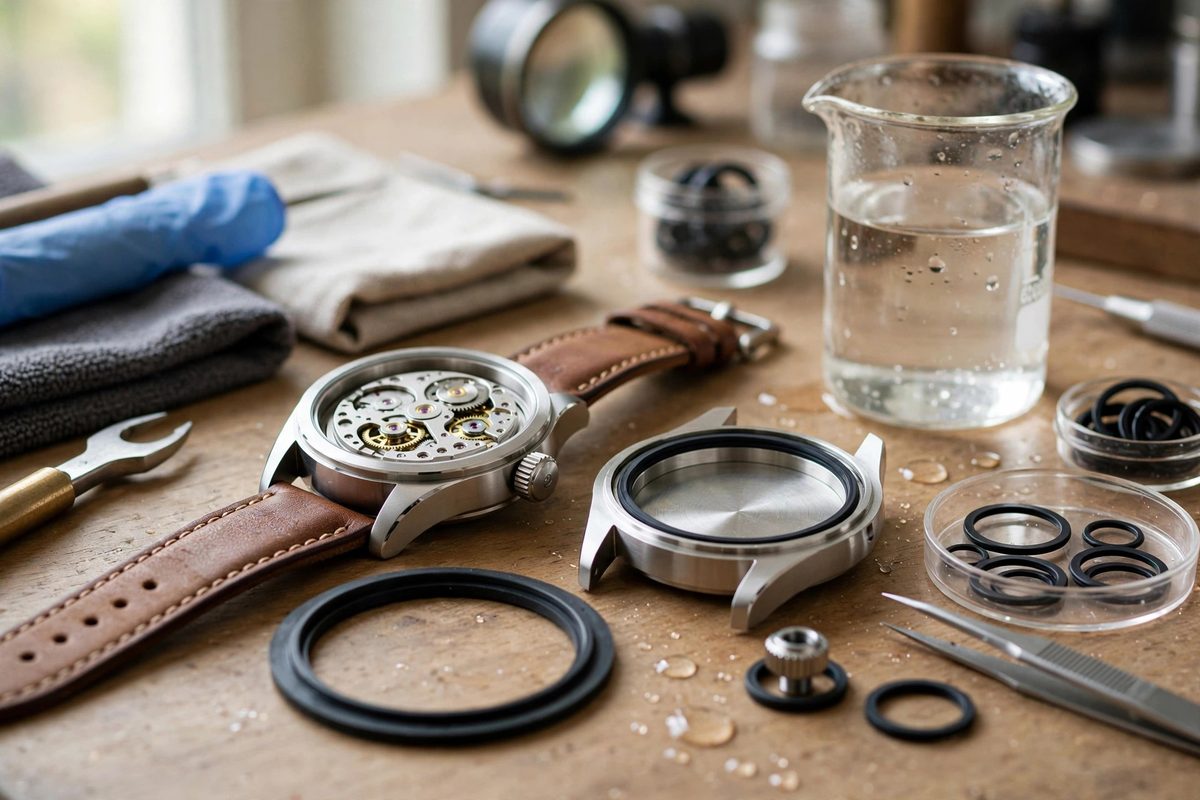
A mechanical watch is a precision instrument that happens to live on a wrist, exposed to rain, sweat, sinks, and the occasional swim. Its defense is a set of humble rubber gaskets: in the case back, around the crown, under the crystal, and at the pushers. These gaskets age, compress, and crack, and when they do, the watch's water resistance quietly expires. Replacing gaskets and verifying the seal is routine watchmaking maintenance, and it is the difference between a watch that survives daily life and one that fogs its crystal at the first rain.
Why gaskets fail
Rubber gaskets fail through compression set and chemical aging. Squeezed in their grooves for years, they take a permanent flattened shape and lose the springiness that makes them seal; this is compression set, and no amount of cleaning reverses it. Ozone, UV, heat, and contact with solvents, sunscreens, and skin chemistry accelerate the rubber's breakdown, making it brittle or gummy. A gasket can look intact while sealing nothing, which is why water resistance has a service interval rather than a visual check: most manufacturers recommend gasket replacement every few years for watches that see water. The failure mode is insidious because the watch keeps perfect time right up until moisture reaches the movement, and by the time the crystal fogs, the damage is done.
Gasket replacement procedure
Open the case with the correct tool for its back type: a case wrench for screw-down backs, a case knife for snap backs, used with care to avoid slipping. Remove the old gaskets from their grooves, noting their exact positions and orientations; case back gaskets, crown gaskets, and crystal gaskets each live in specific grooves and are not interchangeable. Clean the grooves thoroughly with a soft brush and a suitable solvent, removing old lubricant and debris, because a new gasket in a dirty groove seals poorly. Select replacement gaskets of the correct size and profile for the specific watch; gaskets are precision parts, and a near-fit is a leak. Lightly lubricate the new gaskets with silicone grease made for watch gaskets, which conditions the rubber and helps it seat without pinching. Seat each gasket fully and evenly in its groove, checking that it is not twisted or rolled, then close the case, verifying that screw-down backs tighten to their proper torque and snap backs seat fully around their circumference.
The crown and crystal
The crown gaskets deserve special attention because the crown moves: every winding and time-setting cycles the gasket, wearing it faster than the static case back seal. Inspect the crown tube and the crown's internal gaskets, replacing as a set where the design allows. Screw-down crowns must thread smoothly and seat firmly; a crown that cross-threads or will not tighten has a mechanical problem no gasket can fix. The crystal gasket or seal, whether a rubber ring or a cemented fit, should be inspected whenever the crystal is disturbed; crystals are often the leak path in watches whose case back gaskets are fresh. Pushers on chronographs are another moving seal and another wear point. Water resistance is a system: every seal must hold, because one failed gasket anywhere is a failed watch.
Testing water resistance
After replacing gaskets, test before trusting. The professional method uses a pressure tester: the watch goes into a chamber, pressure is applied, and the tester detects case deformation or leaks, dry testing without ever wetting the watch. Wet testing, submerging the watch and watching for bubbles, is the traditional alternative but risks the movement if the seal fails, so it is a test of last resort rather than routine practice. Home testing without proper equipment proves little: holding a watch under a tap tests nothing about sustained pressure, and a pass tells you less than you think. If the watch matters, have the pressure test done by a watchmaker with the right equipment; it is inexpensive and definitive. Never represent a watch as water resistant, to yourself or anyone else, without a passed test after service.
Honest ratings and ongoing care
Understand what the ratings mean: a watch rated for everyday water resistance handles rain and hand washing, not swimming; meaningful swim and dive ratings start higher and require screw-down crowns and robust construction. Gasket replacement restores the factory rating at best; it cannot upgrade a dress watch into a diver. Rinse the watch with fresh water after exposure to salt water or chlorine, which attack gaskets and cases alike. Have the seals checked on schedule, not after a failure. And remember the watchmaker's rule: water resistance is a condition, not a property. It exists only as long as the gaskets hold, the case is intact, and the last test passed.
Fresh gaskets in clean grooves, light silicone lubrication, careful reassembly, and a proper pressure test: that sequence keeps the water outside where it belongs, year after year.
Related Guides
- Testing Bezel Helium Release Valves for Waterproofing: A helium release valve is a one-way pressure vent built into a dive watch case, designed to let trapped helium escape during decompression without
- Setting Crystal Gasket Compression Pressures: The crystal gasket, the small rubber or plastic ring sealing the watch crystal to the case, is a primary defense against water and dust. Its seal
- Caseback O-Ring Compression Limits for Diver Bezels: A diver watch's water resistance lives or dies at its seals, and the caseback O-ring is the largest of them. The O-ring seals by being squeezed