
A helium release valve is a one-way pressure vent built into a dive watch case, designed to let trapped helium escape during decompression without letting water in. Testing it for waterproofing means verifying two things at once: that it seals against water ingress at depth pressure, and that it still vents in the right direction. A valve that fails either test compromises the watch.
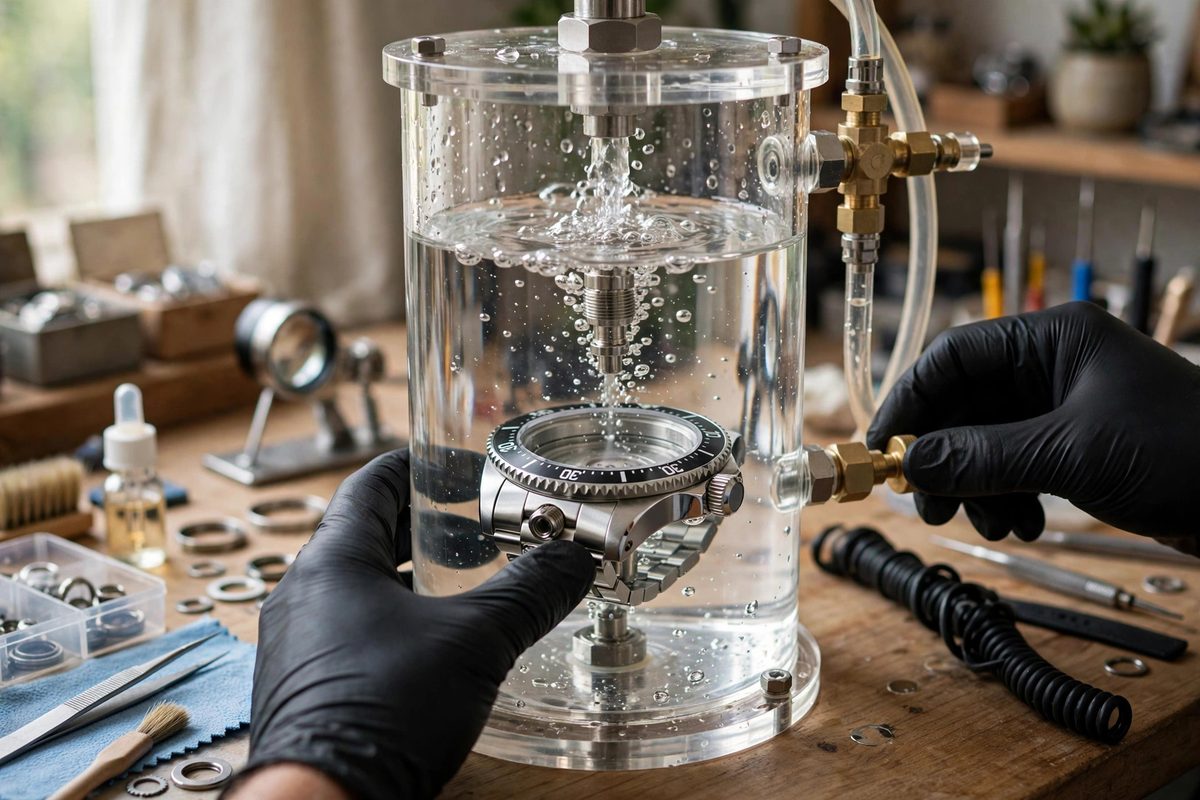
What the Valve Does
During saturation diving, tiny helium atoms seep past the watch's seals and pressurize the case interior. On ascent, the trapped gas expands, and without a vent it can pop the crystal off. The helium release valve opens outward under internal pressure to release the gas, then reseals. It must open at a modest internal overpressure and must never open inward under external water pressure. The waterproofing test focuses on the second requirement: under external pressure, the valve must seal as tightly as the rest of the case.
Pressure Testing the Assembled Watch
The standard test pressurizes the watch in a chamber to its rated depth equivalent, holds it, and checks for leaks. Dry testing with air pressure comes first: the watch goes into the chamber, pressure is applied, and a leak shows as a pressure drop or, in a water-filled chamber variant, as bubbles. For the valve specifically, the test must cover the valve's full operating logic: external pressure should keep it sealed shut, with no bubbles or pressure loss at the valve location. Test to the rated pressure, not beyond; overpressure testing risks damaging a good watch to prove a point nobody needed proven.
Testing the Vent Function
Waterproofing is only half the valve's job. The vent function can be checked by pressurizing the case interior slightly, through the crown tube with the crown removed or via a test fixture, and confirming the valve releases at a low overpressure and reseals afterward. The release pressure should be modest, well below anything that threatens the crystal, and the valve should close cleanly with no weeping afterward. A valve that vents at too high a pressure is as useless as no valve; a valve that does not reseal is a leak.
Common Failure Modes
The usual failures are contamination and spring fatigue. A speck of debris under the valve seat prevents sealing, which shows up as a leak localized at the valve during pressure testing. Disassemble, clean, inspect the seat under magnification, and retest. A weakened spring vents too easily or fails to reseal firmly; replacement is the fix, since springs are not adjustable. Corrosion on the valve components, especially in watches that actually saw salt water, can freeze the valve shut, which passes the waterproof test but fails the vent test. Both tests matter because each catches what the other misses.
Seals, Gaskets, and Reassembly
Every disassembly for valve service demands new gaskets; compressed gaskets do not reseal reliably. Lubricate the new gaskets with the appropriate silicone grease, sparingly, and seat the valve components without twisting or pinching. Torque any threaded valve retainers to spec, since over-tightening distorts the seat and under-tightening leaves a leak path. After reassembly, the full pressure test runs again from the start; there is no partial credit in waterproofing, and the watch is only as good as its last complete test.
A helium release valve earns its place by venting outward on demand and sealing inward under pressure. Test both directions, service the seals on every opening, and retest completely after reassembly. The diver's watch stays dry inside and intact on the way up.
Related Guides
- Replacing Gaskets and Testing Water Resistance: A mechanical watch is a precision instrument that happens to live on a wrist, exposed to rain, sweat, sinks, and the occasional swim. Its defense is
- Setting Crystal Gasket Compression Pressures: The crystal gasket, the small rubber or plastic ring sealing the watch crystal to the case, is a primary defense against water and dust. Its seal
- Caseback O-Ring Compression Limits for Diver Bezels: A diver watch's water resistance lives or dies at its seals, and the caseback O-ring is the largest of them. The O-ring seals by being squeezed