
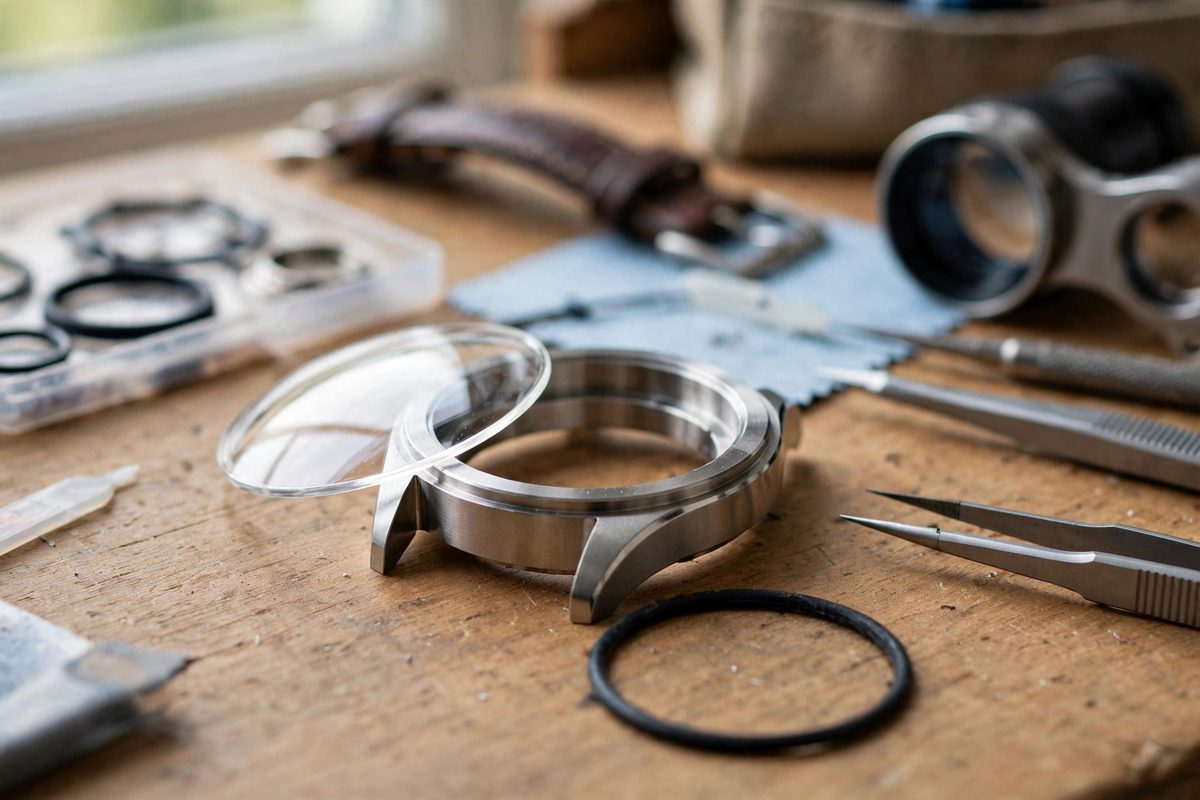
The crystal gasket, the small rubber or plastic ring sealing the watch crystal to the case, is a primary defense against water and dust. Its seal depends on compression: squeezed just enough, the gasket conforms to both surfaces and blocks ingress; under-compressed, it leaks; over-compressed, it deforms permanently, extrudes, or cracks the crystal. Setting the compression correctly is quiet, precise work that determines whether the watch survives real life.
How gasket compression seals
An uncompressed gasket is round (or shaped) in cross-section and touches the sealing surfaces at tangent points. Under compression, it flattens against both surfaces, and the contact area grows; sealing happens across that contact area, where the deformed gasket presses continuously against metal and crystal. The correct compression is typically in the range of 15 to 25 percent of the gasket's cross-section height: enough to create a broad, continuous contact band, not so much that the material takes a permanent set or squeezes out of its groove. The groove dimensions and the crystal's seating depth are what set this compression; the watchmaker's job is to verify and achieve it.
Measuring and selecting the gasket
Measure the groove: its width and depth, with calipers or a measuring microscope. Measure candidate gaskets' cross-sections. The gasket should stand slightly proud of the groove, so that seating the crystal compresses it by the target percentage; a gasket that sits flush or below the groove edge will not compress at all. Gasket material matters: nitrile and silicone are common, with different compression-set resistance and temperature behavior. Replace gaskets rather than reusing them whenever a watch is opened; a used gasket has already taken a set and will not seal to specification again.
Seating the crystal
Seat the crystal with a crystal press, applying even, controlled pressure straight down; angled pressure compresses one side of the gasket more than the other and can crack the crystal. The press should bring the crystal to its designed seat, no further; over-pressing is how crystals crack and gaskets extrude. If the crystal will not seat with reasonable pressure, stop: the gasket is likely oversized or mispositioned, and forcing it damages something. Verify seating visually around the full circumference; the crystal should sit level and the gasket should not be visible bulging out.
Testing the seal
After casing, test water resistance appropriate to the watch's rating: dry air-pressure testing for basic verification, wet testing where the rating demands it. Testing is not optional; a gasket that looks right can still leak from a nick, a twist, or a speck of debris in the groove. If the watch fails, open it, inspect the gasket under magnification (look for cuts, twists, and uneven compression marks), replace it, and retest. Never deliver a watch as water-resistant without testing; the claim must be verified, not assumed.
Common failures
Twisted gaskets are the classic error: a gasket that rolled during installation seals on a spiral instead of a circle. Lubricate the gasket very lightly with silicone grease to help it seat without twisting, but use the merest film; excess grease migrates. Debris in the groove, a single fiber, holds the crystal off its seat and creates a leak path. And aged gaskets in watches that "were fine last year" are the reason water resistance has an expiration date; gaskets are consumables, and every opening is a replacement.
Measure the groove, size the gasket for 15 to 25 percent compression, press straight and even, and test the seal. The watch goes back to its owner ready for weather.
Related Guides
- Caseback O-Ring Compression Limits for Diver Bezels: A diver watch's water resistance lives or dies at its seals, and the caseback O-ring is the largest of them. The O-ring seals by being squeezed
- Replacing Gaskets and Testing Water Resistance: A mechanical watch is a precision instrument that happens to live on a wrist, exposed to rain, sweat, sinks, and the occasional swim. Its defense is
- Testing Bezel Helium Release Valves for Waterproofing: A helium release valve is a one-way pressure vent built into a dive watch case, designed to let trapped helium escape during decompression without