
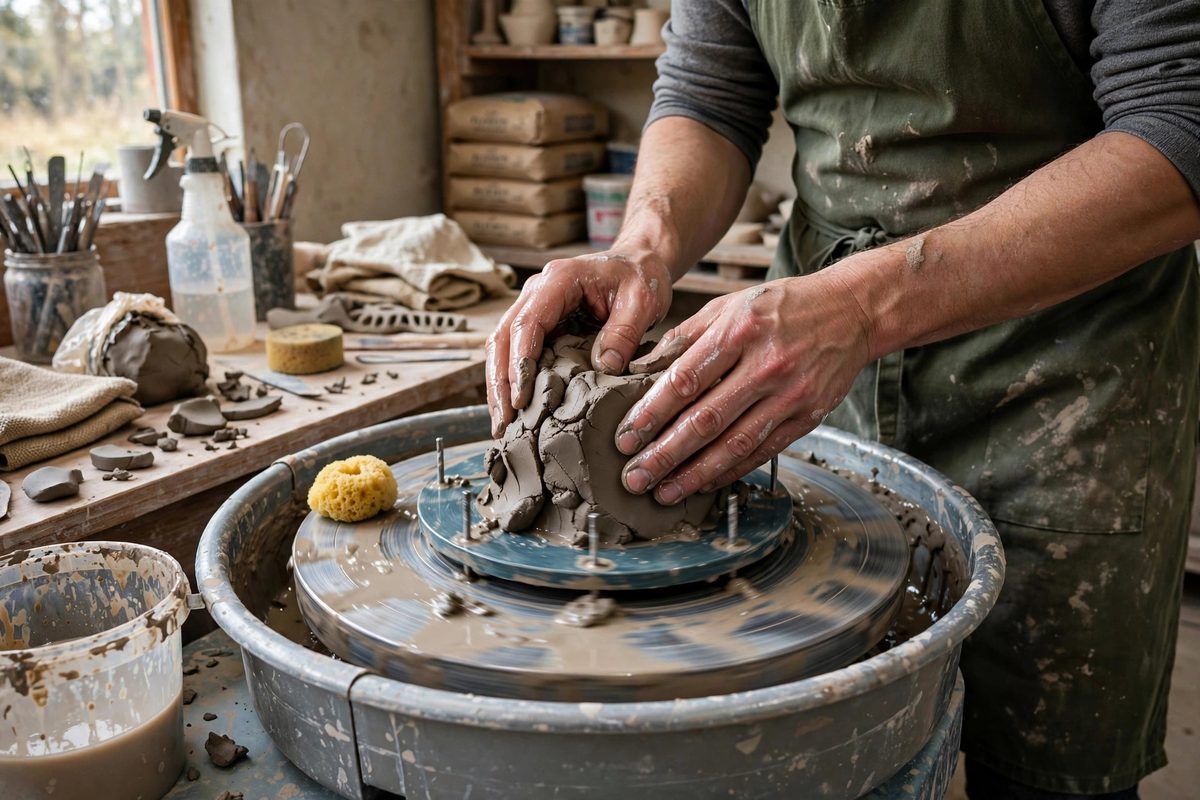
Centering is the foundation of wheel throwing: until the clay spins true, nothing built on it will be true either. Dense stoneware bodies make centering noticeably harder than soft earthenware or porcelain. They are stiff, heavy, and resistant, fighting every push with inertia and attitude. Centering dense clay on a bat, held by bat pins, adds the small complication that the bat itself can shift if the clay is not locked down. The technique adapts to the material: more commitment, better body mechanics, and respect for what dense clay demands.
Why dense clay fights centering
Centering works by pushing the clay's mass into rotational symmetry faster than the wheel's spin can throw it off. Dense stoneware resists for three reasons. Its stiffness means it deforms reluctantly; where soft clay yields to hand pressure, dense clay pushes back. Its weight means more inertia; once off-center, a heavy mass wants to stay off-center, and the wheel's wobble amplifies. And its low water tolerance means it cannot be mushed into submission with sloppy wetness the way soft bodies can; too much water just makes the surface slick while the core stays stubborn. The answer is not more water or more muscle alone, but sustained, correctly directed pressure with the whole body behind it. Dense clay centers fine; it just refuses to be rushed.
Locking the bat and seating the clay
A bat held by pins can rotate slightly or lift under the lateral forces of centering heavy clay, so start by seating it firmly: press it down onto the pins and check for rock. Some throwers dampen the wheel head slightly for extra grip, though a well-fitting bat on clean pins needs nothing. Slam the clay down onto the bat's center with commitment; a hesitant placement starts off-center and wastes the first minute. Then seal the clay's base to the bat by pressing around the bottom edge, creating a bond that resists the lateral push of centering. If the bat shifts during centering, stop and reseat everything; fighting a moving bat teaches nothing and centers nothing. The bat is part of the system, and the system must be stable before the clay can be.
The centering sequence for stiff clay
With the wheel at a good speed, wet the clay and anchor your body: elbows braced against your torso or the wheel pan, so your skeleton, not your arm muscles, transmits the force. Push the clay inward and downward with the heels of your hands, applying steady, sustained pressure rather than shoves. The classic cone helps enormously with dense clay: push the clay up into a cone, then press it back down, repeating two or three times. Each cone-up-and-down cycle works the clay's structure, aligning the particles and distributing the mass more evenly; dense bodies respond to this kneading action far better than to static pushing. Keep the clay lubricated but not drowned; a slick surface with a firm core is the goal. Check centering by touching the clay lightly with a wet finger or a needle tool: when the touch leaves no wobble mark, the clay is centered. Do not overwork it; once centered, move on, because continued pushing just introduces new problems.
Body mechanics and common errors
Most centering failures with dense clay are body mechanics failures. Pushing with the arms alone exhausts you before the clay yields; the power must come from the torso, with arms as rigid transmitters. Sitting too high or too far from the wheel reduces leverage; get close and low. Inconsistent pressure, pushing hard then easing off, lets the clay rebound between pushes; maintain constant contact and constant force. And the classic error: chasing the wobble by pushing at the wobble's peak, which just moves the high spot around. Instead, apply steady inward pressure and let the wheel's rotation average the clay into center. Dense clay punishes every bad habit that soft clay forgives, which makes it an excellent teacher even when it feels like an adversary.
When to walk away and re-wedge
Sometimes the clay wins the first round: it is too stiff, too cold, or has a hard lump that will not center. Recognize this early rather than fighting for twenty minutes. Cut the clay off, wedge it thoroughly to homogenize the moisture and work out the stubborn spots, and start again with better-prepared clay. Wedging is not defeat; it is preparation, and clay that has been properly wedged centers dramatically easier. Also consider the clay's age and storage: stoneware that has dried out in the bag will never center well until it is properly reconditioned. The wheel rewards good preparation more than it rewards effort, and dense clay enforces that lesson strictly.
Seat the bat solid, anchor your body, cone the clay up and down, and press with sustained torso power until the wobble disappears. Dense stoneware centers on the same principles as any clay; it just insists you apply them properly.
Related Guides
- Centering Off-Kilter Clay Balls at High RPMs: Every thrower has faced the clay ball that refuses to center: a lopsided lump, maybe wedged badly or just oddly shaped, that wobbles and slaps no
- Stabilizing Rim Centering on Wide Porcelain Platters: A wide porcelain platter is one of the hardest things to throw: a large, flat expanse of finicky clay that wants to warp, wobble off center, and
- Controlling Centrifugal Flare on Deep Porcelain Bowls: Porcelain wants to be thin, and a deep bowl wants to be tall, and centrifugal force wants to flare the rim outward the moment your attention wanders