
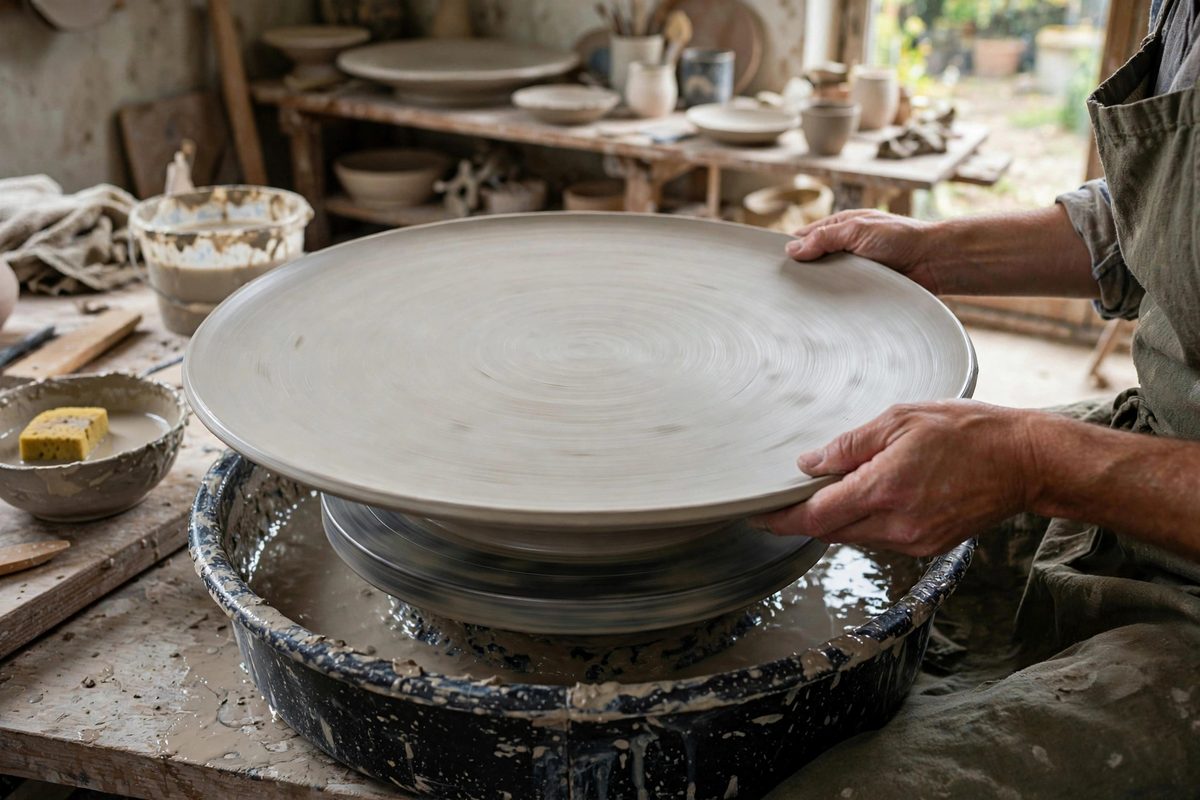
A wide porcelain platter is one of the hardest things to throw: a large, flat expanse of finicky clay that wants to warp, wobble off center, and crack at the rim. Stabilizing the rim during centering and opening sets up everything that follows. Get the rim stable early and the platter practically throws itself; fight a wobbling rim and the whole piece is compromised from the start.
Why Porcelain Platters Are Difficult
Porcelain has short, tight clay particles with little natural plasticity compared to stoneware; it is strong when handled right and unforgiving when handled wrong. A wide platter multiplies every error: a millimeter of off-center at the hub becomes a visible wobble at a fourteen-inch rim, and the broad flat floor has no structural curvature to resist warping. Centrifugal force at the rim is high, so any instability grows as the wheel spins. The rim itself is the most vulnerable part: thin, far from the center, and prone to drying faster than the floor, which sets up the differential shrinkage that cracks rims. Everything about the form conspires against the thrower, which is why rim stabilization is the key skill.
Centering for a Wide Form
Center the clay thoroughly, more thoroughly than feels necessary, because platter throwing exposes incomplete centering mercilessly. Use a generous amount of water and firm, patient pressure; porcelain centers best with confident, continuous contact rather than tentative pats. Once centered, open the form with a wide, stable base, keeping the floor thick enough to support the span. A floor that is too thin at this stage will sag and go off center later no matter what you do. Cone the clay up and down a time or two during centering to align the particles and remove air; porcelain's tight body hides air pockets that become rim flaws.
Stabilizing the Rim as You Open
The critical technique: establish the rim early and keep it thick and supported while you open the floor outward. Many throwers make the mistake of thinning the rim first and then trying to widen the platter; the thin rim immediately goes unstable. Instead, open the floor with the rim left as a thick, stable ring, and only refine the rim's thickness at the very end. Support the rim with a light touch of the fingers or a rib as the diameter grows, damping the wobble before it amplifies. Keep the wheel speed moderate; high speed increases centrifugal instability at large diameters. If the rim starts to wobble, slow down, re-stabilize with gentle pressure, and continue; forcing through a wobble bakes it into the piece.
Water, Speed, and Touch
Porcelain's narrow working window means water management is critical. Too much water and the wide floor goes soupy and sags; too little and the rim drags and tears. Use water sparingly and remove excess from the floor with a sponge or rib frequently. Keep your touch light and continuous on the broad surfaces; porcelain responds to sustained gentle pressure, not to aggressive pulling. Rib the floor regularly to compress and even it out, which also helps prevent the S-cracks that plague wide porcelain floors. Work efficiently but without rushing; porcelain fatigues with overworking, and a platter that has been manhandled too long will warp in drying no matter how good it looked on the wheel.
Drying the Platter Flat
The battle continues after throwing. Dry the platter slowly and evenly, covering it loosely so the rim and floor dry at similar rates; a rim that dries much faster than the floor shrinks first and cracks. Dry it upside down on a flat, absorbent surface once it is leather hard enough to handle, which lets gravity keep the floor flat instead of sagging. Some potters sandwich wide platters between boards with light weight during the final drying to guarantee flatness. Do not rush to the kiln; a platter that looks dry can still hold moisture in its thick floor, and firing it damp invites cracks. Patience in drying is the final ingredient in a flat, stable porcelain platter.
Center completely, keep the rim thick and supported while opening, manage water ruthlessly, and dry the platter slowly and flat. Rim stability at the wheel becomes flatness in the kiln; the two are the same discipline.
Related Guides
- Controlling Centrifugal Flare on Deep Porcelain Bowls: Porcelain wants to be thin, and a deep bowl wants to be tall, and centrifugal force wants to flare the rim outward the moment your attention wanders
- Centering Dense Stoneware Clay on the Bat Pin: Centering is the foundation of wheel throwing: until the clay spins true, nothing built on it will be true either. Dense stoneware bodies make
- Centering Off-Kilter Clay Balls at High RPMs: Every thrower has faced the clay ball that refuses to center: a lopsided lump, maybe wedged badly or just oddly shaped, that wobbles and slaps no