
Porcelain wants to be thin, and a deep bowl wants to be tall, and centrifugal force wants to flare the rim outward the moment your attention wanders. Controlling flare on a deep porcelain bowl is about managing the clay's memory, the wheel's speed, and your hands' discipline through the whole pull. The bowl that survives trimming starts with walls that went up straight.
Why Porcelain Flares
Centrifugal force pushes the clay outward proportionally to the speed and the radius, so the rim of a deep bowl, the widest and fastest-moving part, feels the strongest outward pull. Porcelain's fine particle structure makes it less forgiving than stoneware: it has a shorter working range, it tires faster, and once it starts moving outward it keeps going. The flare often begins invisibly during the pull and only shows itself when you release pressure; the clay springs outward to where the centrifugal force was always pushing it. Understanding this means you throw the bowl slightly narrower than the target, anticipating the flare you cannot fully prevent.
Wheel Speed Strategy
High speed centers and opens efficiently but flares aggressively during pulling. The working approach is to start fast for centering and opening, then drop the speed for the pulls, running only as fast as needed to keep the clay supported. Slow the wheel further for the final shaping passes near the rim, where the radius is largest and the clay is thinnest. Many throwers keep the speed too high out of habit from stoneware; porcelain rewards the discipline of the slower wheel. If the rim starts wobbling, the speed is too high for the clay's remaining strength, full stop.
Hand Position and Pressure
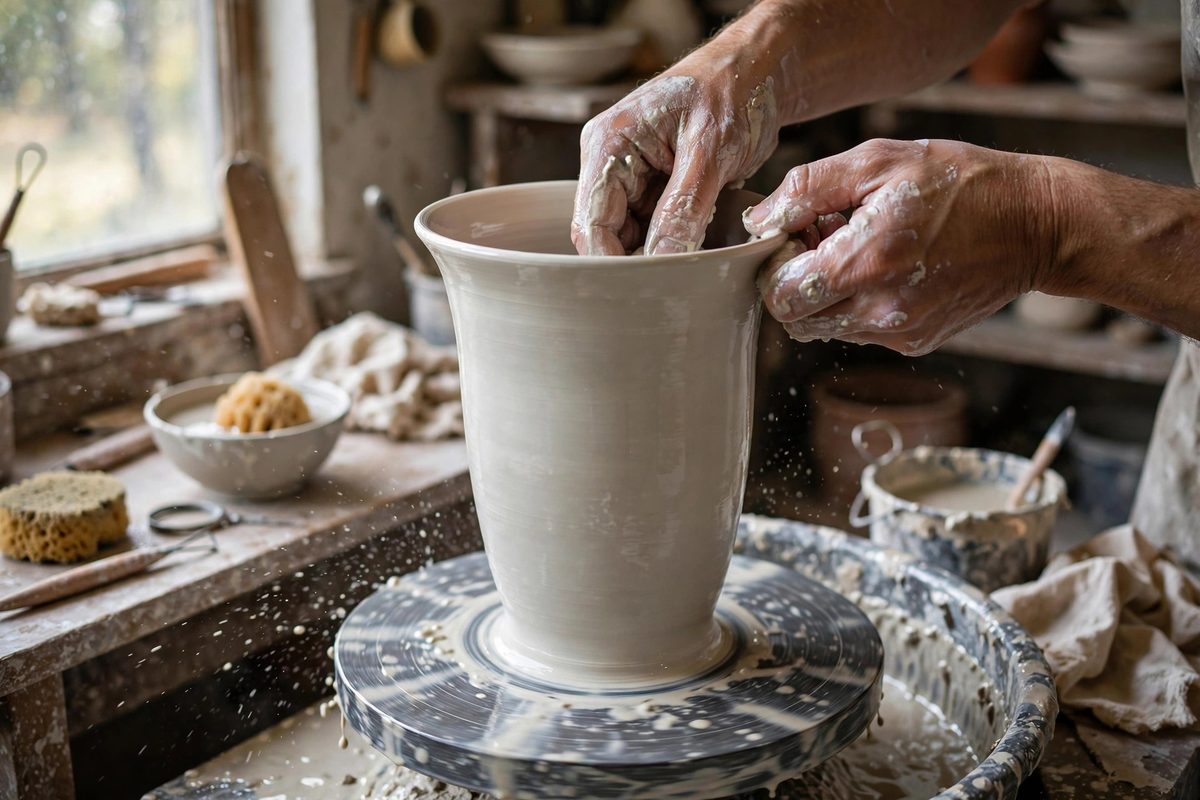
Support the outside of the wall with one hand while the inside hand does the lifting; the outside hand is the brake on centrifugal flare. Keep the supporting hand in contact through the whole pull, moving up with the clay, because the moment support leaves, the rim flares. Use the minimum pressure that moves the clay; squeezing hard thins the wall locally and creates weak rings that flare worse. Collar the rim inward gently between pulls, bringing the diameter back under control before the next lift. The rhythm is lift, collar, lift, collar, with the bowl growing taller while the rim stays honest.
Water and Clay Condition
Porcelain goes from workable to sloppy with very little extra water, and sloppy porcelain cannot resist flare at all. Use water sparingly, just enough to lubricate, and remove excess from the interior with a sponge regularly. If the clay starts feeling tired, soft and unresponsive, stop and let the piece firm up before continuing; throwing tired porcelain taller only produces a taller collapse. Some throwers work deep porcelain in two sessions, throwing the lower portion, letting it stiffen, then finishing the rim, which divides the battle into winnable halves.
Trimming and Finishing
A bowl thrown with controlled flare trims cleanly because the wall thickness is even and the form is true. Trim the foot while the bowl is leather-hard, supporting the rim so trimming pressure does not distort it. The final rim can be gently refined at this stage, but major corrections belong at the wheel, not at the trimming stage. A deep porcelain bowl that survived throwing, stayed narrow at the rim, and trimmed true will fire with the elegance the clay promises and the frustration it usually delivers.
Throw deep porcelain slower than your instincts say, support the outside wall continuously, collar the rim between pulls, and respect the clay's short working window. The flare stays under control and the bowl stands tall the way you intended.
Related Guides
- Stabilizing Rim Centering on Wide Porcelain Platters: A wide porcelain platter is one of the hardest things to throw: a large, flat expanse of finicky clay that wants to warp, wobble off center, and
- Centering Dense Stoneware Clay on the Bat Pin: Centering is the foundation of wheel throwing: until the clay spins true, nothing built on it will be true either. Dense stoneware bodies make
- Centering Off-Kilter Clay Balls at High RPMs: Every thrower has faced the clay ball that refuses to center: a lopsided lump, maybe wedged badly or just oddly shaped, that wobbles and slaps no