
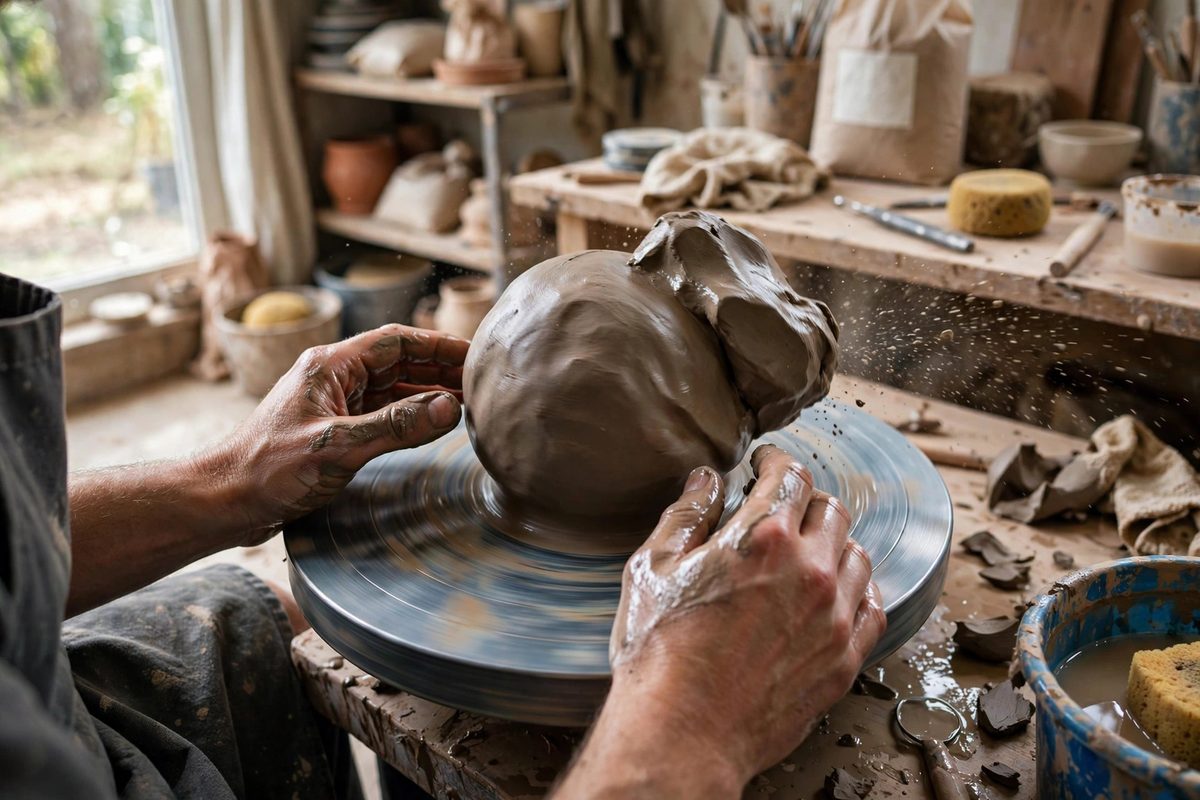
Every thrower has faced the clay ball that refuses to center: a lopsided lump, maybe wedged badly or just oddly shaped, that wobbles and slaps no matter what you do. The instinct is to slow down and fight it gently. The better answer is usually the opposite: get the wheel up to speed and use centrifugal force as your ally. High RPMs do not make centering harder; they make the clay's off-center mass work against itself, and a confident, locked-in technique centers a bad ball faster than cautious slow-speed wrestling.
Why Speed Helps Instead of Hurting
Centrifugal force increases with the square of the rotation speed, which means doubling the RPM quadruples the force pulling the clay outward. That outward pull is what you work against, and working against a strong, consistent force is easier than chasing a weak, wandering one. At low speed, the clay's heavy side flops around unpredictably; at high speed, it presses outward in a stable, readable way, and your braced hands can push it back to center with steady pressure.
The clay also stiffens under speed in a practical sense. A fast-spinning lump resists the kind of smearing and folding that slow-speed pushing causes, so your corrections move the whole mass instead of just squishing the surface. This is why beginners who learn to center at higher speeds often progress faster: the feedback is clearer and the clay cooperates.
Body Position Is the Foundation
None of this works if your arms are floating. Lock your elbows against your torso or your thighs, whichever gives you a rigid connection to the wheel. Your hands become a vise anchored to your body, not two independent paddles flapping at the clay. Sit close enough that your arms are bent at roughly ninety degrees, and keep your shoulders down and relaxed; tension in the shoulders translates into jerky corrections.
Wet your hands and the clay well before starting. Dry friction at high speed will grab the clay and tear it off center faster than you can correct, and it will also chew up your skin. Water is the bearing surface between your hands and the clay, and at high RPMs you need more of it than you think.
The Cone-Up, Cone-Down Cycle
Start by slapping the ball down roughly centered on the wheel head, then get the wheel to a fast centering speed. With braced arms, push the clay into a cone shape, driving it upward and inward: one hand on the side pushing in, the other on top pushing down. The cone concentrates the off-center mass into a smaller region where it is easier to control.
Then push the cone back down into a low dome, applying firm, even pressure from the top with both hands. The up-and-down cycle is the mechanism that actually centers the clay: each cone-up gathers the mass, each cone-down redistributes it more evenly. Two or three cycles will center a ball that seemed hopeless, because each pass compounds the correction.
- Keep your hands wet and re-wet often; high speed dries the surface fast.
- Apply pressure gradually, not in shoves; sudden force at high speed throws the clay off the wheel.
- If the clay starts to wobble worse, you are pressing unevenly: reset your brace and try again rather than chasing it.
- Stop and re-wedge if the clay is genuinely too soft; no technique centers soup.
Reading the Clay at Speed
At high RPMs, a centered ball looks still: no wobble, no slapping against your palms, just a smooth dome that feels quiet under your hands. An off-center ball announces itself as a rhythmic thump against one hand, once per revolution. Close your eyes for a second and feel it; the thump tells you which side is heavy, and you press that side in on the next pass.
Watch the top of the dome too. A centered top spins as a clean point; an off-center top draws a small circle. When the point is steady and the thump is gone, the clay is centered through its full height, not just at the surface. Surface-still with a wobbling core is the classic false finish, and the cone cycle is what fixes the core.
When High Speed Is the Wrong Answer
There are limits. Clay that is too wet will fly apart no matter your brace, and very large lumps (past what your arms can contain) need to be centered at whatever speed lets you stay in control. Porcelain, being less plastic, can tear if pushed too aggressively at speed, so back off the pressure even while keeping the RPMs up.
Fatigue is the other limit. Centering at high speed with locked arms is physical work, and tired arms make sloppy corrections. If you have fought a ball through several cycles and it is still wobbling, cut it off the wheel, re-wedge, and start fresh. There is no prize for winning a wrestling match with clay; the prize is a centered ball, however you get there.
Brace hard, spin fast, and let the cone cycle do the work. The off-kilter ball is not a bad ball; it is just a ball that has not been centered yet, and speed is the fastest way to get it there.
Related Guides
- Centering Dense Stoneware Clay on the Bat Pin: Centering is the foundation of wheel throwing: until the clay spins true, nothing built on it will be true either. Dense stoneware bodies make
- Stabilizing Rim Centering on Wide Porcelain Platters: A wide porcelain platter is one of the hardest things to throw: a large, flat expanse of finicky clay that wants to warp, wobble off center, and
- Controlling Centrifugal Flare on Deep Porcelain Bowls: Porcelain wants to be thin, and a deep bowl wants to be tall, and centrifugal force wants to flare the rim outward the moment your attention wanders