
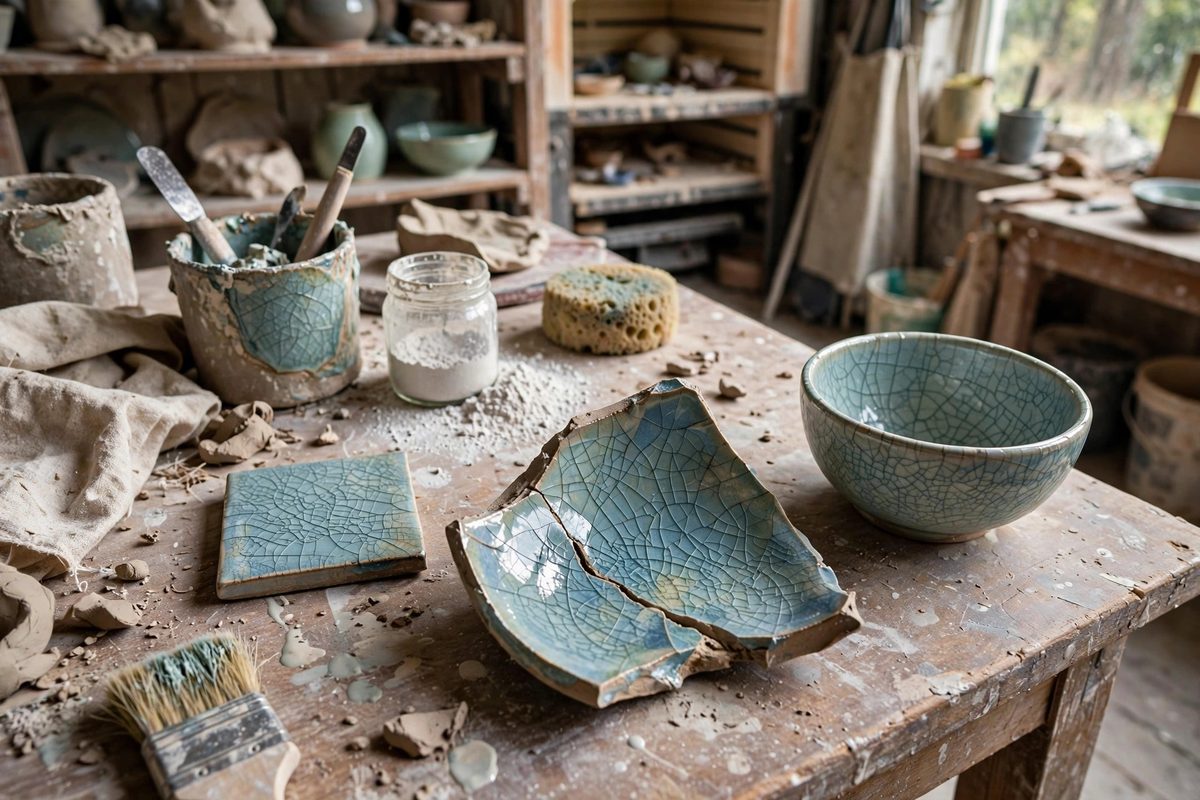
Crazing, that fine web of cracks across a glaze surface, is a fit problem between glaze and clay body. In high alkaline glazes, the ones built on sodium and potassium fluxes that give soda and salt firing its bright, glassy look, crazing is the default outcome unless you engineer against it. Alkaline fluxes drive the glaze's thermal expansion up, while most stoneware bodies sit lower. On cooling, the glaze tries to shrink more than the body allows, goes into tension, and cracks. Controlling crazing means closing that expansion gap.
Why Alkaline Glazes Expand So Much
Sodium and potassium oxides are powerful fluxes: they melt silica at lower temperatures and make fluid, glossy glazes. But they also have very high coefficients of thermal expansion. A glaze rich in soda can expand nearly twice as much per degree as the stoneware beneath it. The mismatch is built into the chemistry before the kiln ever fires.
This is why simply lowering the firing temperature or holding longer at peak does not fix crazing in these systems. The problem is not the firing; it is the recipe. As long as the glaze contains that much alkali relative to the body, tension on cooling is a physical certainty. The fix has to change the composition or change the body it sits on.
Silica and Alumina as Expansion Brakes
The most direct lever is silica. Adding silica to the glaze lowers its thermal expansion and increases its durability, because silica is a glass former with low expansion that dilutes the alkali's effect. The trade is fluidity: more silica stiffens the melt, so a glaze that was flowing nicely may go dry or matte. Alumina, added alongside, keeps the glaze from running while silica does its work on expansion.
Adjust in small increments, a few percent of silica at a time, and fire a test tile with each step. The goal is the smallest silica addition that stops the crazing, because overshooting raises the melting point until the glaze underfires. Test tiles are the whole discipline here; batch-wide changes without them are guesswork with a full kiln load at stake.
Flux Swaps That Keep the Look
When silica additions dull the glaze more than you can accept, the alternative is trading some alkali flux for fluxes with lower expansion. Boron oxide (from frits) is the classic substitute: it fluxes strongly at low expansion, and it keeps the bright glossy surface alkaline glazes are known for. A partial substitution, swapping some of the soda feldspar for a boron frit, often lands the fit without redesigning the glaze.
- Boron frits lower expansion while preserving gloss and fluidity.
- Calcium and magnesium (whiting, dolomite) are low-expansion fluxes that add durability and can replace some alkali in matte or semi-matte versions.
- Zinc lowers expansion too, but watch opacity: it can cloud a transparent glaze at higher levels.
- Lithium has extremely high expansion and goes the wrong way for crazing; keep it out of fit-sensitive alkaline recipes.
Change one flux at a time. Multiple simultaneous changes leave you unable to say which one fixed, or caused, the crazing, and the next glaze problem will send you back to the start.
Matching the Body to the Glaze
The other half of the fit equation is the clay. Some stoneware bodies expand more than others, and a body with higher silica content (more free quartz) will expand more on heating and contract more on cooling, which can close the gap with an alkaline glaze. If the glaze is a keeper and the body is flexible, switching bodies is sometimes the easier path than reformulating a glaze you love.
Body thickness matters as well. Thin-walled pieces cool faster and more unevenly, which can exaggerate crazing on rims and handles even when the main body tests clean. If only the thin sections craze, the glaze is on the edge of fit, and the fix is still compositional, not procedural.
Testing Fit Deliberately
The reliable test is a set of tiles fired with the body and glaze together, then checked after cooling and again after a few days, because delayed crazing is common: a glaze can look perfect out of the kiln and web up a week later as residual stresses relax. Keep the tiles, date them, and look at them under a bright light at an angle, which reveals crazing long before it is visible head-on.
For a quicker read, the ice-water and boiling-water shock test tells you about thermal shock resistance, which correlates with fit. A well-fit glaze survives both; a glaze in high tension often crazes on the first shock. It is a stress test, not a substitute for the waiting period, but it catches the worst offenders fast.
Accepting Some Crazing When It Is the Point
Some traditions want crazing: crackle glazes and raku surfaces treat the crackle as decoration, often rubbed with ink or oxide to highlight it. If crazing is the aesthetic, control means making it uniform and deliberate rather than eliminating it. But for functional ware, crazed surfaces harbor bacteria in the cracks and weaken over time, so fit is not optional.
For alkaline glazes, crazing is the chemistry's way of telling you the expansion numbers do not add up. Add silica, trade flux, match the body, and test with patience. The glaze will tell you when the fit is right: silence, under a raking light, a week after the firing.
Related Guides
- Calculating Frit Expansion Limits for High Fire Glazes: A glaze that does not fit the clay body crazes, shivers, or peels, no matter how beautiful the color. Frits, the pre-melted glass powders that supply
- Specific Gravity Hydrometer Readings for Glazes: A glaze bucket looks the same whether it is mixed correctly or not, which is why glaze results drift mysteriously between sessions: the same recipe
- Specific Gravity Tuning in Raw Ash Celadon Glazes: A raw ash celadon is a glaze mixed from wood ash with minimal processing, and its behavior in the bucket changes with every variable: the ash source