
A raw ash celadon is a glaze mixed from wood ash with minimal processing, and its behavior in the bucket changes with every variable: the ash source, the grind, the water content. Specific gravity, the density of the glaze slurry relative to water, is the potter's practical handle on all of it. Tune the gravity and you tune the application thickness, which tunes the fired result.
Why Specific Gravity Matters
Glaze thickness on the pot determines the fired color and texture of a celadon. Too thin and the iron in the glaze cannot develop the blue-green depth; the result looks washed out and gray. Too thick and the glaze runs, crawls, or opacifies into an unappealing matte. Specific gravity correlates directly with how much glaze solid lands on the pot per dip, because a denser slurry carries more material. Measuring gravity with a hydrometer or by weighing a known volume gives you a repeatable number, which turns "dip it like last time" into an actual specification you can return to.
Measuring and Adjusting
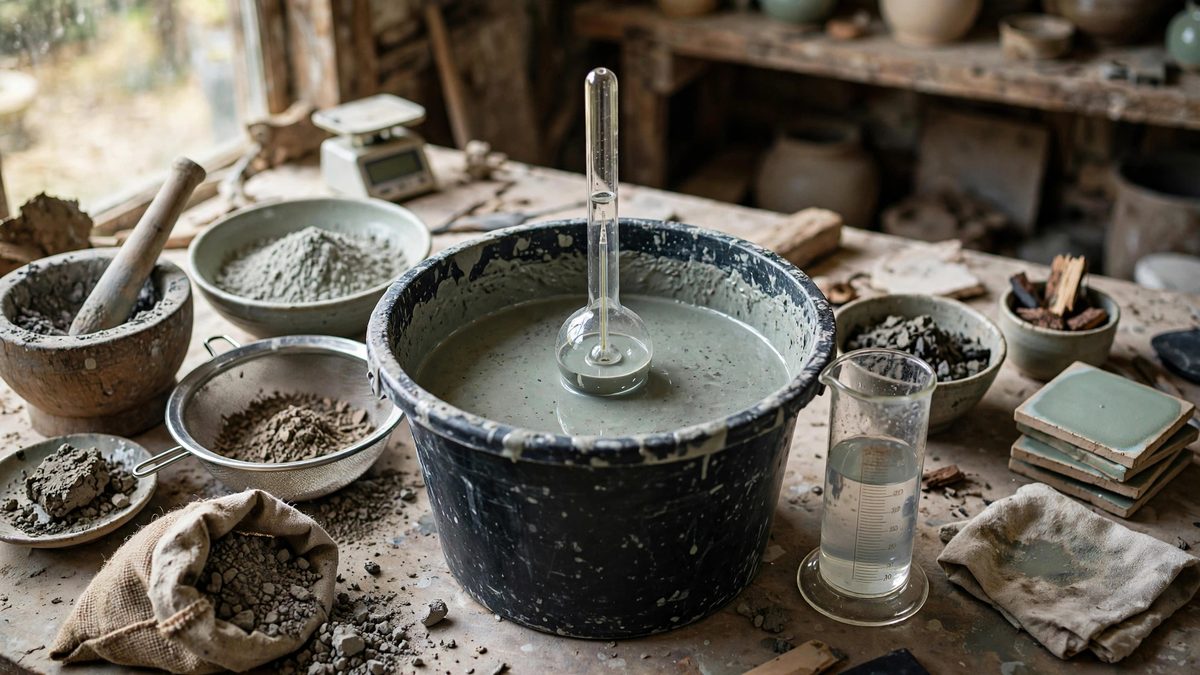
Measure the slurry's specific gravity by floating a hydrometer in a tall sample or by weighing a fixed volume and comparing to water. For dipping glazes, working gravities often land in the range of roughly 1.4 to 1.5, but raw ash glazes vary with their ash content, so establish your own target by testing. To raise gravity, let the slurry settle and decant water off the top, or add dry mixed glaze. To lower it, add water. Adjust in small steps and remeasure; overshooting means a round of correction in the other direction. Record the gravity that produced your best firing, because that number is the recipe's other half.
Raw Ash Variability
Wood ash is not a standardized material. Different woods, different burn temperatures, and different amounts of unburned carbon produce ashes with different fluxing power and different soluble salt content. Soluble salts dissolve into the glaze water and raise the gravity without adding useful glaze material, which is why a gravity reading on a fresh ash glaze can mislead. Let the mixed glaze sit overnight, then measure; better yet, wash the ash before mixing to remove the most soluble salts. Sieve the ash finely and consistently, because particle size affects both the gravity reading and the fired surface.
Dip Timing and Technique
Gravity sets the potential thickness, but dip time sets the actual one: the bisqued pot absorbs water from the slurry, building the glaze layer thicker the longer it stays in. With the gravity tuned, standardize the dip to a quick in-and-out, a few seconds, and keep it consistent across the batch. The pot's bisque temperature and porosity also affect pickup, so glaze pots at similar dryness together. For the foot and thin areas, consider a shorter dip or wax resist, since gravity that is right for the walls may be too much for delicate spots.
Reading the Fired Results
Fire test tiles at several gravities before committing a batch of pots. The tiles show exactly how thickness translates to color in your kiln: the progression from thin gray through the celadon blue-green to thick opaque tells you where your target gravity sits. Keep the tiles as a permanent reference, labeled with gravity and firing details. When a future batch fires off, the first question is whether the gravity drifted, and the hydrometer answers it in seconds. The celadon rewards the potter who measures; it punishes the one who guesses.
Tune the slurry's specific gravity, account for ash variability, standardize the dip, and prove it on test tiles. The raw ash celadon will then repeat its best behavior instead of surprising you every firing.
Related Guides
- Specific Gravity Hydrometer Readings for Glazes: A glaze bucket looks the same whether it is mixed correctly or not, which is why glaze results drift mysteriously between sessions: the same recipe
- Controlling Crazing in High Alkaline Glazes: Crazing, that fine web of cracks across a glaze surface, is a fit problem between glaze and clay body. In high alkaline glazes, the ones built on
- Calculating Frit Expansion Limits for High Fire Glazes: A glaze that does not fit the clay body crazes, shivers, or peels, no matter how beautiful the color. Frits, the pre-melted glass powders that supply