
Scrape through the solder mask down to bare copper and you have exposed a conductor that will oxidize, short against anything that touches it, and eventually corrode. When the scrape has also severed or thinned the trace beneath, the repair needs to restore both the insulation and the conductor. A copper foil bridge does both jobs: the foil replaces the damaged copper, and fresh mask or conformal coating over the repair restores the insulation. The overlap dimensions are what make the repair electrically and mechanically sound.
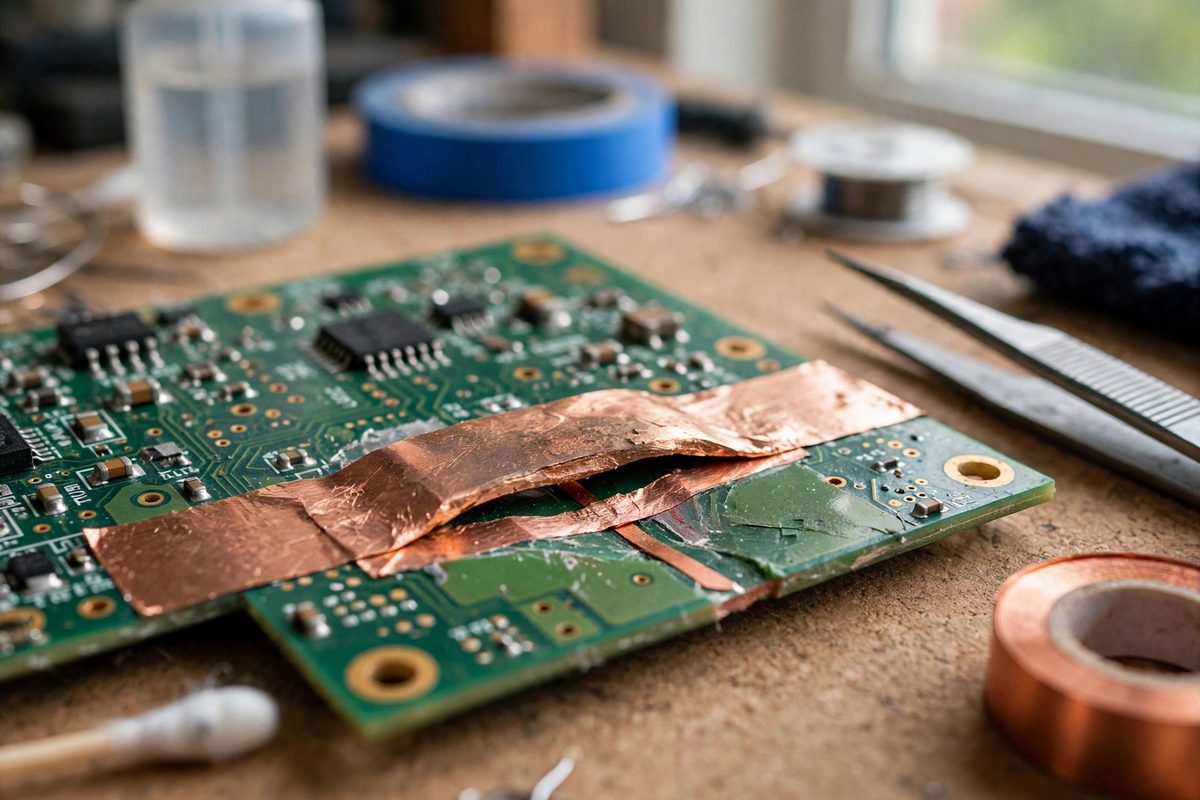
Assessing the damage first
Inspect the scrape under magnification before repairing. Determine whether the copper trace is intact, thinned, or severed, and how wide the exposed area is. An intact trace with only the mask scraped off needs just cleaning and re-masking. A thinned or severed trace needs the foil bridge. Also check for collateral damage: scrapes often come with lifted mask edges nearby and sometimes with damage to adjacent traces that is easy to miss.
Clean the area thoroughly. Remove loose mask flakes, oxidation, and any contamination with isopropyl alcohol and gentle abrasion: a fiberglass scratch brush or a fine abrasive, used lightly, prepares the copper for soldering without removing more than necessary. The foil will only bond as well as the surface it bonds to.
Sizing the foil and the overlap
Cut a strip of copper foil slightly wider than the damaged trace, wide enough to cover the scrape with margin on all sides but not so wide that it risks bridging to neighboring traces. The critical dimension is the overlap onto sound copper at each end of the damage: the foil must extend onto intact, well-adhered trace for a solid soldered lap joint on both sides of the break.
Aim for an overlap of several millimeters on each side, roughly three to five millimeters for typical signal traces. The overlap length determines the joint's mechanical strength and its current capacity: the soldered lap joint carries current through the overlap area, so a longer overlap means lower resistance and a stronger bond. On power traces carrying real current, be generous with both the foil width and the overlap length, since the repair must handle the full operating current without heating.
Soldering the bridge
Tin both the foil and the exposed trace lightly before positioning the foil; pre-tinned surfaces flow together quickly with minimal heat, which matters because prolonged heat lifts the already-weakened trace from the board. Position the foil over the damage, then solder each overlap zone with a clean, hot iron and a brief touch: the solder should wet the full overlap area, visible as a smooth fillet along the foil's edges.
Keep the iron temperature appropriate for the board and work quickly. The surrounding laminate has already survived one trauma; cooking it now causes delamination that turns a trace repair into a board repair. If the trace lifts during soldering, stop, let everything cool, and consider anchoring the repair with a small dot of epoxy at the lift point before continuing.
Restoring the insulation
Once the bridge is soldered and tested for continuity, insulate it. UV-curable solder mask, applied in a thin layer over the repair and cured, restores something close to the original protection. Epoxy or conformal coating also works where UV mask is unavailable. Whatever you use, cover the entire foil bridge plus a margin onto the surrounding original mask, sealing the edges where moisture could creep under the repair.
Do not skip this step. A bare foil bridge is a short circuit waiting for a stray wire clipping, a mounting screw, or a finger to find it, and exposed copper oxidizes steadily, degrading the repair over time. The insulation is half the repair.
Verifying the repair
Test continuity across the bridge and isolation from neighboring traces before powering the board. Then power up and check the repaired trace's function under its normal load, feeling for unexpected warmth at the repair that would indicate high resistance. A good foil bridge runs at ambient temperature and measures as a continuous conductor; anything else means the overlap joint needs rework.
Assess, clean, overlap generously, solder quickly, insulate completely, and verify under load. A foil bridge done this way is a permanent repair, not a temporary patch.
Related Guides
- Restoring Torn Trace Pads With Copper Ribbon: A torn pad, the copper circle ripped off the board along with the component, looks like a dead board. It usually is not. The trace underneath still
- Jumper Wire Loop Strain Relief Under Conformal Coat: Repair jumper wires, the fine wires bodged across a board to fix a broken trace or add a missing connection, fail at the solder joint. The wire
- Rebuilding Broken Circuit Traces With Enamel Wire: Circuit board traces break: scratched by a slipped screwdriver, lifted by overheated rework, corroded by a leaking battery, or cracked by flexing
- Micro-Jumper Bonding With Two-Part Silver Epoxy: Every repair bench eventually meets the board that cannot be soldered: a lifted pad with no copper left to wet, a trace cracked under a chip you