
Copper foil stained glass joins pieces by wrapping each edge in adhesive copper tape and soldering the foiled edges together. The foil's width determines how much copper shows as the solder line's border and how strongly the pieces bond. Hand-rolled glass, with its textured, variable-thickness surface, complicates the choice: the foil must conform to an uneven edge and still center properly. Selecting the right foil width for the glass at hand is a small decision with visible consequences in every seam.
What foil width controls
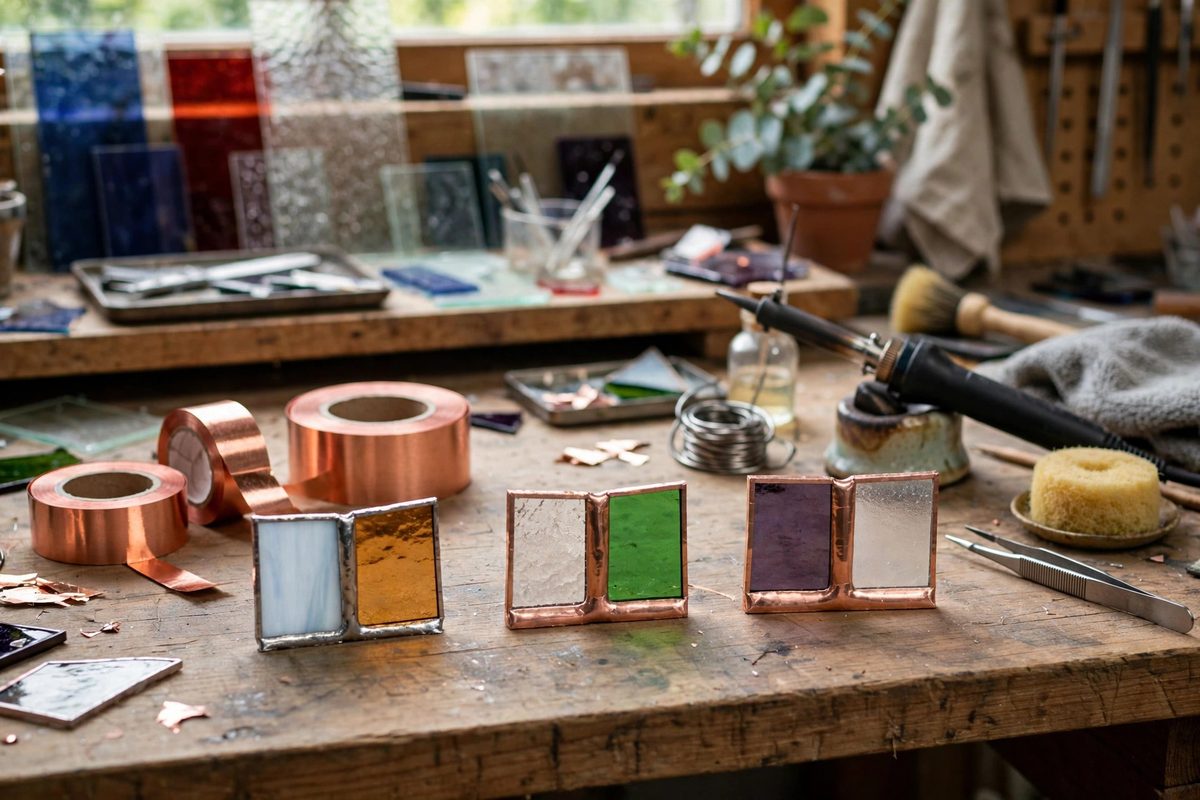
Foil width sets two things: the mechanical grip on the glass edge and the visual width of the finished solder seam. The foil wraps around the edge with roughly equal amounts on each face; wider foil means more adhesive contact on each face (stronger bond, more forgiving of irregular edges) and a wider copper border showing around each piece (a bolder seam line in the finished panel). Narrower foil gives a finer, more delicate seam but less grip and less tolerance for edge irregularity. The standard widths, 3/16 inch, 7/32 inch, and 1/4 inch, cover most work, with wider foils available for thick or sculptural glass. The choice balances aesthetics against the glass's demands: fine work in smooth glass wants narrow foil, rugged textured glass wants wider.
Matching foil to hand-rolled glass
Hand-rolled glass varies in thickness across a single piece, sometimes significantly, and its textured surface means the cut edge is rarely perfectly flat. These traits push foil selection wider than the same design in smooth machine-made glass would need. The 7/32 inch foil is the workhorse for standard hand-rolled glass: wide enough to grip the variable edge securely and to accommodate thickness changes, while still producing a reasonably refined seam. Thicker or more heavily textured glass steps up to 1/4 inch. Reserve 3/16 inch for smooth, uniform glass where a fine seam is the aesthetic goal. When a single panel mixes glass types, it is fine to use different foil widths on different pieces; the solder seams will vary slightly in width, which reads as natural variation in handcrafted work rather than inconsistency.
Centering and burnishing
Foil must be centered on the glass edge so equal amounts wrap each face; off-center foil produces a seam that is wide on one side and starved on the other, weakening the joint and looking lopsided. Apply the foil with the glass edge running down the tape's centerline, pressing it on firmly as you go. Then burnish: rub the foil down hard with a fid or a smooth tool, conforming it tightly to the edge and especially into the texture valleys of hand-rolled glass. Burnishing does three things: it activates the adhesive fully, it eliminates air pockets that would blister under the soldering iron's heat, and it shapes the foil's edge into a crisp line that solders cleanly. Skimp on burnishing and the solder will find every loose spot. Take particular care at inside curves and points, where foil wants to wrinkle; small overlaps and careful burnishing keep these areas sound.
Soldering over the foil
The foil is the substrate the solder bonds to, so its condition determines the seam quality. Solder with a hot enough iron to flow the solder smoothly along the seam in one pass; a too-cool iron drags and produces a lumpy, cold-looking bead. The solder should cover the foil completely with a slightly rounded bead; exposed copper oxidizes and looks unfinished. Keep the iron moving to avoid overheating the adhesive, which fails and lets the foil lift, especially on the textured edges of hand-rolled glass where adhesion is already challenged. After soldering, clean the panel thoroughly to remove flux, which corrodes the solder and foil if left in place. A well-foiled and soldered seam on hand-rolled glass is strong, weathertight, and visually consistent with the glass's handmade character.
Safety with lead and glass
Stained glass work involves lead solder and sharp glass, both demanding respect. Ventilate the soldering area; solder fumes and flux smoke should not be breathed steadily. Wash hands thoroughly after handling solder and before eating, and keep food and drink out of the work area. Handle cut glass with care, wearing eye protection when cutting and grinding; glass splinters are a constant minor hazard that occasional inattention turns major. Store lead solder away from children and pets. These precautions are routine in the craft, and observing them keeps a beautiful art form safe.
Choose the foil width for the glass's thickness and texture, center it, burnish it hard, and solder it clean. The foil is the hidden structure of every seam; select it deliberately and the panel holds together beautifully for generations.
Related Guides
- Flux Residue Neutralization on Stained Glass: Flux makes solder flow, and flux residue makes solder joints corrode. The same chemistry that cleans metal oxides during soldering keeps working
- Reinforced Zinc Came Framing for Large Stained Windows: Large stained glass windows carry real weight, and the zinc came framework that holds the glass must be engineered, not just assembled. Unreinforced
- Lead Came Flange Burnishing for Weatherproof Panels: A stained glass panel's weatherproofing lives in the lead came: the flanges must lie tight against the glass on both faces, with no gaps for water to