
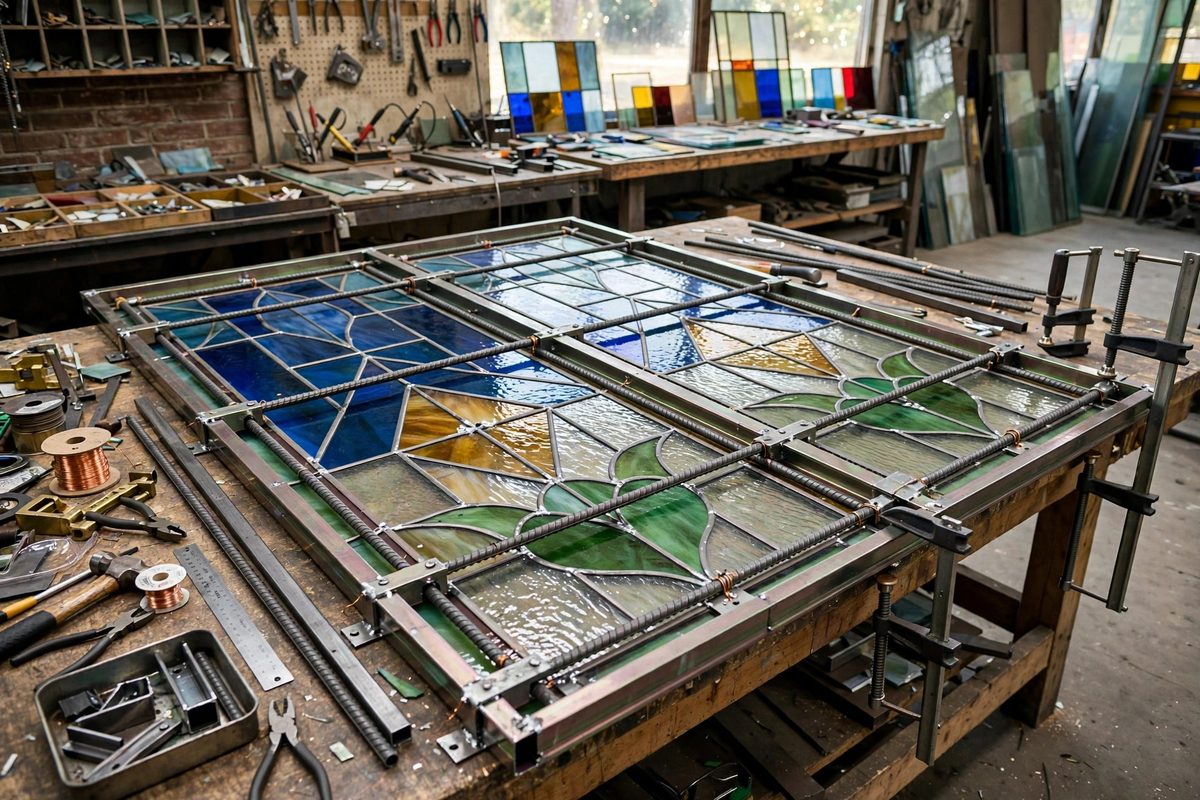
Large stained glass windows carry real weight, and the zinc came framework that holds the glass must be engineered, not just assembled. Unreinforced zinc came is fine for small panels, but a big window needs steel reinforcement integrated into the came channels to resist wind load and the slow creep of gravity. Building that reinforcement in correctly is structural craft that keeps the window true for generations.
Why Large Windows Need Reinforcement
A stained glass window is a heavy, flexible assembly: pounds of glass held in soft metal channels. Under its own weight, an unreinforced panel slowly sags; under wind pressure, it flexes in and out. Zinc came, while stiffer than lead, still bends under sustained load, and solder joints fatigue with repeated flexing. The result of inadequate structure is familiar to anyone who has seen an old window: bowed panels, cracked glass at the stress points, and solder joints pulling apart. Reinforcement, typically steel bars fitted into the zinc came channels and tied into the window's support system, gives the panel the stiffness to resist these loads. The reinforcement does not show; it hides inside the came, doing its work invisibly.
Designing the Reinforcement Layout
Plan the reinforcement before cutting any glass. The steel bars should run vertically in most windows, following the direction of gravity load, and tie into horizontal support bars (saddle bars) that span to the window frame. Space the vertical reinforcements according to the panel's size and the glass weight; a common approach places them every couple of feet, aligned with the came lines so they disappear into the design. The bars must be sized to the came channel: they fit inside the zinc came's heart (the central channel) without distorting it. Draw the full layout, reinforcement and all, on the cartoon so every piece of glass is cut to accommodate the bars from the start; retrofitting reinforcement into a finished panel is far harder.
Fitting Steel Into Zinc Came
Use flat steel bars, often called reinforcing bars or muntin bars, sized to slide into the zinc came channel. Cut them to length so they run the full height of the reinforced section, and flatten or notch the ends where they meet horizontal members. The bars sit inside the came before the glass is inserted, or are threaded through afterward in straight runs. Solder the came joints as usual; the steel inside does not get soldered to the zinc along its length, since the two metals expand differently and the bar must be free to work independently. At the ends, the bars tie into the frame or into soldered attachment points. Keep the steel clean and dry during assembly; rust inside the came is a future failure, so some builders prime the bars before installation.
Tying Into the Window Frame
Reinforcement only works if its loads have somewhere to go. The vertical bars must connect to the window's perimeter frame or to horizontal saddle bars that are themselves anchored to the building. Saddle bars, the horizontal steel bars across the window face, are the traditional load path: the panel is tied to the saddle bars with copper wire twists soldered to the came joints, and the saddle bars bear on the frame. Space saddle bars according to the panel size and exposure; large or windy installations need them closer together. The tie wires should be firm but not drum-tight, allowing for thermal movement. A reinforced panel floating unattached inside its frame is barely better than an unreinforced one; the connections complete the structure.
Long-Term Behavior and Maintenance
A properly reinforced window is stable for many decades, but it still deserves periodic inspection. Check for cracked glass near reinforcement lines, which signals movement or a bar bearing where it should not. Look for solder joint fatigue, bowing between supports, and corrosion of the steel, which shows as rust staining at the came lines. Re-tighten or replace tie wires that have loosened, and address any water infiltration at the frame, since trapped moisture corrodes both steel and came. Document the reinforcement layout for future restorers; the next person to work on the window will bless you for a drawing showing where the steel hides.
Reinforced zinc came framing treats a large stained window as the structure it is: steel bars in the came channels, tied through saddle bars to the frame, planned from the cartoon stage. The glass gets the admiration; the hidden steel earns it.
Related Guides
- Lead Came Flange Burnishing for Weatherproof Panels: A stained glass panel's weatherproofing lives in the lead came: the flanges must lie tight against the glass on both faces, with no gaps for water to
- Flux Residue Neutralization on Stained Glass: Flux makes solder flow, and flux residue makes solder joints corrode. The same chemistry that cleans metal oxides during soldering keeps working
- Copper Foil Width Selection for Hand Rolled Glass: Copper foil stained glass joins pieces by wrapping each edge in adhesive copper tape and soldering the foiled edges together. The foil's width