
Copperplate's elegance comes from its dramatic slant, traditionally 55 degrees from the baseline, and the script falls apart when that angle wanders. A page where some letters lean at 50 degrees and others at 60 looks restless and amateur, no matter how beautiful the individual shades. Holding 55 degrees consistently is a trainable skill built on guidelines and muscle memory.
Why 55 Degrees
The 55-degree slant is not arbitrary. It is steep enough to give copperplate its distinctive forward energy and to let the shaded downstrokes show their full swelling, but not so steep that the letters collapse into illegibility. At this angle, the oval-based letterforms of copperplate sit naturally: the main slant defines the axis of the ovals, and the connective strokes flow along it. Shallower slants make the script look upright and stiff, losing the copperplate character; steeper slants crowd the letters and tangle the loops. The tradition settled on 55 degrees because generations of writing masters found it the most beautiful and functional compromise. Honor it as a starting point, and understand it before varying it.
Setting Up Slant Guidelines
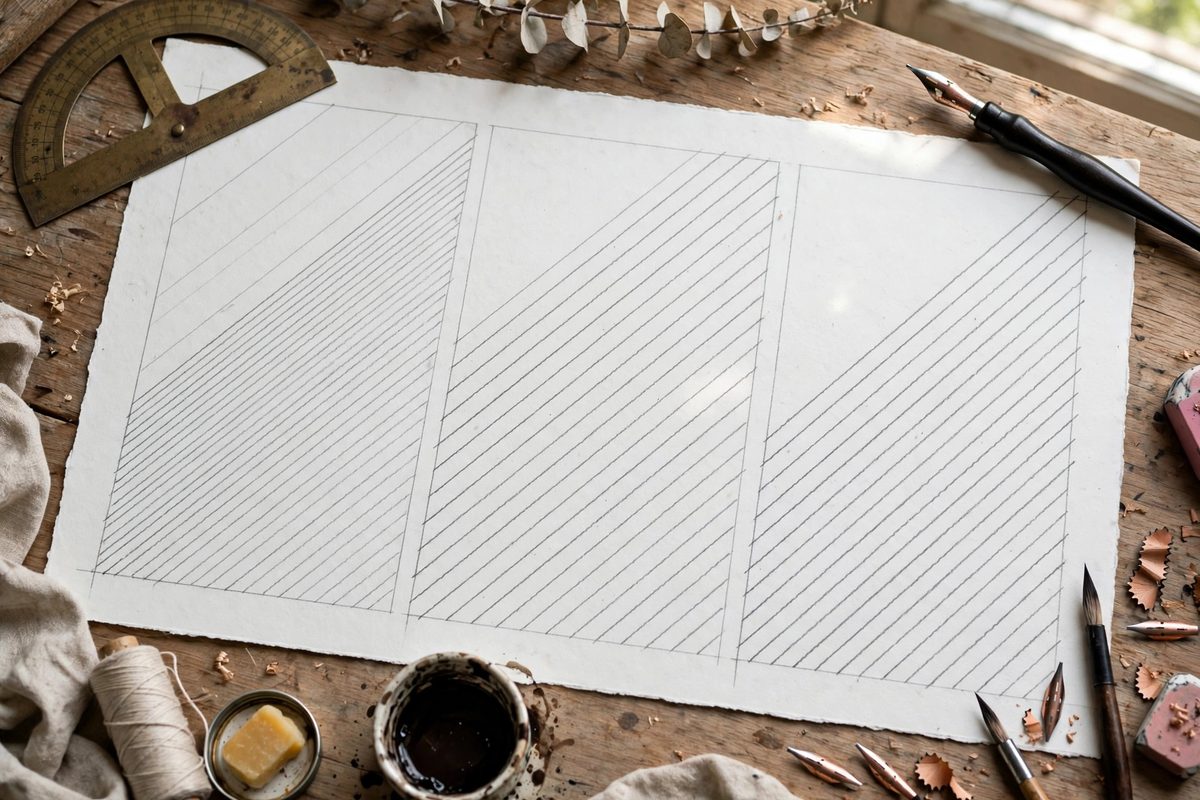
Rule slant lines on every practice sheet and every finished piece. Use a protractor or a printed slant guide to draw lines at exactly 55 degrees across the writing area, spaced about an inch apart. These lines are the non-negotiable reference: every downstroke should parallel them. Many beginners resist guidelines as a crutch, but professionals use them on finished work; the guideline is not a beginner's aid, it is the tool that makes consistency possible. For finished pieces, rule the slant lines lightly in pencil and erase after the ink dries, or write on a guide sheet placed under translucent paper. Check the angle periodically with a protractor during long sessions, since guidelines can be misruled and eyes adapt to error.
Training the Hand
Consistency lives in the arm, not the fingers. Copperplate is written with the whole forearm moving, the hand gliding across the paper, which naturally produces straighter, more consistent slants than finger-writing. Drill the basic strokes, the straight downstroke and the oval, against the slant lines until the 55-degree angle feels like home. A productive drill is to fill pages with parallel downstrokes, checking each against the guidelines; when every stroke parallels the lines without conscious correction, the muscle memory is forming. Pay special attention to the transitions: the slant often shifts where a downstroke curves into an upstroke, and at the tops and bottoms of loops. Slow down at those points until the angle holds through the curve.
Diagnosing Slant Drift
Slant errors have patterns. A gradual steepening across a line means the hand is rotating as it moves, usually from writing with the fingers instead of the arm; reset the arm position. Random variation means the guidelines are being ignored; slow down and check each stroke. A consistent error, every stroke at 50 degrees instead of 55, means the internalized angle is wrong; go back to drills with the protractor until the correct angle is relearned. Fatigue degrades slant before it degrades anything else, so the last line of a long session is the diagnostic: if it matches the first line, the training is working. Photograph practice pages and check the slant digitally; the camera is an unforgiving and useful critic.
Slant in Finished Work
On a finished piece, slant consistency is what the viewer feels as elegance without being able to name it. Keep the guidelines until the ink is dry, then remove them cleanly. Check the whole piece at arm's length: the slant should read as a single unified angle, like corduroy, with no individual letter drawing attention. If a word went wrong, rewrite the word; patching single letters at a different slant is always visible. The discipline of 55 degrees is not rigidity for its own sake; it is the framework that lets the shades, loops, and flourishes play freely without the page dissolving into chaos.
Rule 55-degree slant lines, write with the arm, drill until the angle is automatic, and diagnose drift by its pattern. Slant consistency is the invisible structure of copperplate; everything beautiful in the script hangs on it.
Related Guides
- Flourishing Descender Loops in Copperplate Scripts: Copperplate descender loops are where a page either looks elegant or looks busy, and the difference is discipline. The long-tailed letters (g, j, y
- Balancing Ascender Loops in Modern Script Fonts: Modern pointed-pen script seduces with its flourishes, but its elegance actually rests on discipline: the consistent, balanced loops of its
- Flourish Oval Proportions for Envelope Headers: The envelope header, the name written large across the front, is modern calligraphy's stage, and flourishing is its choreography. The oval is the