
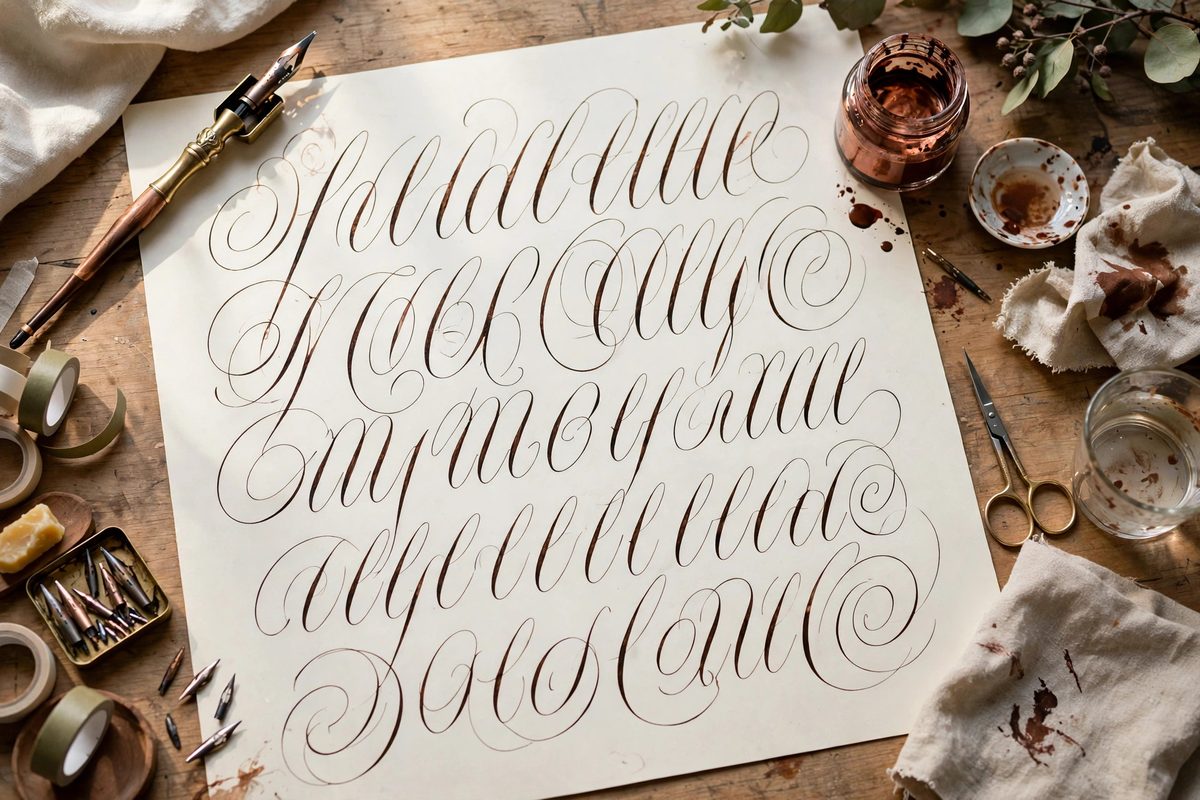
Copperplate descender loops are where a page either looks elegant or looks busy, and the difference is discipline. The long-tailed letters (g, j, y, and their relatives) offer a natural canvas for flourishing, but every extra curve is a promise to the eye that the rest of the page will keep. Done well, a flourished descender adds movement and air to a word; done carelessly, it tangles with neighboring letters and turns handwriting into decoration at the expense of readability.
What a descender loop is actually doing
Strip away the aesthetics and a descender loop has a job: it carries the stroke below the baseline, reverses direction smoothly, and returns to the baseline (or the next letter) without breaking rhythm. The loop itself is two strokes, a shaded downstroke and a thin upstroke, mirroring the main slant of the hand. A flourish is simply an extension of that return: instead of coming straight back up, the upstroke travels further, curves, and resolves into a decorative sweep.
This matters because the flourish is part of the stroke, not an addition to it. The best flourished descenders are drawn in one continuous motion. If you lift the pen to add a flourish after the fact, the join almost always shows, and the loop reads as decorated rather than designed.
Keeping the main slant through the flourish
Copperplate lives on a consistent slant, traditionally around 52 to 55 degrees off the baseline. The shaded downstroke of a descender follows that slant, and the return stroke mirrors it. The flourish should respect the same geometry: sweeping curves look best when their major axis stays aligned with the hand's slant, because the eye has already learned to read curves in that direction.
Where beginners go wrong is letting the flourish follow the hand's natural wrist arc instead of the pen's slant. The wrist wants to sweep horizontally; the script wants diagonals. Anchor your forearm and let the fingers and the hand's lateral motion drive the curve, and the flourish will land in the same family as the letters it extends.
Spacing: the invisible structure
A flourished descender loop occupies vertical space below the baseline and horizontal space to one side. That space is borrowed from the line below and the letters beside it. Before flourishing, check the line spacing on the page: a generous flourish needs clear air underneath, at least the full depth of the loop, or it will collide with the line below. On ruled practice sheets this is easy to ignore and then painful to unlearn, so practice on the same spacing you intend to write at.
Horizontally, the flourish should travel into whitespace, not into the next word. Copperplate already spaces words generously compared to most scripts, and that gap is the natural destination for a rightward sweep. If the next word starts before the flourish can resolve, shorten the flourish rather than cramming it in. A small confident curve beats a large apologetic one.
Pressure control through the curve
The shaded downstroke of a descender loop carries the heaviest pressure in the letter, and the transition from that pressure into the thin return stroke is where the nib is most vulnerable. As the stroke rounds the bottom of the loop, pressure has to ease off smoothly; a sudden release snaps the nib up and leaves a blob or a scratch at the turn. Think of the pressure as following the curve: maximum on the straight shaded portion, tapering as the stroke bends, gone by the time it starts climbing.
This same tapering logic governs the flourish. The decorative sweep should be a consistent thin stroke. Any accidental shading in the flourish reads as a mistake, because the eye expects the shade only on the main downstroke. If your flourishes keep picking up weight, lighten the overall grip pressure and let the nib glide rather than press.
When restraint is the flourish
Not every descender needs to flourish, and a page where all of them do is exhausting to look at. The traditional approach reserves flourishing for specific positions: the final letter of a word, the last line of a verse, a capital at the start of a sentence. A single flourished descender on an otherwise restrained page draws the eye exactly where you want it. Five of them compete with each other and with the text.
This is the hardest part of the skill to practice, because it is a judgment call rather than a technique. Study engraved exemplars and notice how rarely the great penmen flourished mid-line. The flourish was punctuation, not filler. Adopt that discipline and your flourished descenders will look like decisions rather than habits.
Build the loop first, add the flourish second, and always ask whether the page needs it. When the answer is yes, one continuous stroke, on the slant, into open space, with the pressure easing before the curve. That is the whole craft.
Related Guides
- Copperplate Slant Angle Consistency at 55 Deg: Copperplate's elegance comes from its dramatic slant, traditionally 55 degrees from the baseline, and the script falls apart when that angle wanders
- Balancing Ascender Loops in Modern Script Fonts: Modern pointed-pen script seduces with its flourishes, but its elegance actually rests on discipline: the consistent, balanced loops of its
- Flourish Oval Proportions for Envelope Headers: The envelope header, the name written large across the front, is modern calligraphy's stage, and flourishing is its choreography. The oval is the