
A dado stack that wobbles cuts a dado wider than intended, with ragged shoulders and a bottom that is not flat. The wobble often comes not from a bad blade but from tiny imperfections in how the stack seats on the arbor, and precision ground shims are the fix. Eliminating the wobble turns a frustrating dado set into a precision joinery tool.
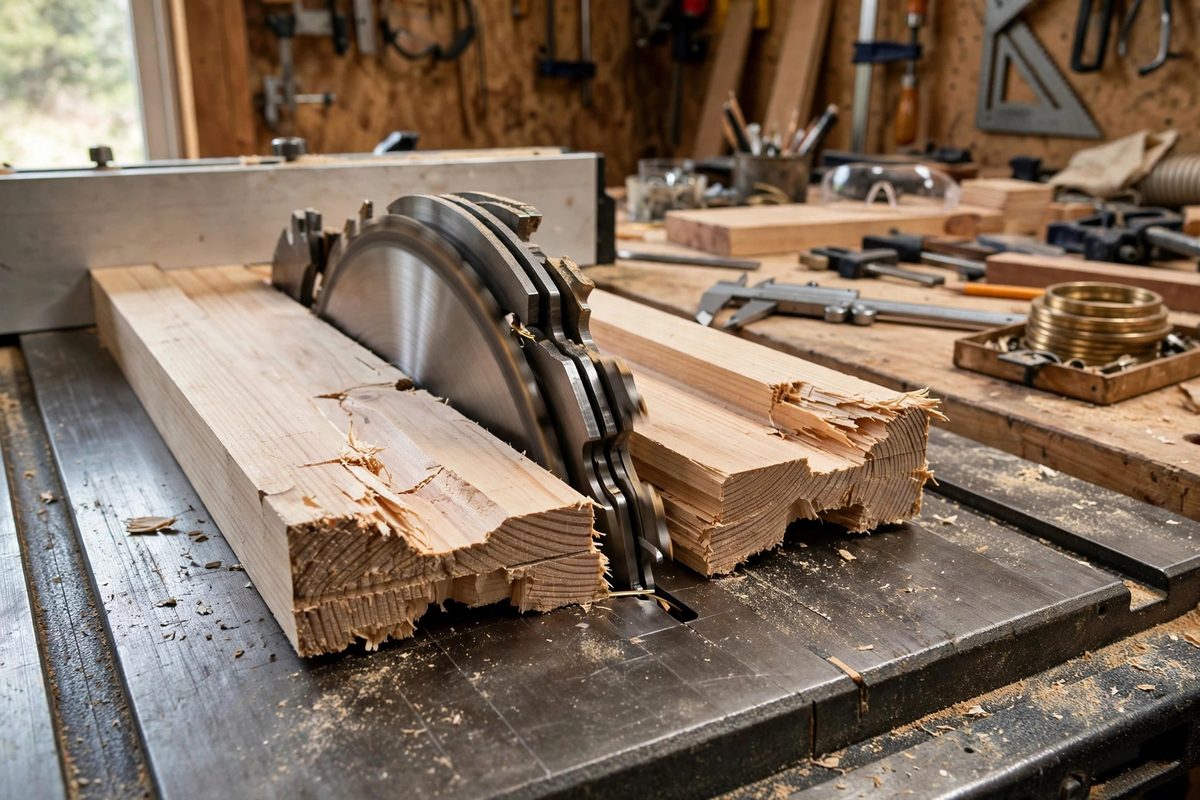
Where Wobble Comes From
The dado stack is a sandwich of blades and chippers clamped on the arbor, and any lack of flatness or parallelism in that sandwich shows up as wobble at the rim. Common causes include a chipper with a slightly dished face, debris between the plates, a burr on the arbor flange, or the stack clamped with uneven pressure. The wobble amplifies with diameter: a thousandth of tilt at the arbor becomes several thousandths at the rim, which is exactly where the cut happens. Diagnosing means finding which element in the stack is not seating flat, not just tightening the nut harder.
Inspecting the Stack
Disassemble the stack completely and inspect every mating surface. Look for sawdust packed between plates, pitch buildup, small dents, and burrs around the arbor holes. Clean everything thoroughly; contamination between plates is the most common wobble source and the easiest to fix. Check each plate for flatness on a known-flat surface, rocking it to feel for dish or warp. Check the arbor flange and the nut's washer face for burrs or damage. Reassemble carefully, seating each element fully before adding the next, and the wobble often disappears with cleaning alone.
Using Ground Shims
When cleaning is not enough, precision ground shims correct the remaining tilt. These thin, flat washers come in precise thicknesses and are placed between stack elements to compensate for the measured wobble. The technique: mount the stack, indicate the wobble with a dial indicator on the outermost blade, note where the high spot is, then place a shim on the opposite side of the stack to tilt it back true. This is iterative; add the thinnest shim that corrects, recheck, and adjust. The shims live with the dado set, marked for their positions, because the correction is specific to that stack's particular imperfections.
Arbor and Flange Condition
No shimming fixes a damaged arbor. Check the arbor for runout with an indicator; a bent arbor wobbles everything mounted on it and needs professional attention or replacement. The flange face must be clean, flat, and perpendicular to the arbor axis; a flange with a ding or a buildup of pitch tilts the whole stack. Some saws benefit from a dedicated precision flange for dado work, since the stock flange was made for single blades. The stack can only be as true as what it mounts on.
Verifying the Cut
After shimming, make test cuts in scrap and measure the dado width at multiple points along its length and at both shoulders. A wobble-free stack cuts a dado of consistent width with clean square shoulders and a flat bottom. Check the width against the intended shelf or tenon stock; the dado should fit with the right friction, not sloppy and not forced. Keep the shim arrangement recorded with the dado set so the next setup starts true. A tuned dado stack is one of the great pleasures of the shop: set it, cut it, and the joint just fits.
Clean the stack, inspect every surface, shim the residual tilt with ground shims, verify the arbor, and prove it in scrap. The wobble disappears and the dado cuts exactly the width the stack promises.
Related Guides
- Build a Table Saw Crosscut Sled: Why Every Woodworker Needs a Crosscut Sled A crosscut sled is one of the most valuable jigs you can build for your table saw. Think of it as a
- Maintaining Traditional Wooden Bench Clamps: The wooden bench clamp, whether a leg vise with its massive wooden screw, a shoulder vise, or a traditional hand screw, is one of the oldest
- Tuning Box Joint Finger Spacing on Table Saws: Box joints, the square-fingered cousins of dovetails, are cut on the table saw with a jig and a dado stack, and their quality lives entirely in the
- Scraping and Truing Traditional Wooden Hand Screws: The wooden hand screw, the classic parallel-jaw clamp with two wooden screws, is one of the most useful clamps ever designed, and vintage ones often