
Driftwood arrives at the beach carrying the ocean inside it. Years of soaking in salt water load the wood's pores with salt crystals, and that salt keeps working long after the wood dries: it draws moisture from the air, blooms white on the surface, corrodes any metal hardware, and interferes with finishes. A driftwood sculpture built from un-desalinated wood will weep, stain, and shed its finish. Soaking baths that draw the salt back out are the unglamorous prep work that makes the difference between a sculpture that lasts and one that slowly self-destructs.
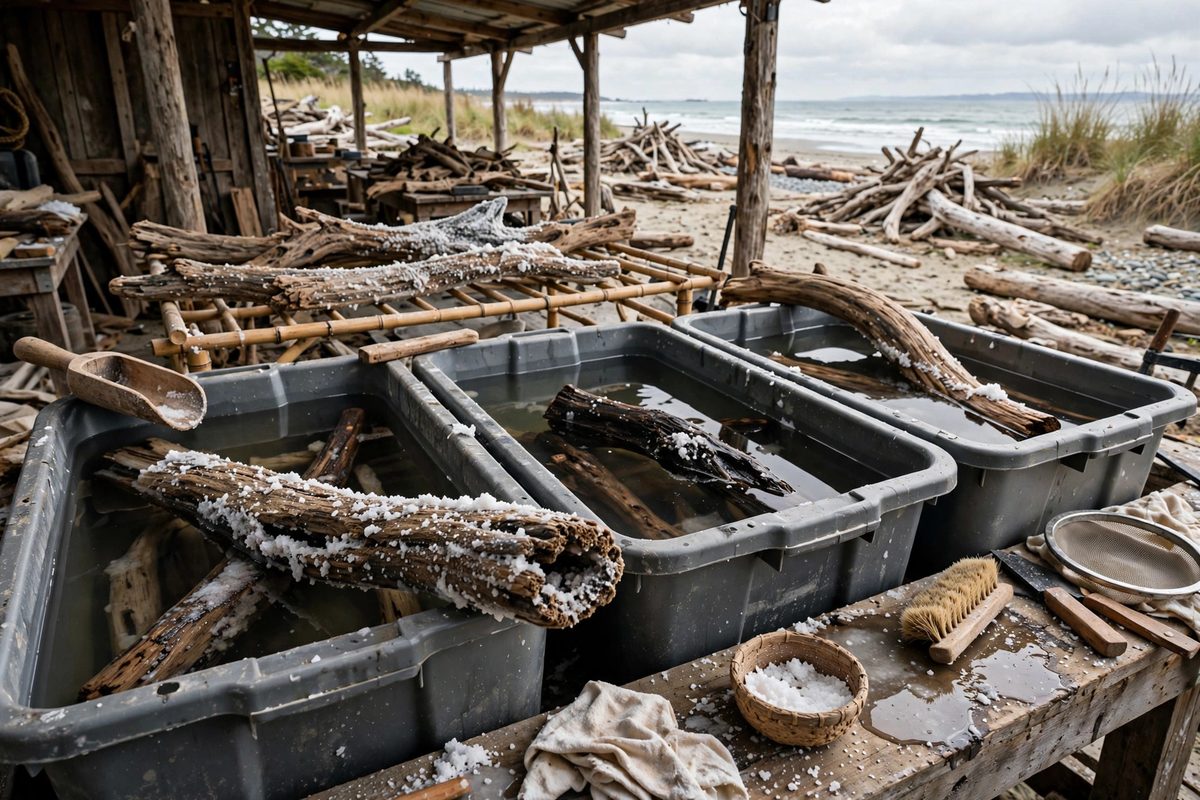
Why salt is the enemy of the finished piece
Salt in wood is hygroscopic: it pulls water vapor out of humid air and holds it in the wood, so salt-laden driftwood never truly dries in a humid climate and cycles between damp and dry with the weather. Each cycle moves salt to the surface, where it crystallizes as a white efflorescence that pushes off paint, oil, and varnish from underneath. The salt also attacks metal directly; screws, wires, and armatures embedded in salty wood corrode far faster than they would in fresh wood, and the corrosion products stain the surrounding wood with rust marks that cannot be sanded out without carving away material. Even without hardware, salt crystals expanding and contracting in the pores slowly break down the wood surface. Desalination removes the root cause instead of fighting the symptoms.
Setting up the soaking bath
The bath is simple: a container large enough to fully submerge the wood, filled with fresh water. A stock tank, a plastic drum, or a lined wooden trough all work; size it to the largest piece you plan to process. Fully submerge each piece, weighting it down if it floats, because any wood above the waterline keeps its salt. Change the water regularly: as salt diffuses out of the wood, the bath water grows salty, and diffusion slows as the concentration gradient shrinks. Fresh water restores the gradient and keeps the salt moving out. Warm water speeds diffusion noticeably, but avoid hot water, which can crack the wood or raise the grain aggressively. For large pieces, a long, slow soak beats any shortcut; there is no safe way to rush salt out of deep wood.
How long to soak
Soaking time scales with the wood's thickness and salt load, so treat any schedule as a starting point. Small pieces, an inch or two thick, often desalinate adequately in about a week of soaking with regular water changes. Medium pieces of several inches may need two to four weeks. Large, dense pieces can take a month or more. The honest way to judge progress is to test the bath water: as long as each fresh fill picks up noticeable salt, the wood is still giving it up. Some makers test with a simple taste of the water or a low-cost salinity meter; either works, since you are watching the trend toward zero, not chasing an absolute number. When several consecutive water changes stay essentially fresh, the wood is done. Rushing this step is the most common failure in driftwood prep, because the wood looks ready long before it is.
Drying slowly after the bath
Freshly soaked wood is saturated and must be dried carefully, or the desalination effort ends in cracked sculpture stock. Dry slowly in shade with good air circulation, never in direct sun or with forced heat, which dries the surface faster than the core and causes checking. Elevate pieces on stickers so air reaches all sides, and expect drying to take weeks for substantial pieces. Sealing the end grain with wax or a commercial end sealer slows moisture loss from the ends, which dry fastest and check first. The wood is ready to work when its weight stabilizes and a moisture meter, if you have one, reads in equilibrium with your shop's climate. Patience here is structural: a sculpture carved from wood that is still drying will move, crack, and open joints as it finishes drying in the finished piece.
Working desalinated wood
Once desalinated and dried, driftwood behaves like any fine, weathered wood: stable, receptive to finish, and kind to tools and hardware. Seal pieces that will live outdoors or in humid spaces, since even desalinated wood can reabsorb some salt from sea air over time in coastal locations. Choose stainless or bronze hardware for any structural connections as cheap insurance. The reward for the weeks of soaking and drying is a material with unmatched character, silvered grain and sculptural form shaped by the ocean, that now behaves itself in the studio. That transformation, from beach find to reliable sculpture stock, is entirely the work of the soaking bath.
Submerge fully, change the water often, wait until the salt stops coming out, and dry slowly in the shade. Desalination is slow, but it is the foundation every lasting driftwood sculpture stands on.
Related Guides
- Vacuum Pressure Infusion of Resin Into Dry Driftwood: Driftwood is beautiful and fragile. Years of water and weather leave it riddled with checks, soft pockets, and hidden voids that crumble under a
- Acetone Dehydration Baths for Weathered Root Woodwork: Weathered root wood, the gnarled, sculptural pieces pulled from riverbanks and old stumps, arrives saturated with water and full of hidden decay
- Stabilizing Punky Wood With Low-Viscosity Resins: Punky wood, the soft, spongy, partially decayed wood found in driftwood and old logs, has extraordinary character: feathered grain, hollows, colors
- Stabilizing Punky Root Wood With Deep Vacuum Resins: Root wood and burls have the wildest grain in the forest, and they are often punky: partially decayed, soft, crumbly, beautiful, and structurally