
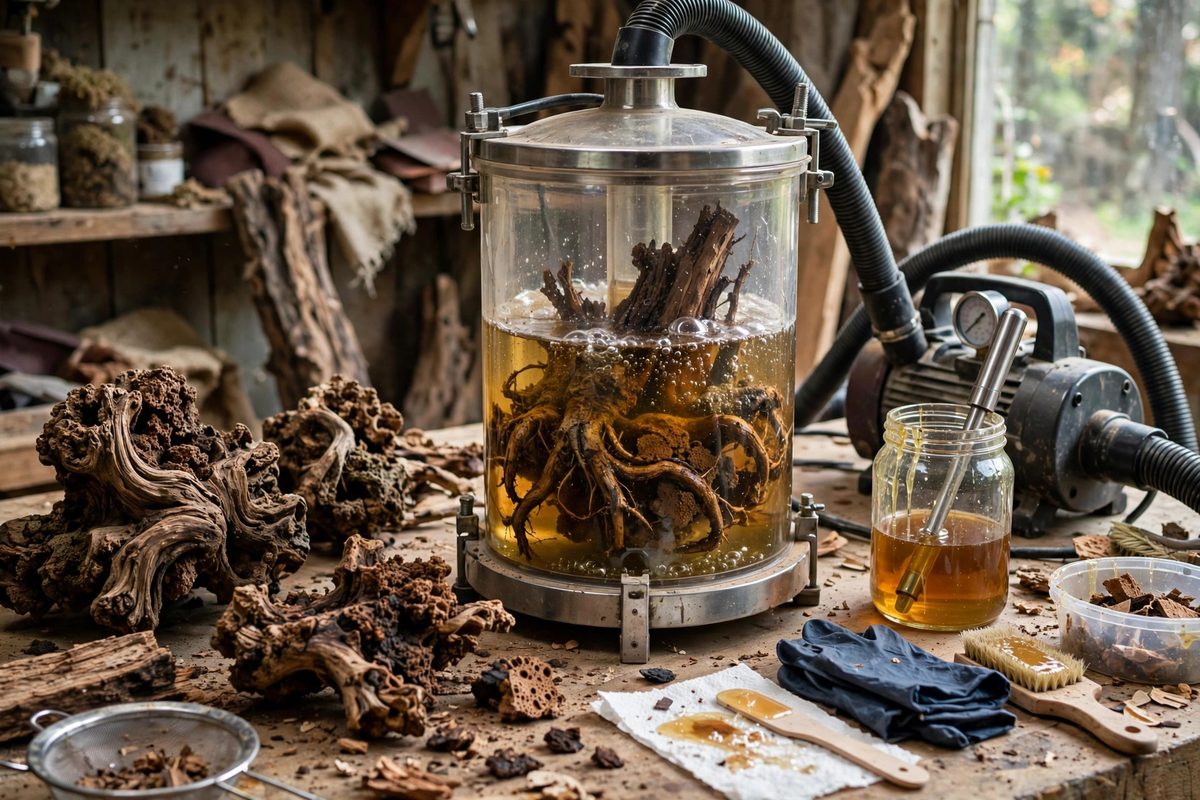
Root wood and burls have the wildest grain in the forest, and they are often punky: partially decayed, soft, crumbly, beautiful, and structurally useless. Stabilizing soaks the punky fibers in resin under vacuum, filling the voids and locking the fibers in place, so the piece can be cut, carved, and polished like solid wood. The vacuum part is what makes it deep: without it, resin only coats the surface and the punky core keeps crumbling.
Why Vacuum Does What Brushing Cannot
Punky wood is full of air: collapsed cells, fungal voids, and micro-checks. Brush-on resin seals the surface and traps that air inside, so the piece looks solid until you cut into it and find powder. Under vacuum, the air is pulled out of the voids first; when the vacuum is released, atmospheric pressure drives the liquid resin deep into the evacuated spaces. The deeper the vacuum and the longer the soak, the deeper the penetration. For thick root sections, this is the only route to a fully stabilized piece.
Choosing the Resin
Thin, low-viscosity stabilizing resins (heat-cured acrylics are the standard) penetrate far better than thick epoxies. The resin must be thin enough to wick into the wood's capillary structure, which means avoiding anything marketed as gap-filling or structural unless it is specifically formulated for stabilization. Heat-cured resins stay liquid at room temperature for long soaks and then cure hard in an oven, which is ideal: you get unlimited working time followed by a fast, complete cure. Whatever resin you choose, verify that it cures fully in the presence of wood moisture and residual fungal material, since punky stock is never perfectly dry or clean.
The Vacuum Process Step by Step
Dry the wood first, as dry as you can get it; water in the cells blocks resin entry. Submerge the piece fully in resin inside a vacuum chamber, weighting it down so it cannot float. Pull vacuum and watch the wood fizz as air escapes; keep the vacuum on until the bubbling substantially stops, which can take hours for thick root sections. Release the vacuum and let the piece soak at atmospheric pressure for at least as long as the vacuum cycle, so the pressure differential drives resin into the deepest voids. Then remove the piece, wipe off the excess, wrap it to prevent dripping, and cure per the resin's schedule.
Chamber and Safety Setup
A vacuum chamber for stabilizing needs to be resin-safe (many resins attack cheap plastics), large enough to submerge your biggest piece, and rated for full vacuum. Use a real vacuum pump, not a venturi or a converted compressor, because deep, sustained vacuum is the whole point. Work with ventilation and gloves: stabilizing resins are skin sensitizers and the uncured material should never touch bare skin. Cure in a dedicated toaster oven or similar, never the kitchen oven, because resin fumes during curing are not food-safe.
Assessing Penetration
After curing, cut a test slice from an inconspicuous area or a cutoff end and inspect the cross-section. Fully stabilized wood shows even resin coloration through the full thickness; a dry, pale core means the vacuum cycle was too short or the resin too thick. Weigh the piece before and after stabilizing: a healthy weight gain (often 30 percent or more for very punky stock) confirms deep uptake. If penetration is shallow, re-soak with a longer vacuum cycle rather than accepting a half-stabilized piece that will crumble at the first carving cut.
Working Stabilized Root Wood
Properly stabilized punky wood machines beautifully: it turns, carves, and sands without tear-out, and it takes a polish that rivals dense hardwoods. But it is harder and more abrasive than natural wood, so expect faster tool wear and use sharp edges. The resin dust is a respiratory irritant, so wear a respirator during sanding and collect the dust. Finish with oils or lacquers as you would any dense wood; the stabilized surface takes finish evenly because the resin has already filled the grain.
Deep vacuum stabilization rescues wood that would otherwise be firewood, turning punky root sections into carveable, polishable material. Dry it, vacuum it long, soak it longer, cure it properly, and verify the penetration; the wild grain was always worth saving.
Related Guides
- Stabilizing Punky Wood With Low-Viscosity Resins: Punky wood, the soft, spongy, partially decayed wood found in driftwood and old logs, has extraordinary character: feathered grain, hollows, colors
- Vacuum Pressure Infusion of Resin Into Dry Driftwood: Driftwood is beautiful and fragile. Years of water and weather leave it riddled with checks, soft pockets, and hidden voids that crumble under a
- Acetone Dehydration Baths for Weathered Root Woodwork: Weathered root wood, the gnarled, sculptural pieces pulled from riverbanks and old stumps, arrives saturated with water and full of hidden decay
- Desalination Soaking Baths for Driftwood Sculpture: Driftwood arrives at the beach carrying the ocean inside it. Years of soaking in salt water load the wood's pores with salt crystals, and that salt