
Driftwood is beautiful and fragile. Years of water and weather leave it riddled with checks, soft pockets, and hidden voids that crumble under a chisel. Vacuum pressure infusion drives stabilizing resin deep into the wood's structure, turning a crumbly beach find into carvable stock. The technique borrows from wood stabilization for knife handles and pen blanks, scaled up for the irregular shapes driftwood arrives in.
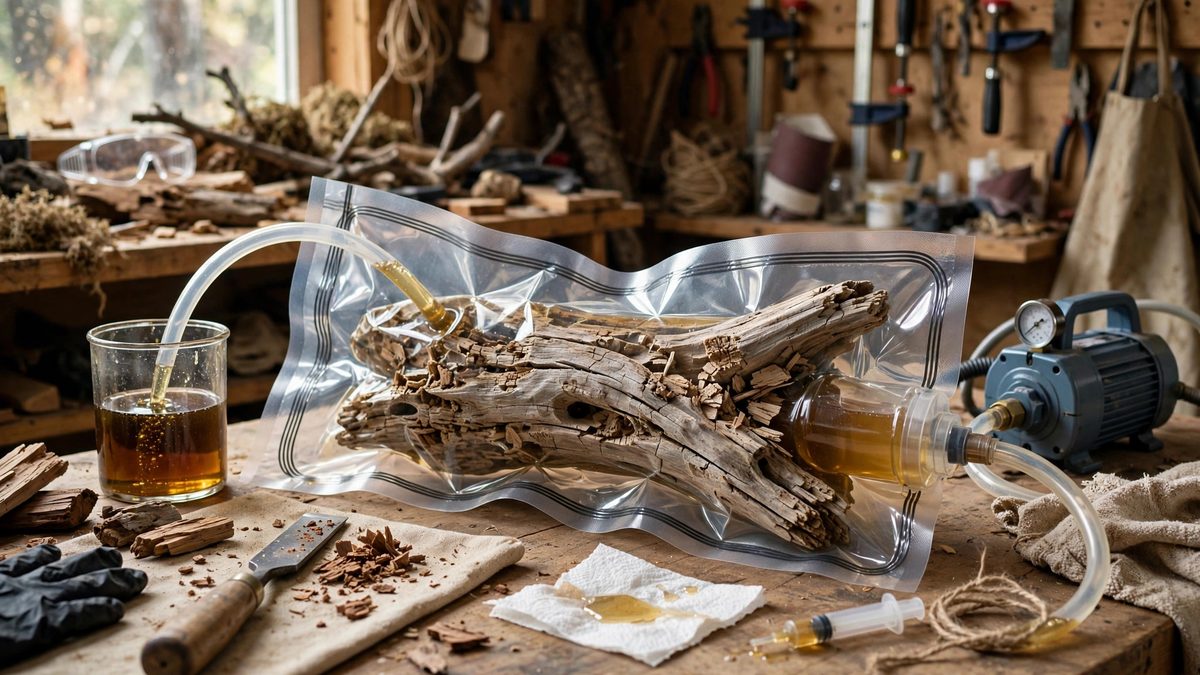
Preparing the Driftwood
Infusion only works on dry wood. Wet or even damp driftwood resists resin because water occupies the same pores the resin needs to fill, and trapped moisture can interfere with curing. Dry the piece thoroughly, which for thick driftwood can take weeks in a warm dry spot. Weigh it at the start and again every few days; when the weight stops dropping, it is ready. Clean off salt, sand, and loose bark first, since salt residue can draw moisture back in later and loose material blocks resin entry. A dry, clean piece absorbs resin like a sponge; a damp one just makes a mess.
Choosing the Resin
Thin, low-viscosity stabilizing resins penetrate deeper than standard casting resins. Heat-cured stabilizing resins designed for wood turn the fibers themselves hard without filling every void with glassy plastic, which keeps the carve feeling like wood rather than acrylic. For large voids and cracks you plan to fill visibly, a separate casting resin applied afterward handles the gaps while the stabilizing resin handles the structure. Match the resin's cure requirements to your equipment: heat-cured resins need an oven cycle, while room-temperature cure resins trade some penetration for convenience.
The Vacuum Stage
Submerge the driftwood in resin inside a vacuum chamber and pull vacuum. As pressure drops, air bubbles stream out of the wood's pores and cracks, which you can watch happening. Hold the vacuum until the bubbling slows dramatically, which signals that most of the trapped air has left and resin has taken its place. Rushing this stage leaves air pockets that become soft spots in the finished piece. The chamber must be large enough that the resin covers the wood completely with room to spare, because resin that does not cover the wood cannot infuse it.
The Pressure Stage
After releasing the vacuum, many makers follow with a pressure stage: the resin-soaked wood goes into a pressure vessel at moderate pressure, which forces resin deeper into dense grain and tight checks that vacuum alone could not reach. The combination of vacuum pulling air out and pressure pushing resin in produces far more complete penetration than either stage alone. Soak times under pressure run from hours to a full day for dense pieces. Patience here pays directly in how far the resin travels into the wood.
Curing and Working the Stabilized Piece
Cure according to the resin maker's schedule, completely. Under-cured resin stays gummy, dulls tools, and can weep in warm weather. After curing, the driftwood machines and carves like dense hardwood: sharp tools, light passes, and respect for the fact that stabilized wood is abrasive and wears edges faster than natural wood. Dust from stabilized wood contains cured resin particles, so wear a respirator when sanding or carving; the stabilization did not make the dust safe to breathe. Finish as you would any dense wood, knowing the piece will not move, check, or crumble the way raw driftwood would.
Vacuum pressure infusion is the bridge between driftwood's weathered beauty and a maker's need for reliable stock. Dry it fully, pull the air out, push the resin in, cure it completely, and the beach gives you material that carves like it grew in a forest.
Related Guides
- Desalination Soaking Baths for Driftwood Sculpture: Driftwood arrives at the beach carrying the ocean inside it. Years of soaking in salt water load the wood's pores with salt crystals, and that salt
- Stabilizing Punky Root Wood With Deep Vacuum Resins: Root wood and burls have the wildest grain in the forest, and they are often punky: partially decayed, soft, crumbly, beautiful, and structurally
- Stabilizing Punky Wood With Low-Viscosity Resins: Punky wood, the soft, spongy, partially decayed wood found in driftwood and old logs, has extraordinary character: feathered grain, hollows, colors
- Acetone Dehydration Baths for Weathered Root Woodwork: Weathered root wood, the gnarled, sculptural pieces pulled from riverbanks and old stumps, arrives saturated with water and full of hidden decay