
Watch lugs are small, curved, and constantly visible, which makes them the hardest part of a case to refinish well. Diamond paste in descending micron sequences cuts hardened steel efficiently and leaves a controlled finish, but the sequence must be complete: skipping a grade leaves scratches that no amount of work at the fine end will remove.
Why Diamond Paste on Lugs
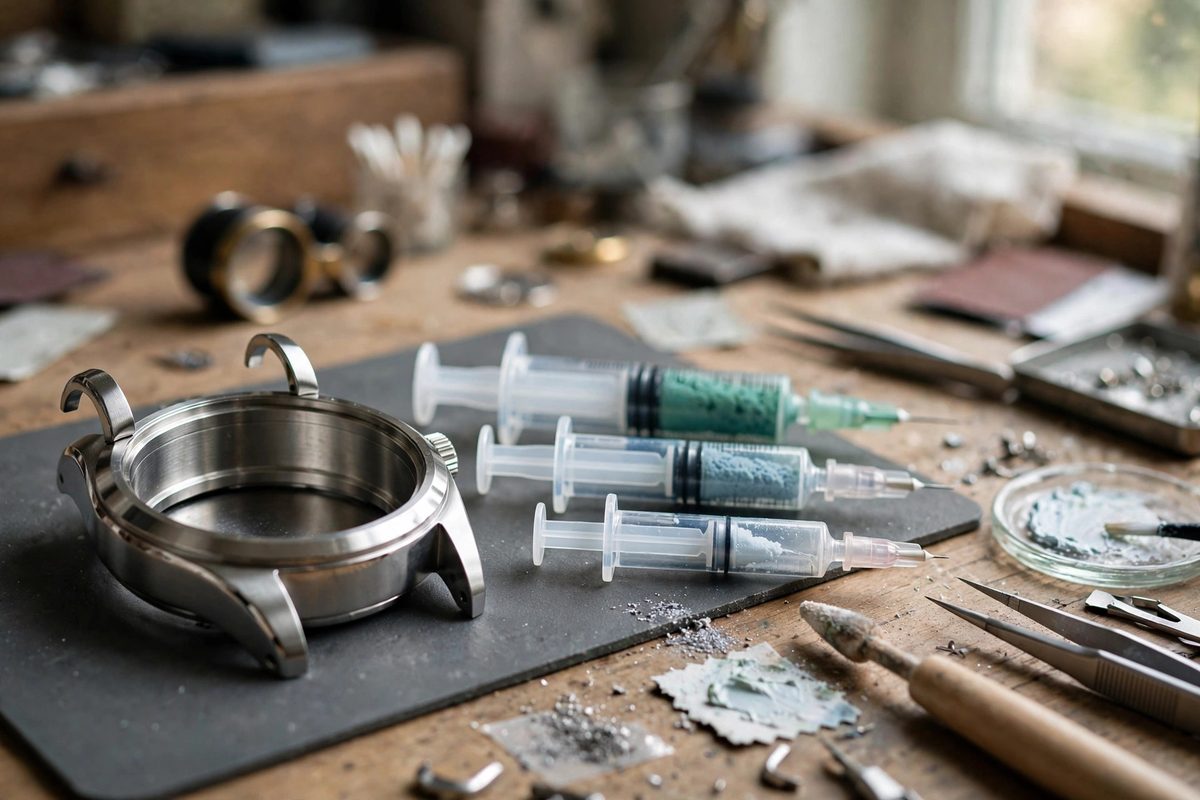
Case steel is hard, and lug surfaces are too small and curved for large polishing equipment. Diamond paste on a shaped carrier, a wood stick, a felt bob, or a leather strop, conforms to the lug's curves while cutting aggressively. The paste format lets you work one lug facet at a time with full control, which is exactly what the geometry demands. Compared to abrasive papers, paste on a firm carrier follows the existing shape instead of flattening it, preserving the lug's designed curves while refining the surface.
The Micron Sequence
Work from coarse to fine without skipping: a typical lug refinishing runs from roughly thirty or fifteen microns down through nine, six, three, and one, finishing at a quarter micron for a mirror. Each grade's only job is to remove the scratches of the previous grade; it cannot skip ahead. The test between grades is visual under magnification: when no scratches from the previous grade remain, move on. Rushing a grade leaves deep lines that the next grade, cutting finer and slower, will take far longer to remove than doing the grade properly would have. The sequence is the fastest path precisely because it is complete.
Preparing the Lugs
Before the first paste grade, true up the lug shape. Remove deep scratches, dings, and previous bad polishing with files or coarse abrasive, restoring the intended facets and curves. The paste sequence refines; it does not reshape efficiently. Mask or protect the areas you are not refinishing, the case sides, the bezel seat, because paste migrates and a mirror finish where a brushed finish belongs is a restoration error. Clean the lugs thoroughly between shaping and the first paste grade so no coarse grit contaminates the sequence.
Working Each Grade
Apply a small amount of paste to the carrier, not to the lug; a little paste does a lot of work and excess just makes a mess. Work with moderate pressure and steady motion along the lug's length, keeping the carrier moving so no spot gets overworked. Clean the lug completely between grades, because a single coarse particle carried into a fine grade undoes that grade's work. Use separate carriers per grade or clean them meticulously; cross-contamination is the most common reason a sequence stalls at a hazy finish. Inspect under magnification often, since the naked eye forgives scratches the loupe will not.
Matching the Original Finish
Not every lug wants a mirror. Many watches combine polished lug tops with brushed sides, and the refinish must match the factory pattern. Stop the sequence at the grade that produces the intended finish: a mid-range micron grade with a straight-line motion gives a convincing brushed look, while the full descent to sub-micron gives the mirror. Study the untouched areas or reference examples before deciding. A perfectly executed wrong finish is still wrong, and originality matters in watchmaking in a way it does not in general metalwork.
True the shape first, run the full micron sequence without skipping, keep every grade clean of the last, and stop at the finish the watch was born with. The lugs will look like they were never touched, which is the highest compliment a refinish can earn.
Related Guides
- Lapping Beveled Case Edges With Diamond Paste: The beveled edges of a fine watch case, the crisp chamfers where the case flank meets the bezel or the lugs meet the case band, are among the most
- Buffing Acrylic Crystals With Cerium Slurry: Acrylic watch crystals scratch easily, which is also why they restore easily: unlike glass or sapphire, acrylic can be polished back to clarity with
- Hard Felt Wheel Lapping for Factory Satin Case Finishes: Factory satin finishes on watch cases, the soft directional grain on lugs and case flanks, look effortless and are surprisingly hard to reproduce