
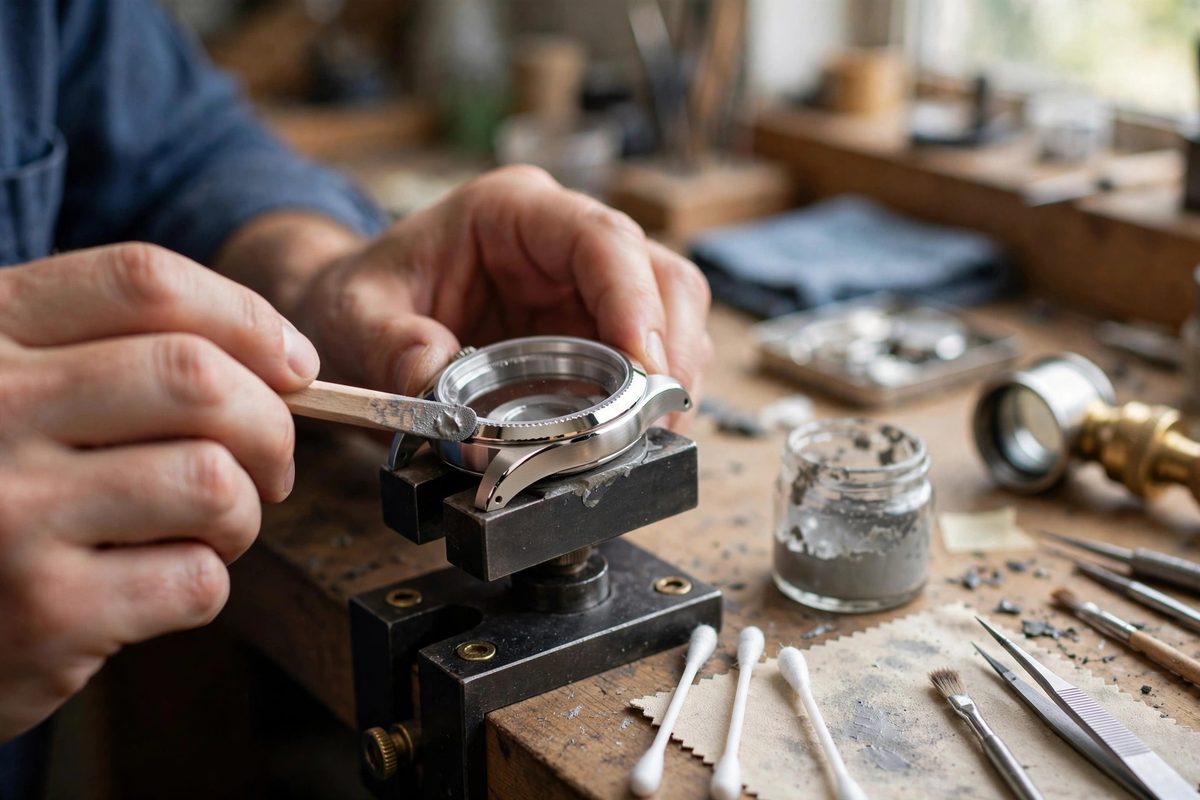
The beveled edges of a fine watch case, the crisp chamfers where the case flank meets the bezel or the lugs meet the case band, are among the most admired details in watchmaking. They catch light in a sharp line that defines the case's architecture. Restoring or creating those bevels by hand is lapping: abrading the edge against a flat surface charged with diamond paste, progressing through grits until the bevel is geometrically true and mirror bright. It is slow, meditative work, and the difference between a crisp bevel and a rounded-over edge is entirely in the discipline.
What lapping does that polishing does not
Machine polishing with a buffing wheel removes material fast but rounds edges; the soft wheel conforms to the work and erases the crisp intersection that makes a bevel a bevel. Lapping works the opposite way: the case edge moves against a hard, flat reference surface, so the abrasive cuts the high spots down to a true plane. The flat lap preserves geometry while the diamond paste does the cutting. This is why hand lapping is the standard for beveled case edges even in high-end manufacture: no machine reproduces the combination of flatness and control. The bevel that results has two qualities a buffed edge never achieves: its surfaces are optically flat, and its edges, where bevel meets adjacent surface, are sharp enough to catch light in a clean line.
Diamond paste grit progression
Diamond paste comes graded by micron size, and the progression runs from coarse shaping to mirror finishing. A typical sequence for restoring a beveled edge might start around 15 to 30 microns to establish the geometry, then step through roughly 9, 6, 3, and 1 micron, finishing with a sub-micron paste for the mirror. Each grit must completely remove the scratches of the previous one before moving on; rushing the progression leaves deep scratches visible in the final mirror, and there is no shortcut back except returning to the coarser grit. Charge the paste sparingly onto the lap, a flat piece of glass, steel, or a dedicated lapping plate, and spread it thin. More paste is not faster; a thin, even charge cuts more uniformly. Clean the work thoroughly between grits, because a single stray coarse diamond particle in a fine stage will scratch the bevel you just perfected.
Technique: keeping the bevel true
Hold the case so the bevel lies flat on the charged lap, and work it in smooth, even strokes with light, consistent pressure. The enemy is rocking: any tilt rounds the bevel, so the hand must keep the surface flat on the lap through the whole stroke. Work the entire bevel evenly, checking frequently under magnification and in raking light, which reveals low spots and uneven cutting instantly. Mask adjacent brushed or satin surfaces with tape before you start; diamond paste does not respect boundaries, and a mirror bevel is ruined if the paste scuffs the neighboring finish. For lug bevels and other small features, make miniature laps or use the edge of the main lap, always keeping the reference surface flat against the work. Patience is the technique: the geometry emerges from hundreds of consistent strokes, not from pressure.
Refinishing the surrounding surfaces
A restored bevel next to a tired case looks wrong, so lapping usually accompanies a broader refinishing. Brushed surfaces get re-grained with the appropriate abrasive, applied in straight, even passes in the original direction; polished surfaces get their own diamond progression on appropriate laps. The transitions between finishes, where the mirror bevel meets the brushed flank, are the signature details: they must be sharp and clean, which is why the masking discipline matters. Step back frequently and view the case as a whole under good light; individual surfaces can each look right while the overall composition looks off, usually because one finish is brighter or duller than its neighbors. The goal is a case that looks coherent, as if all its surfaces were finished in the same session by the same hand.
Knowing when to stop
Lapping removes metal permanently, and vintage cases have finite material. Deep scratches and dents in a beveled edge present a judgment call: removing them entirely may require taking off enough metal to alter the case's proportions or erase its character. Often the right answer is to improve the bevel substantially without chasing perfection, preserving the case's integrity. Document the starting condition with photographs, work conservatively, and stop while the case still looks like itself, only better. Over-polishing is the most common sin in case refinishing, and it is irreversible. The best bevel work is the kind that looks original, not the kind that looks worked on.
Flat lap, thin diamond charge, full grit progression, no rocking, masked neighbors, and the restraint to stop in time. That is the whole craft of the beveled edge, and it shows in every glint.
Related Guides
- Hard Felt Wheel Lapping for Factory Satin Case Finishes: Factory satin finishes on watch cases, the soft directional grain on lugs and case flanks, look effortless and are surprisingly hard to reproduce
- Diamond Paste Micron Sequences for Steel Watch Lugs: Watch lugs are small, curved, and constantly visible, which makes them the hardest part of a case to refinish well. Diamond paste in descending
- Buffing Acrylic Crystals With Cerium Slurry: Acrylic watch crystals scratch easily, which is also why they restore easily: unlike glass or sapphire, acrylic can be polished back to clarity with