
Factory satin finishes on watch cases, the soft directional grain on lugs and case flanks, look effortless and are surprisingly hard to reproduce. The professional method is lapping on a hard felt wheel charged with abrasive, which cuts a uniform fine grain without the waviness of hand sanding. Done correctly, the result is indistinguishable from the original finish; done carelessly, it is a polished mess.
What the Satin Finish Is
A satin finish is a field of fine, parallel scratches that scatter light softly in all directions except along the grain. The eye reads it as a smooth matte surface with a subtle direction. The grain must be uniform in depth and spacing, and it must follow the case's geometry: along the lug, around the bezel, straight on the flank. Any break in direction, any patch of deeper scratches, or any polished spot shows immediately. The finish is functional as well as decorative; it hides small scratches from wear far better than a mirror polish. Restoring it means recreating that uniform directional grain, not just making the metal look clean.
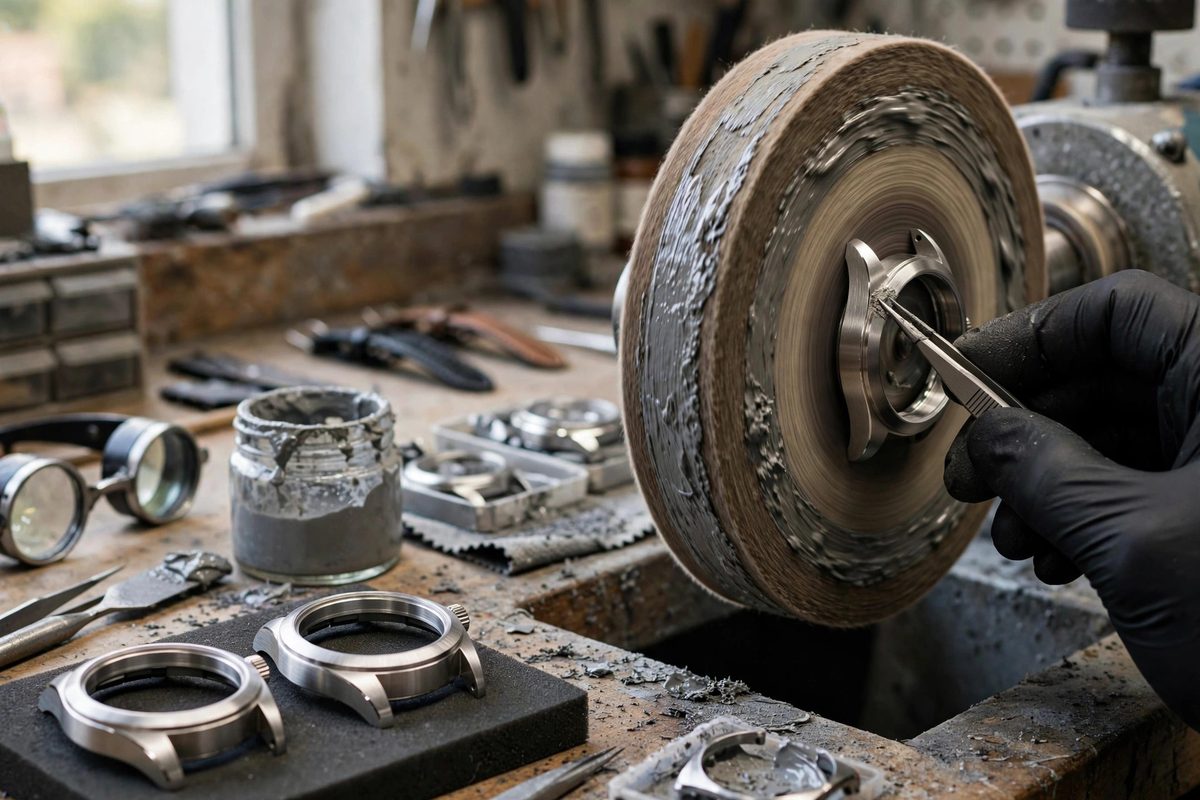
The Hard Felt Wheel Setup
A hard felt wheel, dense and firm rather than soft and fluffy, holds its shape against the work and cuts evenly. Charge it with a fine abrasive compound; the compound grade determines the grain: coarser for a bolder satin, finer for a softer sheen. Run the wheel at moderate speed; too fast generates heat that can discolor the steel or melt the felt, and too slow cuts unevenly. Dress the wheel before use so the face is true and the abrasive is evenly distributed. The wheel should be dedicated to one compound grade; mixing grades on one wheel produces an unpredictable finish. Keep a separate wheel for each finish you regularly produce.
Technique: Direction and Pressure
Present the case to the wheel so the grain runs in the correct direction for that surface, and move the work steadily to avoid dwelling in one spot. Use light, even pressure; heavy pressure digs deeper scratches and generates heat, while inconsistent pressure creates visible bands. Overlap each pass slightly, like mowing a lawn, so no strip is missed. For curved surfaces like lugs, rock the case gently to keep the contact patch following the curve, maintaining the grain direction along the curve. The most common error is changing direction mid-surface, which creates a visible crosshatch where the grains collide. Plan each surface's grain direction before touching the wheel, and complete each surface in one continuous session so the grain matches across it.
Masking and Protecting Adjacent Finishes
Real cases mix finishes: polished bevels next to satin flanks, brushed tops with polished sides. Mask the polished areas before lapping, because the felt wheel will satinize anything it touches. Use a firm masking that conforms to edges; tape alone often lifts under the wheel's drag. Work up to the masked edge carefully, keeping the grain parallel to the boundary line. A crisp transition between satin and polish is the hallmark of factory work, and it comes from disciplined masking, not from a steady hand alone. Remove the masking and inspect the boundary under magnification; any bleed of the satin grain onto the polished bevel needs careful repolishing of the bevel, which is far more work than masking properly.
Cleaning and Final Inspection
After lapping, clean the case thoroughly to remove all abrasive residue; trapped compound continues to scratch and will contaminate subsequent polishing steps. Ultrasonic cleaning followed by a rinse works well. Inspect the finish under strong, raking light from multiple angles: the grain should be uniform, directional, and free of deep strays or polished patches. Compare against an original-finished reference if available. If the grain is too coarse, refine it with a finer compound on a clean wheel; if it is uneven, the only fix is to re-lap the entire surface uniformly, since spot fixes show. A proper satin refinish should look like the case left the factory yesterday.
Hard felt wheel lapping reproduces factory satin by cutting a uniform directional grain with controlled pressure and disciplined direction. Mask what stays polished, keep the pressure light and even, and inspect under raking light. The finish looks simple because the technique is controlled.
Related Guides
- Lapping Beveled Case Edges With Diamond Paste: The beveled edges of a fine watch case, the crisp chamfers where the case flank meets the bezel or the lugs meet the case band, are among the most
- Buffing Acrylic Crystals With Cerium Slurry: Acrylic watch crystals scratch easily, which is also why they restore easily: unlike glass or sapphire, acrylic can be polished back to clarity with
- Diamond Paste Micron Sequences for Steel Watch Lugs: Watch lugs are small, curved, and constantly visible, which makes them the hardest part of a case to refinish well. Diamond paste in descending