
Soft, flattering key light is the foundation of good-looking video, and diffusion scrims, translucent fabrics stretched on frames, are how you make a hard light source soft. But the softness depends not just on the fabric but on the spacing: the distance from the light to the scrim and from the scrim to the subject. Get the ratios right and a cheap work light becomes a beautiful soft source; get them wrong and you just have a dimmer hard light.
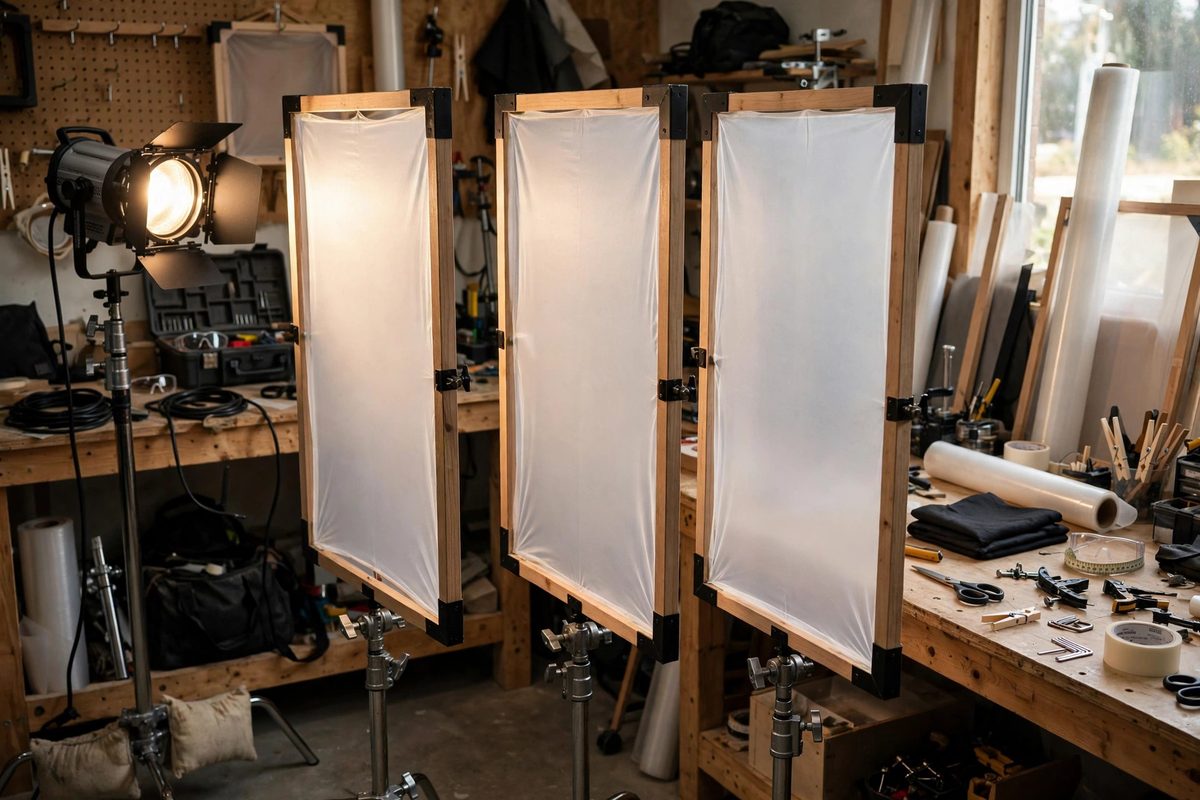
Why distance creates softness
A light's apparent softness is set by its apparent size from the subject's point of view: a large, close source wraps around features and fills shadows, while a small or distant source casts hard-edged shadows. The scrim becomes the effective source, so its size relative to the subject and its distance from the subject determine the softness. A scrim two feet from the subject's face is dramatically softer than the same scrim eight feet away, because it subtends a much larger angle. Distance is the primary softness control; fabric density is secondary.
The spacing ratios
A practical working ratio: place the scrim roughly as far from the light as the scrim is large in its smallest dimension, and place the subject within one to two scrim-widths of the scrim. Concretely, with a 4x4-foot scrim, put the light about 4 feet behind it and the subject 4 to 8 feet in front. This gives the light room to spread evenly across the scrim (avoiding a hot center) while keeping the scrim close enough to the subject to act large. If the light is too close to the scrim, the center blows out and the edges fall off; too far, and you waste output lighting the room instead of the scrim.
Layering scrims for extra softness
One scrim softens; two scrims, spaced apart, soften further by making the effective source even more uniform. Space layered scrims a foot or two apart so the second scrim diffuses the first's output rather than just stacking density in one plane. Each layer costs light output, roughly a stop or more depending on the fabric, so balance softness against the exposure you need. For interviews and close work, a double-scrim setup close to the subject gives the creamy, shadowless look that flatters everyone.
Fabric choices
Diffusion fabrics range from light (quarter-stop loss, mild softening) to heavy (two-plus stops, very soft). Silk and grid cloth are traditional; modern synthetic diffusions offer consistent, fire-rated options. Heavier fabric compensates somewhat for imperfect spacing, since it scatters more aggressively, but no fabric fixes a scrim placed too far from the subject. Keep scrims clean; dirty diffusion yellows the light and scatters unevenly. And mind fire safety: hot lights near fabric demand fire-rated materials and attention, which is one more reason LEDs have taken over video lighting.
Shaping with the soft source
Soft does not mean shapeless. Once the key is beautifully diffused, control where it goes: use black flags and cutters to keep it off the background, and add a harder rim or back light for separation. The classic setup is a large, close, diffused key at roughly 45 degrees to the subject, with the fill and background handled separately. The scrim spacing gives you the quality of light; the flags give you the control.
Big scrim, close to the subject, light spaced to fill it evenly, layered if needed. Soft light is geometry before it is gear.
Related Guides
- High CRI LED Diffusion Scrim Spacing for Key Lights: A key light shapes the face, and its quality decides whether skin looks alive or waxy. High-CRI LED panels give accurate color, but bare LEDs are
- Fresnel Lens Collimation for Clean Studio Key Lights: A bare LED panel throws light everywhere, spilling onto backgrounds and flags and generally making a mess. A Fresnel lens in front of the source
- High CRI LED Strip Color Rendering on Studio Walls: LED strips have become the default accent and fill lighting for video studios: cheap, flexible, dimmable, and available in every color temperature
- Parabolic Softbox Efficiency Limits for Rim Lighting: Parabolic softboxes promise focused, punchy light with softbox quality, and they deliver it, within limits. Used as a rim light, a parabolic modifier