
A CRT monitor tube stores a dangerous charge on its anode, the high-voltage connection under the suction-cup cap on the side of the tube, even after the set has been unplugged for days. That charge, tens of thousands of volts, can deliver a serious shock to anyone who touches the anode connector during service. Discharging it safely is the mandatory first step of any CRT work, and doing it correctly means understanding that one discharge is not always enough. This is a procedure where the safety steps are the procedure.
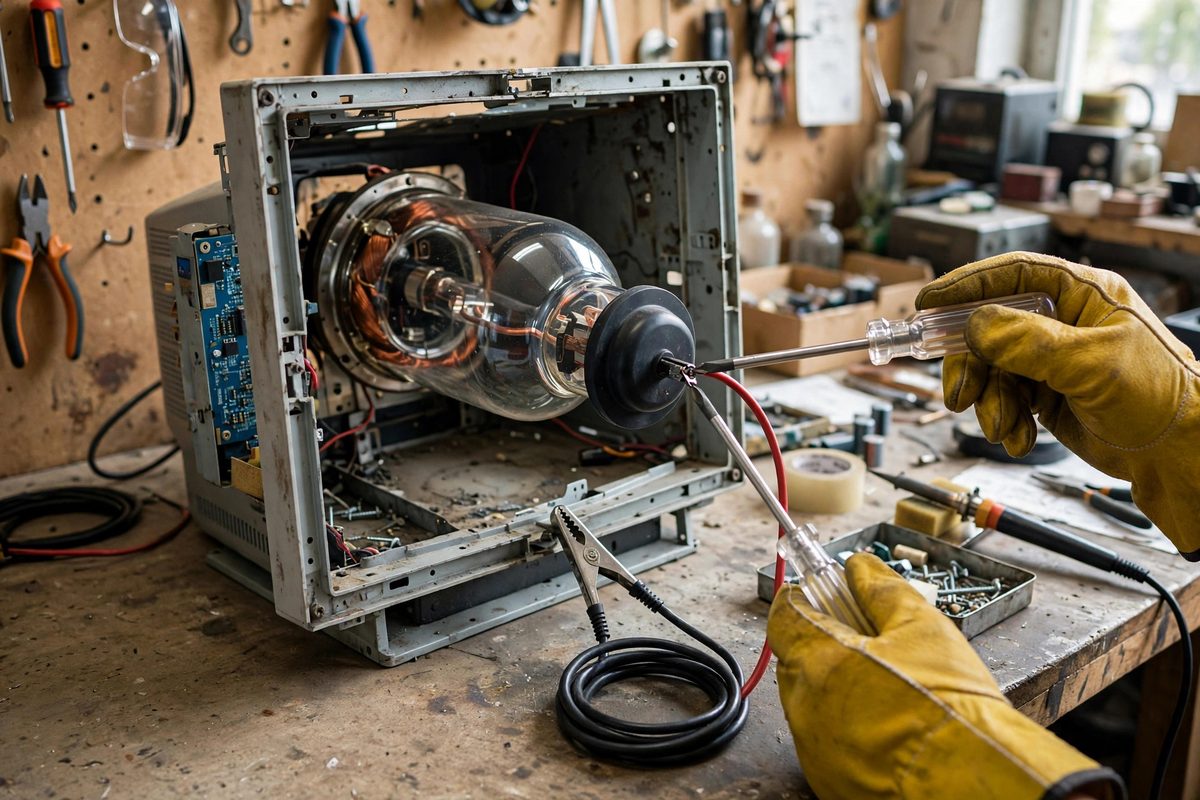
Why the charge persists
The CRT's glass envelope, with its conductive aquadag coatings inside and out, forms a large capacitor: the anode button connects to the inner coating, the outer coating connects to chassis ground, and the glass between them is the dielectric. When the set runs, the flyback transformer charges this capacitor to the anode voltage, typically 15,000 to 30,000 volts depending on tube size. Unplugging the set removes the charging source but not the stored charge; the capacitor self-discharges only very slowly through leakage. Days later, enough charge can remain to knock you across the room. Worse, the dielectric exhibits absorption: after you discharge the tube once, charge trapped in the glass migrates back to the plates over minutes, partially recharging the tube. This is why the procedure calls for multiple discharges with waiting time between them.
Building the discharge probe
Do not discharge a CRT by shorting the anode directly to ground with a screwdriver; the violent arc pits the contacts and the current spike stresses the tube. Build a proper probe: a well-insulated handle, a probe tip, and a high-value resistor, typically several megohms rated for high voltage, in series with a wire ending in a sturdy alligator clip. The resistor limits the discharge current to a safe trickle, draining the charge over a second or two instead of in a violent snap. Commercial high-voltage probes include this resistor internally; a homemade probe must not omit it. Verify the probe's insulation is rated for the voltages involved, and inspect it before every use: cracked insulation on a high-voltage probe is a trap.
The discharge procedure
With the set unplugged and the back removed, clip the probe's ground lead to a solid chassis ground point, the CRT's outer aquadag grounding strap if accessible, otherwise the metal chassis. Confirm the ground connection is mechanically secure; a clip that falls off mid-procedure leaves you holding a live probe. Then, with one hand only (the other hand stays in your pocket or behind your back), slide the probe tip under the anode cap's rubber seal until it contacts the anode connector. You may hear a faint tick as the charge drains through the resistor. Hold contact for several seconds, then withdraw. Wait a few minutes for dielectric absorption to bring up any residual charge, and discharge again. Repeat a third time after another wait. Only then treat the anode as safe, and even then, keep the one-hand habit and the respect: verify with a high-voltage meter if you have any doubt.
Working safely around the discharged tube
Discharging the anode does not make a CRT safe; it makes one specific hazard safe. The tube is still an implosion risk: the envelope holds a hard vacuum, and breaking the glass, especially the thin neck, causes a violent inward collapse followed by flying glass. Handle the tube by its designated lifting points, never by the neck, and wear eye protection whenever working around an exposed CRT. Other capacitors in the set, particularly the main filter capacitors, hold their own charges and need separate discharge through a resistor. Keep your workspace dry, uncluttered, and well lit. And never work on CRT equipment alone if you can avoid it; a second person who knows to unplug the set and call for help is the cheapest safety equipment there is.
Knowing your limits
Stated directly: if the high-voltage precautions in this article feel unfamiliar or intimidating, CRT service is not a learn-as-you-go activity. The voltages involved punish mistakes instantly and severely, and the implosion hazard adds a mechanical danger most electronics work lacks. There is no shame in leaving CRT repair to experienced technicians; many skilled electronics people do exactly that. For those who proceed, the discipline is simple and absolute: discharge properly with a resistor probe, discharge more than once, verify, keep one hand behind your back, protect your eyes, and never rush. The set will wait. Your safety will not.
Resistor probe, solid ground, one hand, contact under the cap, wait, repeat twice more. Then, and only then, begin the actual work, with the same care you brought to the discharge.
Related Guides
- Discharging Ultor Anode Voltage on Color CRT Tubes: A color CRT holds a lethal charge on its ultor anode long after the set is unplugged, tens of thousands of volts waiting under the suction-cup
- Flyback Transformer Arcing and Corona Rings: The flyback transformer in a CRT television generates the high voltage, typically 20,000 volts or more, that accelerates the electron beam. At those
- Horizontal Linearity Coil Tuning on Classic Trinitrons: A classic Sony Trinitron with stretched or compressed picture geometry on the left or right side of the screen often needs its horizontal linearity