
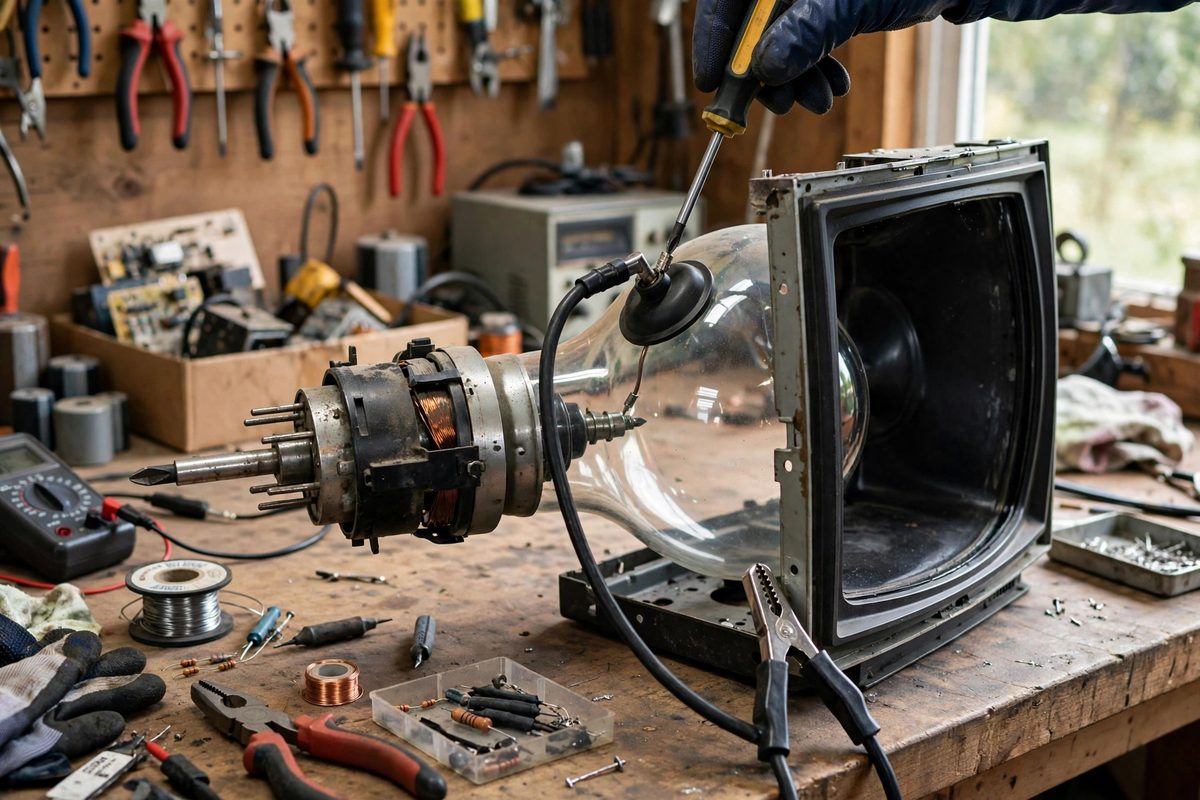
A color CRT holds a lethal charge on its ultor anode long after the set is unplugged, tens of thousands of volts waiting under the suction-cup connector on the tube. Discharging it safely is the mandatory first step of any CRT service. This is not a step to improvise; the procedure is simple, but it must be done right every single time.
Why the Charge Persists
The CRT's aquadag coating and the glass envelope form a large capacitor, charged by the flyback to the anode voltage, typically in the twenty to thirty kilovolt range for color tubes. Capacitors hold their charge until given a discharge path, and the CRT's internal leakage is slow enough that a dangerous voltage remains for days or longer after power-off. The charge does not care that the set is unplugged or that the power switch is off. Treat every CRT as charged until you have personally discharged it and verified it.
Building a Discharge Tool
The discharge tool is a well-insulated probe with a grounded lead. A common build uses a long insulated handle, a metal probe tip, and a wire with an alligator clip running to a solid chassis ground, with a high-value resistor in series to limit the discharge current and protect the tube's coatings. The insulation must be rated for the voltage involved; hardware-store electrical tape on a screwdriver is not adequate. The ground connection must go to the set's chassis ground or the CRT's aquadag ground strap, verified as a real ground path, not to some random metal that may be floating.
The Discharge Procedure
With the set unplugged, connect the discharge tool's ground clip first, then slide the probe tip under the anode cap's edge until it contacts the anode connector. You may hear a snap as the charge dumps; hold the contact for several seconds to let the full charge bleed off through the resistor. Then, keeping the ground connected, short the anode directly with the probe to catch any residual charge. Wait a minute and repeat the whole thing, because CRTs can partially recharge themselves through dielectric absorption, a phenomenon where the charge seems to creep back after discharging. The second discharge catches what the first missed.
Verifying It Is Safe
Do not trust a single discharge. After discharging twice with a pause between, verify with a high-voltage probe and meter rated for the range, measuring the anode to ground. Only when the meter reads essentially zero is the tube safe to handle around the anode. Keep the discharge tool's ground connected or a grounding strap on the anode while you work, because the tube can slowly rebuild a charge while sitting. Make discharging the first thing you do when opening the set and the last thing you verify before touching the anode area.
Respecting the Rest of the Set
The ultor is the headline danger, but a CRT set holds other hazards: the main filter capacitors in the power supply store mains-level voltage, and the tube's neck is fragile enough that a careless bump implodes the envelope. Discharge the power supply caps as well before working in that section. Handle the tube by its designated safe areas, never by the neck, and wear eye protection whenever working around an exposed CRT. The implosion risk is real and the flying glass is not theoretical.
Discharge the ultor before anything else, with a proper tool, a verified ground, two passes with a pause between, and a meter check to confirm. The procedure takes minutes and it is the difference between servicing a vintage set and becoming a cautionary story.
Related Guides
- Discharging Anode Voltage on CRT Monitor Tubes: A CRT monitor tube stores a dangerous charge on its anode, the high-voltage connection under the suction-cup cap on the side of the tube, even after
- Flyback Transformer Arcing and Corona Rings: The flyback transformer in a CRT television generates the high voltage, typically 20,000 volts or more, that accelerates the electron beam. At those
- Horizontal Linearity Coil Tuning on Classic Trinitrons: A classic Sony Trinitron with stretched or compressed picture geometry on the left or right side of the screen often needs its horizontal linearity