
The flyback transformer in a CRT television generates the high voltage, typically 20,000 volts or more, that accelerates the electron beam. At those voltages, the air itself becomes a failure mode: sharp points concentrate the electric field until the air ionizes, producing corona discharge and eventually arcing. Vintage TV restorers meet this as crackling sounds, ozone smell, and visible blue sparking around the flyback. Understanding corona and the rings that suppress it keeps the set running safely.
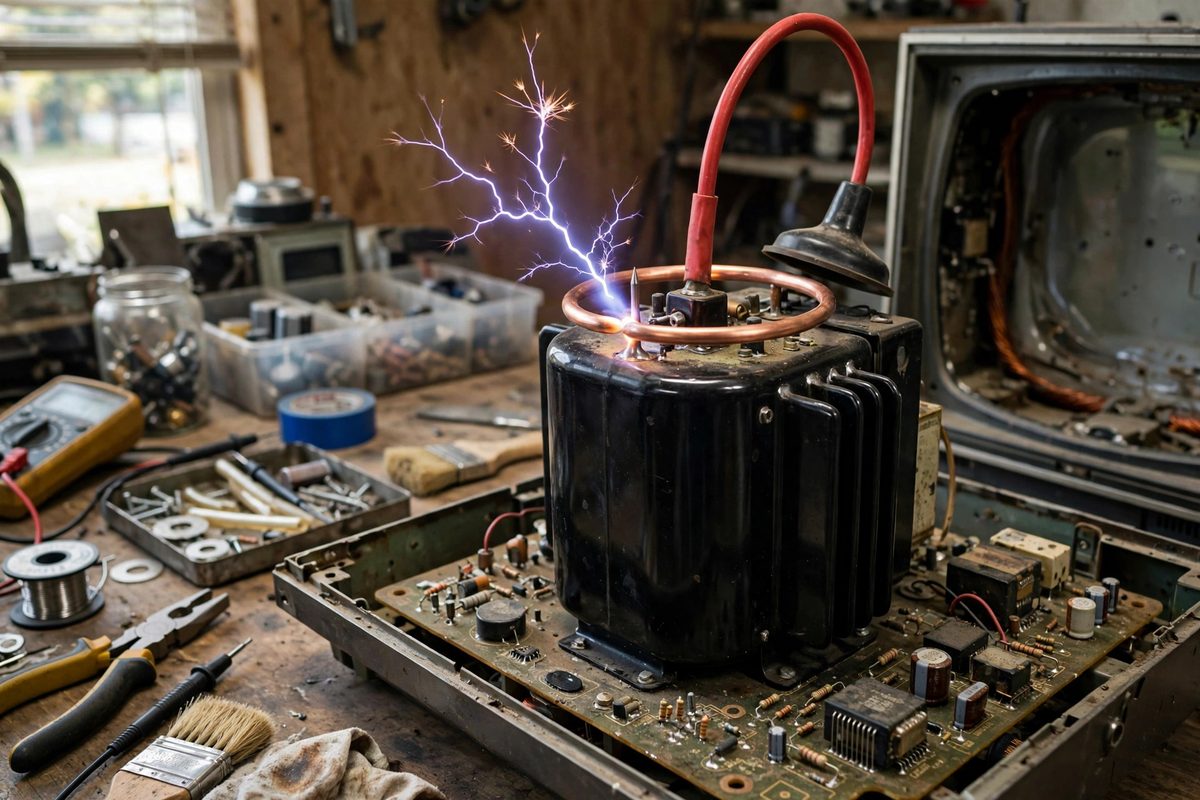
Why high voltage arcs
Electric field strength concentrates at sharp points and edges; a sharp solder spike at 25 kV can have a local field far exceeding air's breakdown strength even though the average field is modest. Once the air ionizes, corona discharge begins: a faint glow and hissing that erodes insulation and generates ozone. Corona is the warning stage; left alone, it carbonizes insulation, creating a conductive track that leads to full arcing, a violent discharge that can punch through insulation, crack the flyback, and start fires. Every arc you hear is damage happening.
Corona rings and what they do
A corona ring (or corona shield) is a smooth, rounded metal torus placed around a high-voltage point. Its large radius of curvature keeps the local field below corona inception: the field spreads over the ring's smooth surface instead of concentrating at a sharp point. You will find corona rings on the anode cap connections of many CRTs and on some flyback terminals. They work purely by geometry, no power, no maintenance, just smooth metal in the right place. If a set originally had one and it is missing, its absence is likely why the set now arcs.
Finding and fixing corona sources
Diagnose in a dark room: power the set and look and listen for the faint blue glow and hissing of corona, or the sharp snap of arcing. Common sources include sharp solder points on the flyback terminals, cracked or degraded anode lead insulation, dust and grime providing tracking paths, and damaged corona dope (the insulating coating on the flyback). Clean first: dust and nicotine films are conductive enough to start tracking. Round off sharp solder points with fresh solder flowed smooth. Replace cracked anode leads and degraded insulation; patching high-voltage insulation with tape is temporary at best.
Corona dope and insulation restoration
Corona dope is an insulating varnish applied to flyback windings and terminals to suppress discharge. When it cracks or flakes with age, recoating restores the protection: clean the area thoroughly, apply the dope in thin coats, and let each cure fully. This is maintenance, not a cure for a failing flyback; a transformer with shorted turns or internal carbon tracking needs replacement, not paint. Distinguish the two: external corona responds to cleaning and recoating, while internal failure shows as low high-voltage, overheating, or arcing that persists after the exterior is pristine.
Safety is absolute here
CRT high voltage can kill. Discharge the CRT's anode to the chassis ground with a proper high-voltage probe and bleeder before touching anything in the high-voltage section, and confirm zero voltage before proceeding. Keep one hand behind your back when working near energized high voltage. Never defeat interlocks. If you are not certain of the procedure, stop; high-voltage work is not the place to learn by experimentation. The set is replaceable; you are not.
Clean it, smooth the sharp points, restore the insulation, replace the missing rings, and respect the voltage absolutely. The crackle should be gone, and the set should stay that way.
Related Guides
- Discharging Anode Voltage on CRT Monitor Tubes: A CRT monitor tube stores a dangerous charge on its anode, the high-voltage connection under the suction-cup cap on the side of the tube, even after
- Horizontal Linearity Coil Tuning on Classic Trinitrons: A classic Sony Trinitron with stretched or compressed picture geometry on the left or right side of the screen often needs its horizontal linearity
- Discharging Ultor Anode Voltage on Color CRT Tubes: A color CRT holds a lethal charge on its ultor anode long after the set is unplugged, tens of thousands of volts waiting under the suction-cup