
The drawband is the flat woven strap that pulls the typewriter carriage leftward as you type, powered by the mainspring in the spring drum. On Royal typewriters, as on most, the drawband's tension must be calibrated: too loose and the carriage stalls or the spacing goes erratic; too tight and the keys feel heavy, the escapement wears, and the band itself breaks prematurely. Setting the drawband tension correctly restores the machine's typing feel.
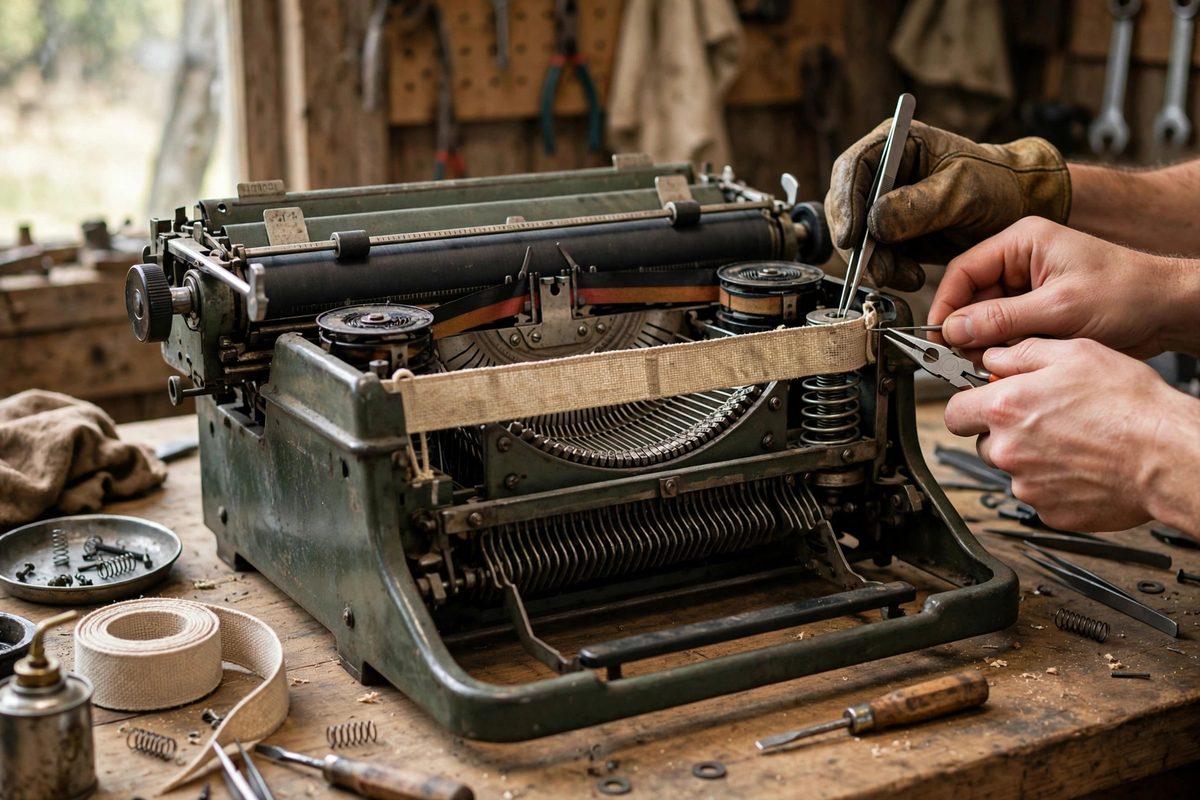
How the drawband system works
Each keystroke trips the escapement, which releases the carriage to move one space left, pulled by the drawband wound on the spring drum. The mainspring inside the drum provides the pull; the drawband transmits it. The tension must overcome the carriage's friction and inertia crisply but not violently: the carriage should glide left with authority and stop cleanly at each escapement tooth. When the tension is right, typing feels effortless and spacing is uniform; when wrong, everything about the machine feels off, though the symptom is often misdiagnosed as an escapement problem.
Diagnosing tension problems
Test by releasing the carriage with the carriage release lever: it should travel smoothly and smartly to the left without hesitation or racing. If it creeps or stalls, especially toward the left end of its travel (where the spring is most unwound), tension is low. If it slams left violently or the keys feel stiff, tension is high. Also type a line and watch the spacing: uneven spacing that is not fixed by escapement adjustment often traces to a drawband delivering inconsistent pull, usually from a band that is fraying, slipping, or wound unevenly on the drum.
Adjusting the tension
On Royals, drawband tension is typically set at the spring drum: the drum has an adjustment (a ratchet, a tension screw, or a windable arbor depending on the model) that changes the mainspring's preload. Increase tension in small increments, testing the carriage travel after each change; it is easy to overshoot. The service manual's specification, if available, gives the target in terms of pull weight or carriage behavior; without the manual, calibrate by feel against the tests above. If the drum's spring is broken or has lost its temper, no adjustment helps; the spring needs replacement, which is a deeper repair.
Drawband condition and replacement
Inspect the band itself: fraying, kinking, or a band that has stretched unevenly cannot deliver consistent tension regardless of drum adjustment. Replacement bands are available, or can be made from suitable woven strap material of the correct width and flexibility; the band must be supple enough to wind cleanly on the drum but strong enough to last. When installing, wind it neatly on the drum without overlaps or twists, route it through its guides, and attach it to the carriage at the correct point. An incorrectly routed band rubs, frays, and delivers uneven pull.
Fine-tuning the whole carriage system
Drawband tension interacts with carriage rail cleanliness, bearing condition, and escapement adjustment. Clean and lightly lubricate the carriage rails before final tension calibration; a gummy rail mimics low tension and leads to over-tightening. After setting tension, verify escapement function across the full carriage travel, since the escapement was likely adjusted (or misadjusted) to compensate for the old tension. The goal is a system in balance: clean rails, correct tension, crisp escapement, and a machine that types like it should.
Test the travel, adjust in small steps, replace worn bands, and balance the whole carriage system. The Royal will reward you with that unmistakable, effortless typing feel.
Related Guides
- Mainspring Drum Tension Calibration on Vintage Royals: The mainspring drum is the muscle of a vintage Royal typewriter, storing the energy that drives the carriage return and powers the escapement. When
- Cleaning Sluggish Segment Slots on Typebars: A typewriter whose typebars hesitate, stick halfway to the platen, or return lazily almost always suffers from gummed segment slots: the slotted
- Escapement Rocker Clearance on Manual Typewriter Cams: The escapement is the mechanism that lets a typewriter carriage advance exactly one space per keystroke, and the rocker is the pivoting piece that