
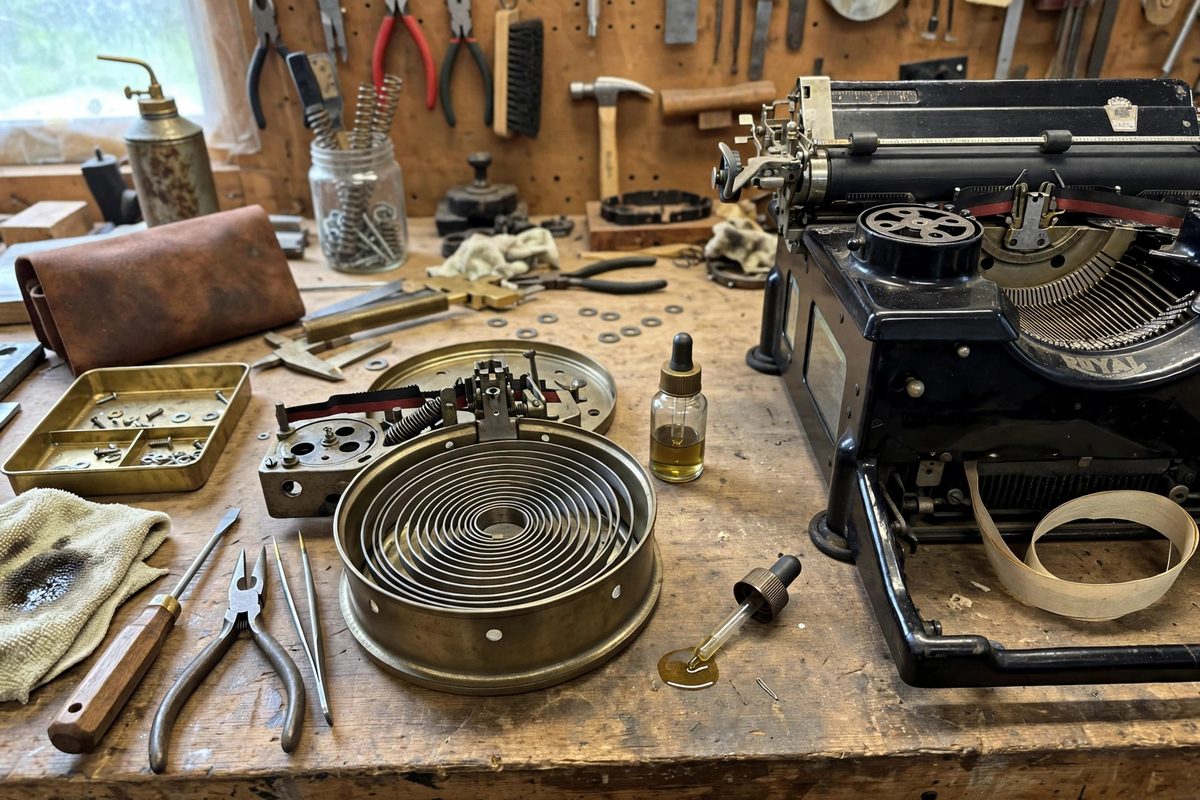
The mainspring drum is the muscle of a vintage Royal typewriter, storing the energy that drives the carriage return and powers the escapement. When its tension is wrong, the symptoms are unmistakable: a carriage that will not return fully, keys that feel dead, or a drawband snapping under excessive pull. Calibrating the drum tension restores the machine's rhythm.
What the Mainspring Does
The coiled spring inside the drum pulls the drawband, which pulls the carriage leftward after each line. The escapement meters that pull into precise character spaces as you type. The spring must be strong enough to return the carriage smartly against the friction of the rails and the escapement, but not so strong that it slams the carriage or overloads the drawband and its attachments. Decades of sitting wound, or sitting unwound, change the spring's temperament; old springs take a set and deliver less force than they did new.
Diagnosing Tension Problems
Test the carriage return with the machine in normal typing condition. The carriage should travel its full return smoothly and settle against the left margin stop without hesitation or slamming. If it stalls partway, tension is low or friction is high; clean and lubricate the carriage rails first, because gummed rails mimic weak spring tension and the fix is cleaning, not cranking the spring tighter. If the carriage slams hard enough to bounce, tension is too high. If the drawband shows fraying or the spring feels notchy when wound, the spring itself may need replacement rather than adjustment.
Adjusting the Drum
The drum typically adjusts by adding or removing pre-wind turns on the spring. With the drawband detached or slack, wind the drum to increase tension or let it unwind to decrease, counting the turns so the change is deliberate and reversible. A common starting point is the factory specification of turns for the model, found in service manuals; without the manual, adjust in half-turn increments and test. The goal is the minimum tension that returns the carriage reliably, because excess tension only accelerates wear on the drawband, the escapement, and the margin stops.
The Drawband Connection
The drawband transmits the spring's force to the carriage, and its condition affects everything. A stretched, frayed, or improperly routed drawband wastes spring energy and produces erratic carriage motion no spring adjustment can fix. Inspect the full length of the band, check its anchor points at both ends, and replace it if it shows wear; drawband replacement is routine maintenance on these machines. Route the new band exactly as the original ran, since a misrouted band changes the effective pull geometry. After any drawband work, recheck the drum tension, because the system's balance has changed.
Lubrication and Final Testing
The mainspring itself wants only the lightest appropriate lubrication; heavy oil on a coiled spring gums up and changes its behavior with temperature. A proper spring lubricant applied sparingly keeps the coils sliding without attracting dust. After adjustment, type several full lines, testing return, backspace, and tab functions, because the spring interacts with all carriage motion. The machine should feel alive but not violent, with the carriage gliding home like it remembers the way.
Calibrate the mainspring drum to the minimum tension that does the job, on clean rails, with a sound drawband. The Royal will type the way it was built to type, with the carriage snapping home on every return.
Related Guides
- Drawband Spring Tension Calibration on Royals: The drawband is the flat woven strap that pulls the typewriter carriage leftward as you type, powered by the mainspring in the spring drum. On Royal
- Cleaning Sluggish Segment Slots on Typebars: A typewriter whose typebars hesitate, stick halfway to the platen, or return lazily almost always suffers from gummed segment slots: the slotted
- Escapement Rocker Clearance on Manual Typewriter Cams: The escapement is the mechanism that lets a typewriter carriage advance exactly one space per keystroke, and the rocker is the pivoting piece that