
The escapement is the mechanism that lets a typewriter carriage advance exactly one space per keystroke, and the rocker is the pivoting piece that meters that motion. When the clearance between the rocker and its cam is wrong, the carriage skips spaces, double-spaces, or refuses to move at all. Setting this clearance is precision work measured in thousandths, but the logic behind it is straightforward.
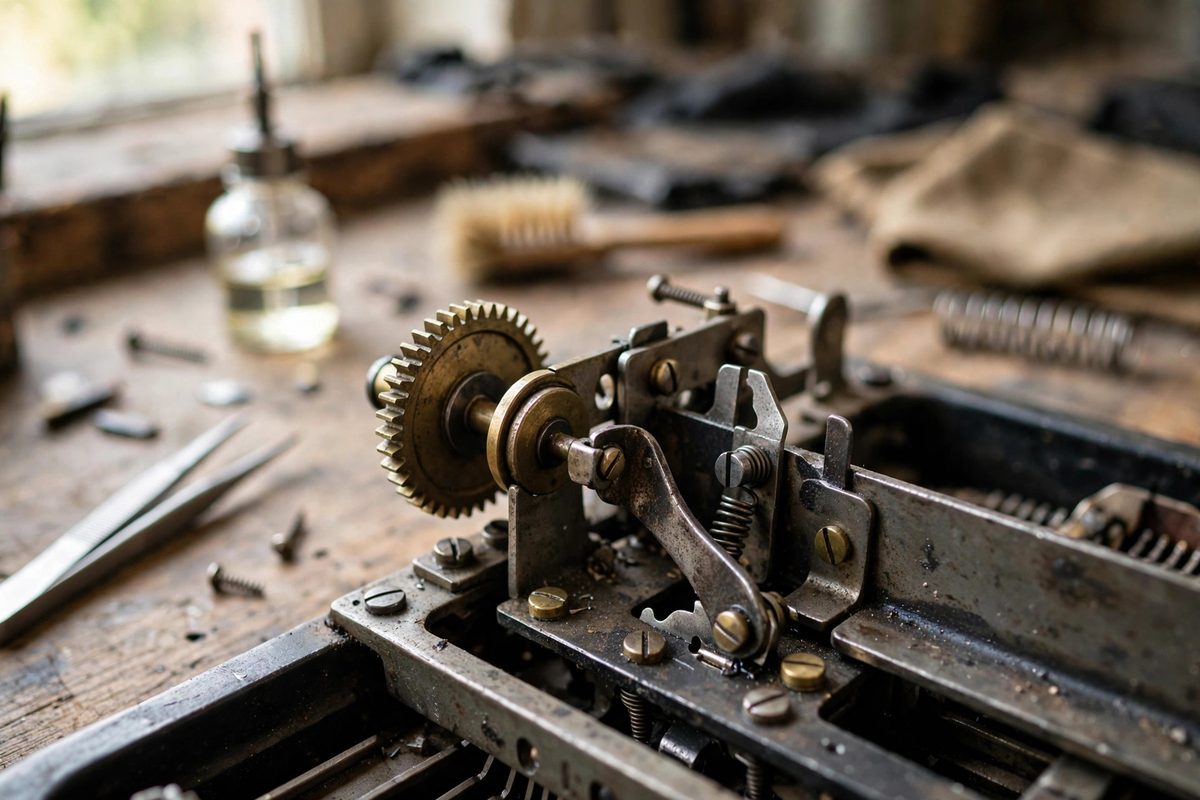
How the Escapement Meters Space
Each keystroke trips the escapement, which releases the carriage to move one tooth of the escapement rack under spring tension, then catches it again. The rocker pivots between two positions: in one, its dogs engage the rack to hold the carriage; in the other, they release it just long enough to advance one space. The cam drives the rocker's motion, and the clearance between the rocker's engaging surfaces and the cam determines the timing and completeness of each step. Too much clearance and the rocker does not fully engage, so the carriage slips extra teeth and skips spaces. Too little clearance and the mechanism binds, making the keys feel heavy and the carriage sluggish. The escapement is a clockwork, and like a clock, it tolerates only small deviations.
Diagnosing Clearance Problems
The symptoms point to the cause. Skipped spaces, where the carriage jumps two or more positions per keystroke, usually mean excessive clearance or worn dogs that no longer catch reliably. A carriage that will not advance at all, or advances only with heavy key pressure, suggests binding from insufficient clearance, gummed-up pivots, or a weak mainspring unable to overcome the friction. Inconsistent spacing, sometimes one space and sometimes two, often means the clearance is marginal and the mechanism works only when conditions are perfect. Before adjusting anything, clean the escapement thoroughly; decades of dried oil and dust mimic clearance problems exactly, and adjusting a dirty mechanism just moves the error around.
Setting the Clearance
With the mechanism clean, check the clearance between the rocker and the cam at the engaging surfaces using feeler gauges or the specification in the service manual for the model. The adjustment is typically made by repositioning the rocker's pivot bracket or by turning an eccentric screw, depending on the design. Move in tiny increments: a small change in clearance produces a large change in escapement behavior. After each adjustment, test by typing a full line and watching the carriage advance one crisp space per keystroke, then test the backspace and the tabulator, which use the same escapement. The space bar deserves special attention, since it trips the escapement without printing and is the purest test of the mechanism.
Lubrication and Wear
The escapement wants minimal, correct lubrication: a tiny drop of light oil on the pivots, and no oil on the engaging faces of the dogs and rack, where oil attracts dust and forms grinding paste. Many escapement problems blamed on clearance are actually wear: the dogs develop flats, the rack teeth round over, and no adjustment restores the original geometry. Inspect the engaging surfaces with magnification; polished wear flats on the dogs mean the parts are tired. Light wear can sometimes be dressed with a fine stone, but heavily worn escapement parts need replacement, which on common machines means a donor machine. Lubricate sparingly after any adjustment, then work the mechanism through its full travel to distribute the oil.
Testing Like a Typist
Final testing should mimic real use, not just bench exercises. Type several lines at normal speed, use the margins and the tab stops, and backspace through a word. The carriage should advance positively every time, with a consistent feel across the keyboard. Let the machine sit overnight and test again cold, since clearances and old lubricants behave differently at room temperature after sitting. A properly set escapement feels almost invisible: the typist thinks about words, not spaces. When the mechanism is right, the machine disappears and only the writing remains, which is exactly what the designers intended.
Escapement rocker clearance is the difference between a typewriter that types and one that fights. Clean first, adjust in tiny steps to specification, keep oil off the engaging faces, and test like someone writing a letter. The mechanism will reward the patience.
Related Guides
- Cleaning Sluggish Segment Slots on Typebars: A typewriter whose typebars hesitate, stick halfway to the platen, or return lazily almost always suffers from gummed segment slots: the slotted
- Drawband Spring Tension Calibration on Royals: The drawband is the flat woven strap that pulls the typewriter carriage leftward as you type, powered by the mainspring in the spring drum. On Royal
- Mainspring Drum Tension Calibration on Vintage Royals: The mainspring drum is the muscle of a vintage Royal typewriter, storing the energy that drives the carriage return and powers the escapement. When