
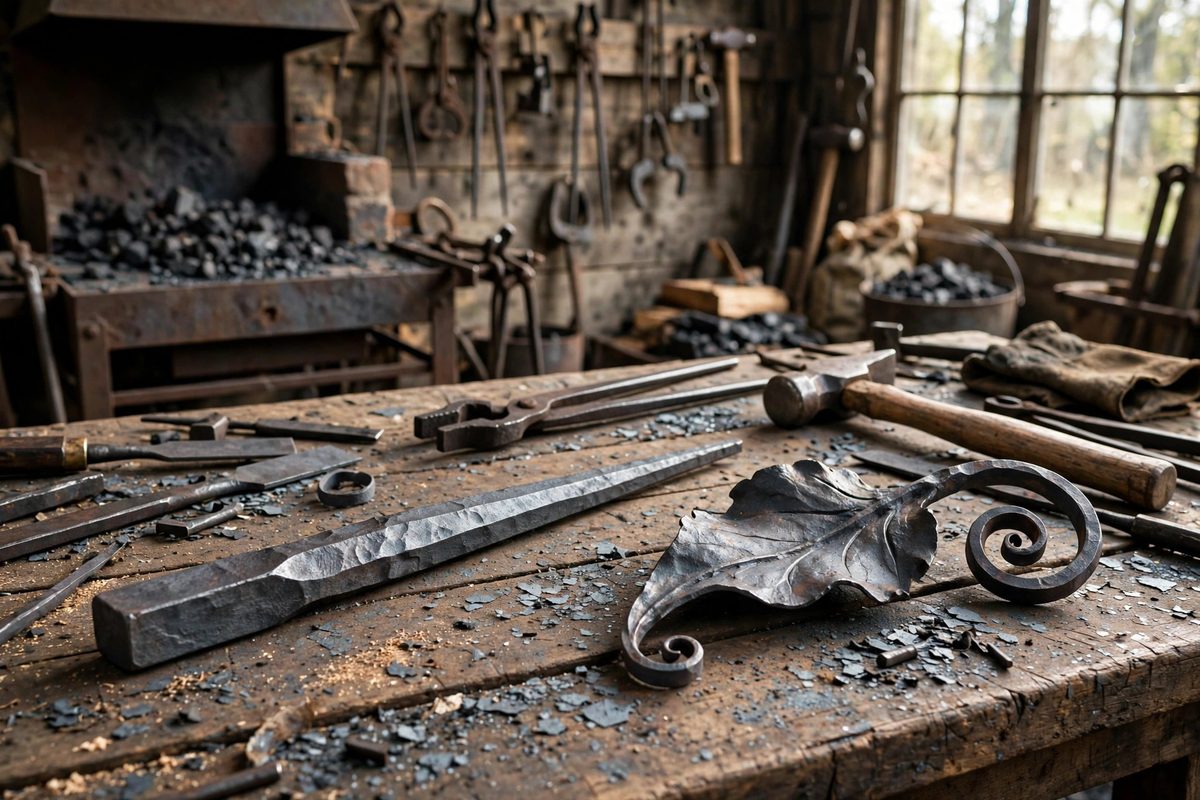
The tapered bar and the scrolled leaf are the alphabet of decorative ironwork: nearly every gate, railing, and bracket ever forged combines drawn tapers and bent scrolls in endless variation. Drawing a taper, forging a bar down to a fine point, teaches heat control and hammer discipline. Bending that taper into a scrolling leaf teaches layout and the feel of hot metal in motion. Together they are the foundation exercises of the ornamental smith, and they remain the visible signature of hand-forged work.
Drawing a taper: the mechanics
To draw a taper, you heat the end of the bar and forge it down, working from the tip backward, so the cross-section shrinks progressively toward the end. The hammer blows fall on the corners first, turning square to octagon to round as the taper develops, or the taper can be left square for a bolder look. Work at a bright forging heat, where the steel moves willingly; cold steel resists and cracks, while overheated steel burns and crumbles. Rotate the bar a quarter turn between blows to keep the taper even on all sides, and keep the taper's length proportional to its ambition: a long, slender taper needs more heats and more patience than a short, stubby one. The most common beginner error is hammering the very tip too thin too fast, creating a fishtail or a cold shut; instead, establish the taper's overall shape first and refine the tip last. A good taper is straight, centered, and evenly reduced, with no lumps where heats overlapped.
Heat control through the taper
The thin tip of a taper cools far faster than the thick parent bar, which creates a constant thermal management problem: by the time you have worked the middle of the taper, the tip is too cold to move. The solution is to work quickly at the tip and to reheat often, sometimes reheating just to finish the last inch. Some smiths cool the thick end deliberately to concentrate the forging heat where it is needed, though this is an advanced touch. Watch the color: work while the steel is bright, stop when it dulls to red, and never forge below a dull red, where the steel is at risk of cracking. Each heat should advance the taper noticeably; if you are making no progress, the steel is too cold or your blows are too timid. Confidence with the hammer matters as much as heat: committed blows move metal, tentative taps just make noise.
From taper to scroll
A scroll is a taper bent into a spiral, and the bending starts where the taper ends. Heat the tapered section evenly, then begin the curl at the tip: bend the fine point around first, using the horn of the anvil, scrolling pliers, or a bending fork, and work backward toward the thicker section, increasing the radius as the material thickens. The classic scroll tightens toward the center, following the natural logic that thin material bends tighter than thick. Keep the scroll in one plane as you bend; a scroll that wanders out of plane looks sloppy and is hard to correct. Work at a good bending heat throughout, reheating as needed, because bending cold steel springs back and work-hardens. The scroll's final shape should be fair and even, with the spacing between turns consistent; the eye forgives small irregularities in handwork but punishes a scroll that is visibly lopsided.
Cutting and forming the leaf
A scrolling leaf adds a forged leaf shape at the scroll's center or tip. Form it by flattening the tapered end into a leaf profile with the hammer, wider in the middle and pointed at the tip, then veining it with a chisel: short, angled cuts pressed into the hot steel that suggest the leaf's veins. The veining must be done at the right heat, hot enough to cut cleanly, not so hot the chisel sinks uncontrollably. Curl the leaf slightly for dimension, giving it a gentle cup that catches light. Then scroll the stem behind it as described above. The leaf-and-scroll combination is greater than its parts: the organic leaf against the geometric scroll is the contrast that makes ornamental ironwork lively. Practice leaves as standalone exercises before combining them with scrolls; each element deserves its own competence.
Safety and the rhythm of the work
Decorative forging involves the standard forge hazards with an added one: long, thin tapers whip and spring unexpectedly when struck, and a hot taper tip can flick toward the smith. Keep your body positioned to the side of the work's likely motion, wear eye protection without exception, and maintain a firm grip with tongs suited to the stock size. The work develops a rhythm, heat, hammer, reheat, bend, and rushing breaks the rhythm and causes the injuries; the steel sets the pace, not your impatience. Quench test pieces and let finished pieces cool in a safe spot where no one will grab them; hot steel looks exactly like cold steel.
Draw the taper straight and even, bend the scroll fair in one plane, vein the leaf with confidence, and let the heat set the pace. These two elements, mastered, unlock the entire vocabulary of decorative ironwork.
Related Guides
- Forge Welding Flux Ratios for Mild Iron Bars: Forge welding joins iron to iron with heat and pressure alone, no filler metal, but the weld only takes if the mating surfaces are clean at the
- Fire Weld Heat Boundaries for Slender Iron Scrolls: Fire welding slender scrollwork is a study in heat control. The pieces are thin, they heat fast, and the difference between a weld that takes and a
- Fluxless Forge Welding in Propane Muffle Forges: Forge welding without flux sounds like a contradiction; flux exists to dissolve the scale that prevents welds. But in a propane muffle forge, the