
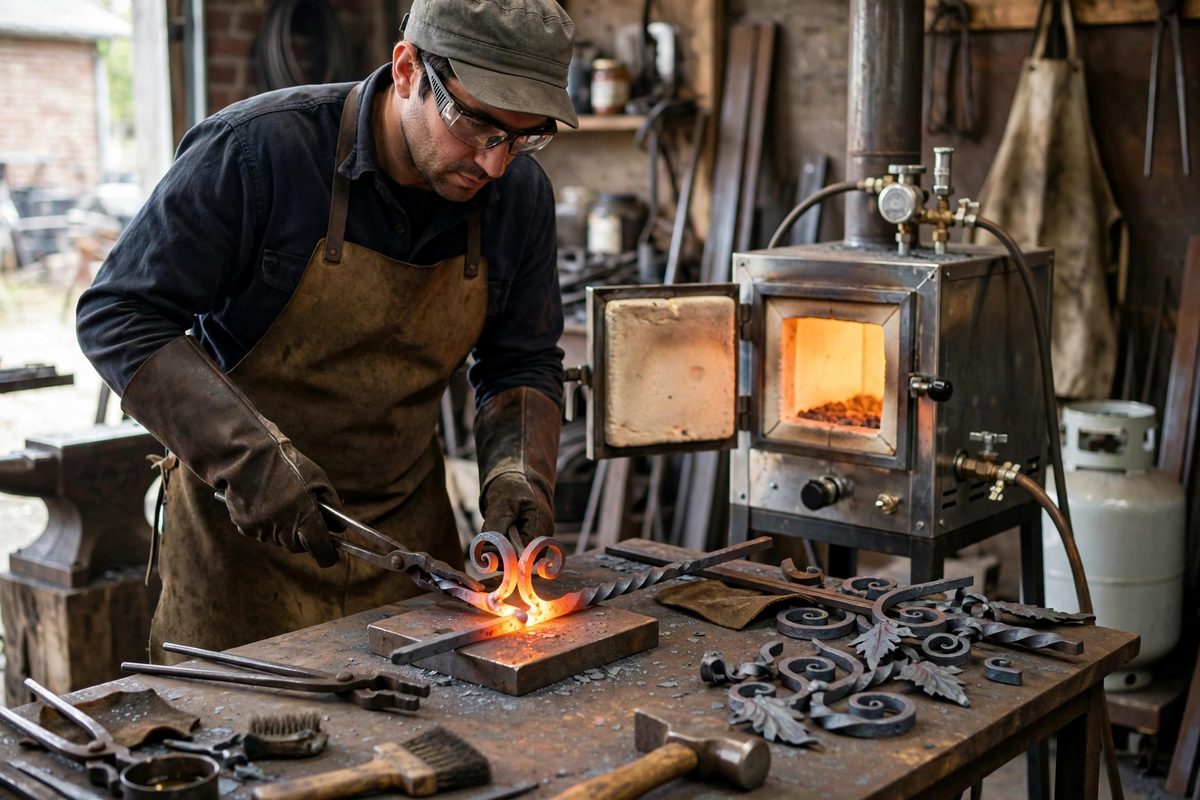
Forge welding without flux sounds like a contradiction; flux exists to dissolve the scale that prevents welds. But in a propane muffle forge, the atmosphere can be controlled tightly enough that scale barely forms, and clean steel welds to clean steel with heat and pressure alone. The technique trades the mess of flux for discipline in fire management.
Why Flux Is Normally Needed
Steel at welding heat oxidizes instantly in air, forming scale that blocks the metal-to-metal contact a weld requires. Flux melts over the joint, dissolving scale and shielding the surfaces from oxygen until the weld closes. Without flux, any oxygen reaching the joint ruins it. The propane muffle forge makes fluxless welding possible because the muffle, an enclosed chamber heated by the burner, can hold a reducing atmosphere: slightly fuel-rich combustion that consumes free oxygen and even reduces light scale. Control the atmosphere and you control the oxidation.
Setting the Muffle Atmosphere
Tune the burner slightly rich, past the point of a clean blue flame toward a flame with soft orange tips and a hint of dragon's breath at the muffle openings. Too lean and the atmosphere oxidizes; too rich and soot deposits on the work and the forge runs cool. The sweet spot shows as clean, scale-free steel coming out of the muffle with a dull glow and no flaking oxide. Learn to read the steel's surface as it soaks: bright and clean means the atmosphere is right, growing scale means it is too lean. Small burner adjustments make big atmospheric differences, so tune patiently.
Preparing the Joint
Fluxless welding is unforgiving of dirty steel. Grind or wire-brush the mating surfaces to bright metal immediately before heating; mill scale, rust, and oil all become weld defects without flux to dissolve them. Fit the joint tightly so the surfaces meet fully under the hammer; gaps become unwelded voids. Some smiths lightly bevel the mating edges to squeeze contaminants out ahead of the weld front. Handle the cleaned steel with gloves from cleaning to forge, because fingerprints are oil and oil is a defect.
The Weld Sequence
Bring the joint to welding heat in the reducing muffle, watching for the surface to reach the bright near-white heat where steel welds. Work quickly but without panic: pull the steel, place it on the anvil, and strike the joint with firm, overlapping blows starting from one end so the weld front progresses and pushes any remaining contamination ahead of it. One heat should close the weld; if it does not take, re-clean and try again rather than hammering cold steel into a false weld that will fail later. A good fluxless weld feels solid under the hammer immediately, with no sponginess or shifting at the joint.
Testing the Weld
Test every fluxless weld before trusting it. Bend the welded section, quench a test piece and break it, or simply work the joint hard at the anvil and watch for any opening. A sound weld behaves as one piece of steel; a failed weld shows a dark line or separates. Decorative ironwork lives or dies on its joints, and a weld that fails in the client's hands is worse than no weld at all. The muffle atmosphere rewards the disciplined smith with clean, flux-free welds and punishes the careless one immediately, which is honestly the best kind of teacher.
Fluxless forge welding in a propane muffle is atmosphere control plus surface preparation: tune the burner rich, clean the steel to bright metal, fit the joint tight, and weld in one confident heat. The weld that results is as clean as the fire that made it.
Related Guides
- Forge Welding Flux Ratios for Mild Iron Bars: Forge welding joins iron to iron with heat and pressure alone, no filler metal, but the weld only takes if the mating surfaces are clean at the
- Drawing Tapers and Bending Scrolling Leaves: The tapered bar and the scrolled leaf are the alphabet of decorative ironwork: nearly every gate, railing, and bracket ever forged combines drawn
- Fire Weld Heat Boundaries for Slender Iron Scrolls: Fire welding slender scrollwork is a study in heat control. The pieces are thin, they heat fast, and the difference between a weld that takes and a