
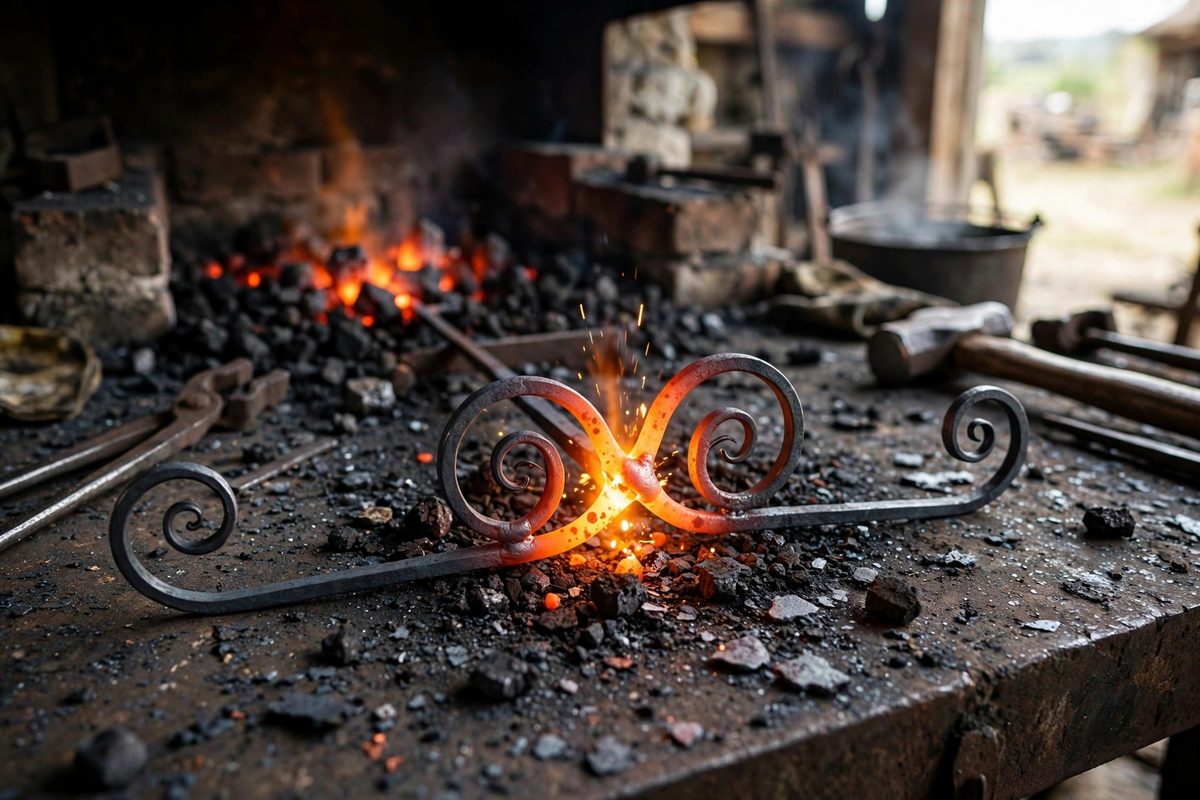
Fire welding slender scrollwork is a study in heat control. The pieces are thin, they heat fast, and the difference between a weld that takes and a piece that burns is a matter of seconds and a few inches of the bar. Managing the heat boundary, the zone of welding heat versus the cooler surrounding metal, is the skill that separates successful scroll welds from ruined stock.
Why Slender Stock Is Unforgiving
Thin scroll material has very little thermal mass. It reaches welding heat quickly, but it also overshoots into burning just as quickly, and it loses heat to the air and to the anvil rapidly once out of the fire. The heat boundary on slender stock is therefore sharp: a short section at welding heat with cooler metal on either side. That sharp boundary is both the challenge and the tool. The weld must be made in the hot zone before it cools, and the cooler adjacent metal must not be dragged into the weld or overheated. Thicker stock forgives sloppy heat management by sheer mass; slender scroll stock does not. Every fire weld on thin material is a timed operation.
Setting the Heat Boundary in the Fire
Build a clean, deep fire with a well-formed cave of coke around the work. Position the joint so only the weld zone sits in the hottest part of the fire; the rest of the scroll should be shielded by the fire's cooler edges or by the mass of surrounding coke. This selective heating is how you set the boundary before the steel ever leaves the fire. Watch the color: the weld zone should reach a bright yellow, near-white heat with the surface looking almost wet, while the adjacent metal stays at orange or below. Flux at the right moment, when the steel is hot enough to melt the flux but not yet at welding heat, so the flux flows into the joint and protects it during the final heat. A common mistake is heating the whole scroll evenly; then everything is at welding heat, nothing can be handled, and the thin sections burn.
The Weld: Speed and Placement
Pull the work at welding heat and move fast. Place the joint on the anvil and strike with quick, firm blows starting at the center of the weld and working outward; this squeezes flux and scale out of the joint instead of trapping it. The blows should be confident but not brutal; slender stock deforms easily, and the goal is to unite the surfaces, not to reshape the scroll. Work within the heat: you typically get a handful of good blows before the thin stock drops below welding temperature. If the weld does not take, re-flux and reheat rather than hammering cold; hammering below welding heat just work-hardens the joint and guarantees a cold shut. A good fire weld on scrollwork shows as a nearly invisible line after dressing.
Protecting the Surrounding Scroll
The already-formed parts of the scroll must survive the welding heat. Keep finished curves and details out of the hot zone, and quench adjacent areas lightly if needed to stop heat creep, though quenching near the weld can chill the joint, so judge the distance. Plan the fabrication sequence so welds happen before the most delicate details are formed; it is far easier to scroll a welded joint than to weld next to a finished scroll. If a nearby section does overheat and lose its shape, it can usually be re-formed while hot, but repeated overheating burns the steel and ruins the surface. One clean heat beats three marginal ones.
Dressing and Finishing the Weld
After the weld takes, dress it while still hot: light hammer work blends the joint into the surrounding stock so the scroll's lines flow uninterrupted. Let the piece cool naturally; quenching decorative ironwork can harden thin sections unpredictably. Once cool, wire-brush the joint to check for cracks or incomplete fusion, which show as dark lines. A sound weld brushes clean and bright like the parent metal. Finish the scroll with the usual surface treatment, and the fire welds should be essentially invisible, which is the whole aesthetic point of forge-welded scrollwork: joints that disappear.
Fire welding slender scrolls is heat-boundary management: heat only the joint, flux at the right color, weld fast within the heat, and protect the finished work. Sharp boundaries, quick hands, and clean fires make invisible welds.
Related Guides
- Forge Welding Flux Ratios for Mild Iron Bars: Forge welding joins iron to iron with heat and pressure alone, no filler metal, but the weld only takes if the mating surfaces are clean at the
- Drawing Tapers and Bending Scrolling Leaves: The tapered bar and the scrolled leaf are the alphabet of decorative ironwork: nearly every gate, railing, and bracket ever forged combines drawn
- Fluxless Forge Welding in Propane Muffle Forges: Forge welding without flux sounds like a contradiction; flux exists to dissolve the scale that prevents welds. But in a propane muffle forge, the