
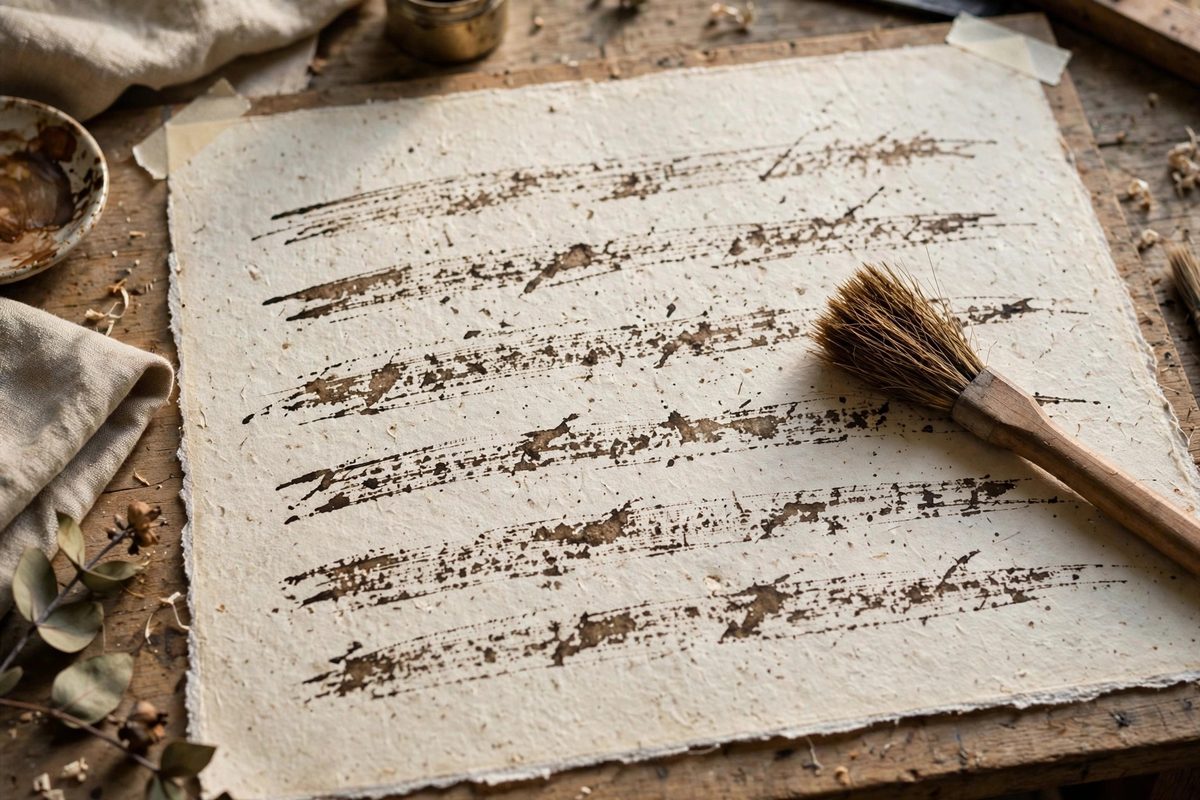
Dry brush lettering, where a relatively dry brush skips across the paper leaving broken, textured strokes, is a study in controlled imperfection. On textured parchment, the paper's tooth grabs the brush unevenly by nature, which is both the opportunity and the hazard: the texture can produce gorgeous broken edges, or it can snag the brush and ruin the stroke. Pressure timing, when and how hard you press during each stroke, is the control you have over that collaboration between brush and paper.
How Dry Brush Interacts With Texture
A dry brush carries little paint, so the stroke deposits color only where the bristles touch the paper's high points. On smooth paper, the result is a fairly even broken line; on textured parchment, the high points are irregular, so the stroke breaks into an organic, varied pattern. Press harder and more bristles contact more high points, filling in the texture; press lighter and only the tallest points catch paint, leaving an airy, sparse mark.
The parchment's texture is fixed, but your pressure is variable throughout the stroke. That means a single stroke can move from dense to broken and back, creating the swelling, breathing quality that makes dry brush lettering lively. The pressure envelope of each stroke is the design.
The Pressure Envelope of a Stroke
Think of each stroke as having a pressure timeline: touch down lightly, build pressure through the stroke's belly, and release as the stroke ends. The touchdown sets the stroke's beginning character; a feather-light touchdown gives a wispy start, while a firm plant gives a bold one. The pressure peak determines the stroke's maximum density. The release shapes the ending: a gradual lift trails off into texture, while an abrupt lift leaves a blunt, charged end.
On textured parchment, the timing of these phases matters more than on smooth paper, because the texture amplifies every pressure change. A pressure shift that would be subtle on smooth paper becomes dramatic on tooth. This is why dry brush on parchment looks so expressive with so little effort, and why it also goes wrong so quickly when the pressure is careless.
Loading the Brush for Texture Work
Load the brush, then remove most of the paint: wipe it, brush it out on scrap, work it until the brush feels almost dry. The right load for textured parchment is drier than beginners expect; the parchment's tooth will pull paint off the brush efficiently, and an overloaded brush floods the texture and kills the broken effect. You can always add paint; you cannot un-flood a stroke.
- Test the load on scrap parchment of the same stock; the texture match matters.
- Reload before the brush goes completely dry unless the fading tail is the effect you want.
- Keep a consistent load across a word; varying dryness within a word looks accidental.
- Clean and reshape the brush when paint builds up at the ferrule; dried paint there stiffens the bristles.
Speed as a Pressure Partner
Stroke speed interacts with pressure: a fast stroke with light pressure skips dramatically across the texture, while a slow stroke with the same pressure deposits more paint as the bristles dwell on each high point. Most dry brush lettering lives in the medium-fast range, where the stroke has energy and the texture breaks it up naturally.
Slow down deliberately for emphasis strokes, the moments where you want density and presence. The contrast between fast, broken strokes and slow, dense ones is the dynamic range of dry brush lettering. Without that contrast, the work goes flat; every stroke at the same speed and pressure is just texture without music.
Practicing the Feel
Dry brush pressure timing is a hand skill that lives in the muscles, not in the head. Practice alphabets focusing on one variable at a time: a page of strokes varying only the touchdown pressure, then a page varying only the release. The parchment will show you exactly what each change does, and your hand will learn the mapping faster than any explanation.
Work large when practicing. Small dry brush work demands a precision that fights the technique's nature; larger strokes let the pressure envelope breathe and the texture speak. Scale down only after the hand knows the moves.
Touch light, build through the belly, release with intention, and let the parchment's tooth do half the work. Dry brush on texture is a duet between your pressure and the paper's surface, and the best strokes sound like both players listening.
Related Guides
- Pressure Ratios for Flexible Brush Calligraphy: Flexible brush calligraphy creates its signature thick-and-thin contrast through pressure: press harder and the bristles spread, laying down a broad
- Fine Hair Spring Tensioning for Controlled Brush Lines: A fine brush line, the hairline stroke of pointed pen or brush lettering, is controlled not by the hand alone but by the brush's spring: the way the
- Nib Angle Consistency in Textura Quadrata Lettering: Textura quadrata, the dense blackletter of medieval manuscripts, gets its unmistakable texture from one thing above all: the broad nib held at a
- Gum Arabic Dilution for Pointed Pen Pigments: Pointed pen work with pigments, gouache, watercolor, or powdered color mixed by hand, depends on a binder that flows off the nib smoothly and dries
- Calculating Baseline Ratios in Rotunda Scripts: Rotunda, the rounded southern European book hand, has a distinctive compact rhythm that comes from its proportions. The baseline ratios, the