
A fine brush line, the hairline stroke of pointed pen or brush lettering, is controlled not by the hand alone but by the brush's spring: the way the bristles flex under pressure and snap back to a point when released. Tuning that spring tension, through brush selection, loading, and handling, is what makes hairlines consistent instead of accidental.
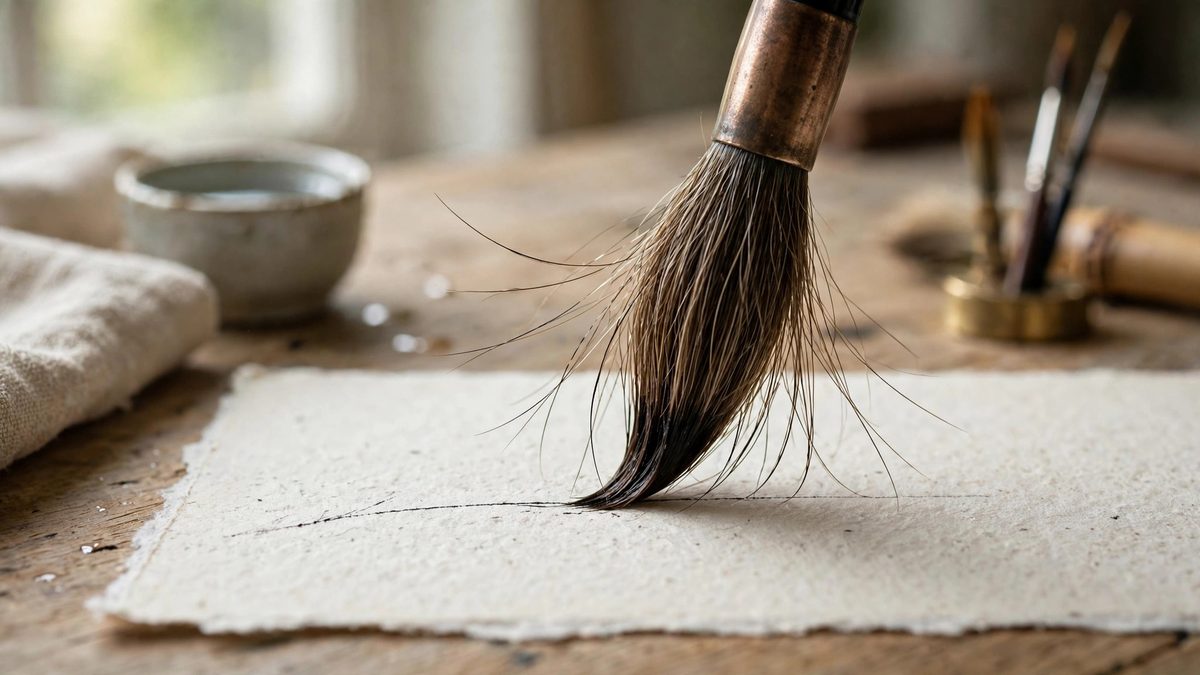
How Brush Spring Works
Brush bristles are tiny cantilevers; pressure bends them and their elasticity returns them. A brush with good spring bends smoothly under light pressure and snaps back to a fine point instantly when pressure releases. Too stiff a brush needs heavy pressure to make any mark, producing scratchy uneven hairlines; too soft a brush collapses and will not return to a point, producing blobbed starts. The spring must match the line weight: fine hairline work wants a responsive brush that moves with minimal pressure and recovers crisply.
Selecting the Brush
For controlled fine lines, choose a brush with a fine point, good belly for ink capacity, and lively spring. Natural hair, particularly sable and squirrel blends, offers the best combination of point and spring, though quality synthetics have closed the gap considerably. Test the spring before buying if possible: wet the brush, flick it, and watch the point reform; a good brush snaps back instantly, a poor one stays splayed. The brush size should suit the lettering scale; an oversized brush on small lettering forces the hand to work at the very tip, where control is worst.
Loading for Hairlines
The ink load affects the spring directly: an overloaded brush is heavy and sluggish, while a properly loaded brush stays responsive. Load the brush fully but then work some ink out on a test surface until the brush makes a clean hairline without flooding. The consistency of the ink matters too; ink too thick drags and needs extra pressure, ink too thin floods the hairline. For the finest lines, many letterers keep the brush slightly less loaded than for shaded strokes, trading capacity for control. The brush should feel alive in the hand, not laden.
Pressure Technique
Hairlines are made with the brush barely touching the surface, using only the very tip. The hand's job is to guide, not to press; pressure comes from the brush's own weight plus the lightest finger guidance. Keep the brush relatively upright for hairlines, since a low angle lays more bristle on the surface and thickens the line. Move with the whole arm for long hairlines rather than just the fingers, because arm movement is smoother and more consistent. The transition between hairline and shaded stroke is a pressure gradient, and practicing that gradient slowly builds the muscle memory that makes it automatic.
Maintaining the Point
A brush that will not hold its point cannot make controlled hairlines. Rinse the brush thoroughly but gently, reshape the point with the fingers, and store it point-up or hanging so the bristles are not bent in storage. Never leave a brush standing on its tip in water; the bent bristles lose their spring permanently. Condition natural hair brushes occasionally with a tiny amount of appropriate conditioner to keep the bristles supple. The brush is a precision instrument; the spring tension you depend on is a property you maintain, not one you can take for granted.
Choose a brush with lively spring, load it for responsiveness rather than capacity, touch the surface with only the tip, and maintain the point religiously. The hairlines will come out fine, consistent, and controlled, which is the whole art of the thing.
Related Guides
- Pressure Ratios for Flexible Brush Calligraphy: Flexible brush calligraphy creates its signature thick-and-thin contrast through pressure: press harder and the bristles spread, laying down a broad
- Dry Brush Pressure Timing on Textured Parchment: Dry brush lettering, where a relatively dry brush skips across the paper leaving broken, textured strokes, is a study in controlled imperfection. On
- Nib Angle Consistency in Textura Quadrata Lettering: Textura quadrata, the dense blackletter of medieval manuscripts, gets its unmistakable texture from one thing above all: the broad nib held at a
- Gum Arabic Dilution for Pointed Pen Pigments: Pointed pen work with pigments, gouache, watercolor, or powdered color mixed by hand, depends on a binder that flows off the nib smoothly and dries
- Calculating Baseline Ratios in Rotunda Scripts: Rotunda, the rounded southern European book hand, has a distinctive compact rhythm that comes from its proportions. The baseline ratios, the