
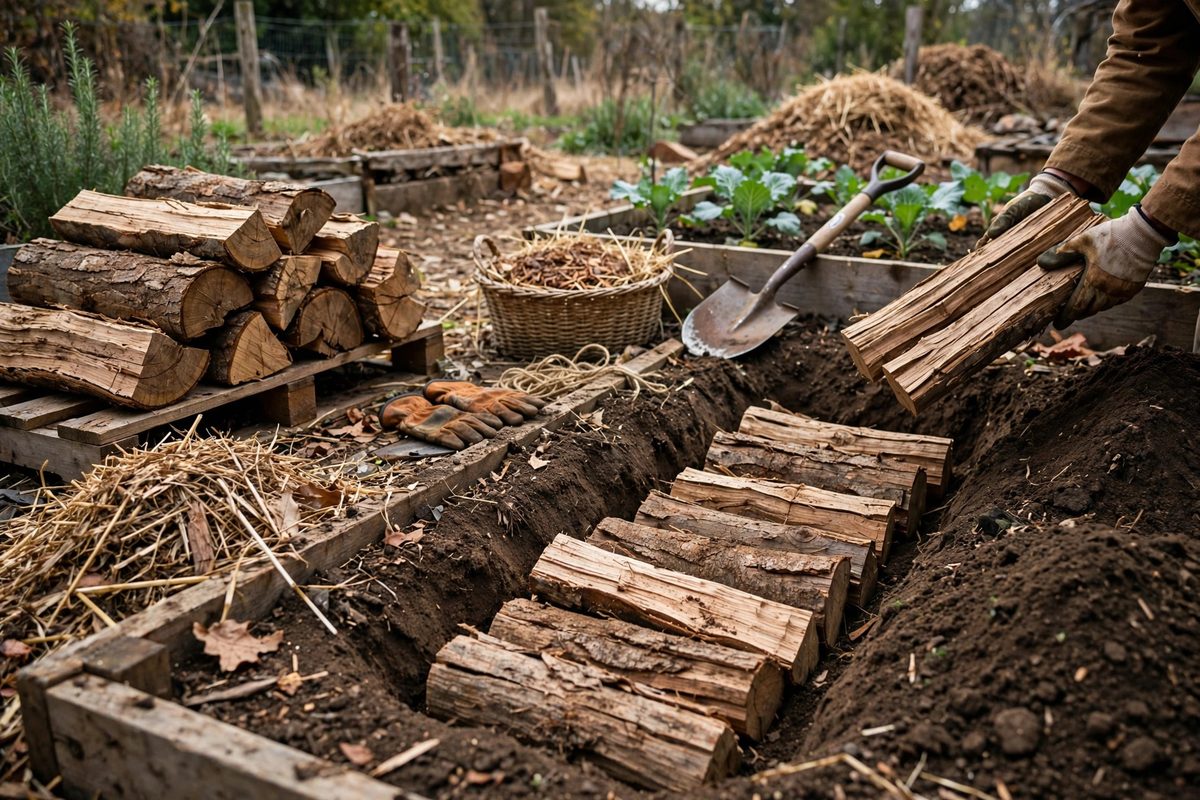
Burying wood in garden beds, the practice behind hugelkultur mounds and woody sub-surface layers, builds long-term fertility as the logs slowly decompose. But fresh, wet logs buried under soil and mulch create a hidden hazard that surprises many gardeners: under the right conditions, buried woody material can smolder and flare, especially where sub-surface heat builds up. Properly drying and preparing logs before burial is what separates a productive bed from a slow-burning problem. The physics involved are the same ones behind compost fires, and they deserve respect.
How buried wood becomes a fire risk
Microbial decomposition generates heat; that is the same heat that makes a compost pile steam. In a large mass of buried woody material with limited airflow, heat accumulates faster than it dissipates, and interior temperatures can climb far beyond what the surface suggests. If pockets of dry, fine woody material exist within that hot mass and air finds its way in, smoldering combustion can begin deep underground, invisible until it breaks the surface as a flare-up. The dangerous combination is partially dried wood (dry enough to burn, not dry enough to be inert), fine material mixed with coarse logs (kindling among the fuel), and restricted but nonzero airflow. Fresh green logs are actually less risky than half-dried ones, because their high moisture content absorbs heat; it is the in-between state, damp on the outside and dry inside, that burns best.
Drying logs before burial
The single most effective prevention is to dry logs thoroughly before they go underground. Season cut logs above ground for several months, ideally through a full dry season, stacked off the ground with air circulation, exactly as you would season firewood. The goal is wood that is uniformly dry, not wood with a dry shell and a wet core. Split large logs to speed drying and to eliminate the moisture gradient that makes half-dried wood so flammable. As a practical test, the logs should feel light for their size, the ends should show checking, and two pieces knocked together should ring rather than thud. Uniformly dry wood buried in a bed decomposes slowly and predictably; it is the unevenly dried log that creates the hazardous pockets.
Bed design that prevents heat buildup
How you build the bed matters as much as how you dry the wood. Keep woody layers modest in depth and intersperse them with soil, which conducts heat away and breaks up continuous fuel beds. Avoid burying large quantities of fine woody material, wood chips, sawdust, and bark fines decompose hot and fast, and a thick layer of fines is the closest thing to a buried kindling pile. Mix particle sizes so air and moisture move through the bed rather than channeling. In particular, do not combine deep woody layers with nitrogen-rich materials in a way that supercharges microbial heating right against the wood; the hottest composting should happen in a managed pile, not inside a planting bed. Sub-surface irrigation lines add another consideration: keep drip lines from creating persistently saturated zones against woody layers, since wet-dry cycling accelerates the decay that generates heat.
Monitoring and early warning
A bed with substantial buried wood deserves occasional checking, especially in its first hot season. Push a long thermometer or a metal rod deep into the bed; if it comes out too hot to hold comfortably, the interior is running hotter than it should. Surface signs include soil that stays warm to the touch, unusual steam on cool mornings, or a sweet-sour smell of intense decomposition. If you suspect overheating, water the bed deeply: saturating the woody layer both cools it and displaces the air pockets that smoldering needs. For a bed that repeatedly runs hot, excavating and rebuilding with drier wood and more soil separation is the honest fix. Never ignore a bed that smells like smoke; investigate immediately.
Responding to a sub-surface fire
If buried material ignites, treat it as a real fire even though it is underground. Soak the area thoroughly and repeatedly, since sub-surface fires survive a single watering by smoldering in dry pockets. Excavate to expose the burning material if you can do so safely, separating burning wood from unburned fuel. Keep a hose running and watch the area for days afterward, because deep smoldering fires are notorious for rekindling. Call the fire department if the fire is beyond a small, accessible pocket or if it threatens structures; sub-surface fires have a way of traveling along buried fuel that amateurs consistently underestimate. Prevention, dry wood and sane bed design, is profoundly easier than suppression.
Buried wood is a wonderful slow-release fertility engine when it is dry, well-separated by soil, and built in moderation. Give logs a proper drying season, design beds that shed heat instead of hoarding it, and check on them; the flare-ups happen to beds that were buried and forgotten.
Related Guides
- Pressure Drop Calculation in Sub-Surface Drip Lines: Sub-surface drip lines water from below, putting moisture at the root zone with almost no evaporation loss. But buried emitters cannot be watched, so
- Pressure Compensating Emitter Spacing for Terraces: Terraced gardens defeat ordinary drip irrigation: water pressure changes with elevation, so emitters at the bottom of a slope deliver far more water
- Sizing Siphon Relief Valves in Gravity Drip Systems: Gravity drip systems are beautifully simple: an elevated tank, some tubing, and emitters, with no pump. But gravity creates a siphon problem: when
- Pressure Drop Compensating Valves in Raised Drip Runs: A drip run climbing a slope delivers uneven water: the emitters at the bottom drown and the emitters at the top barely drip. Pressure-compensating