
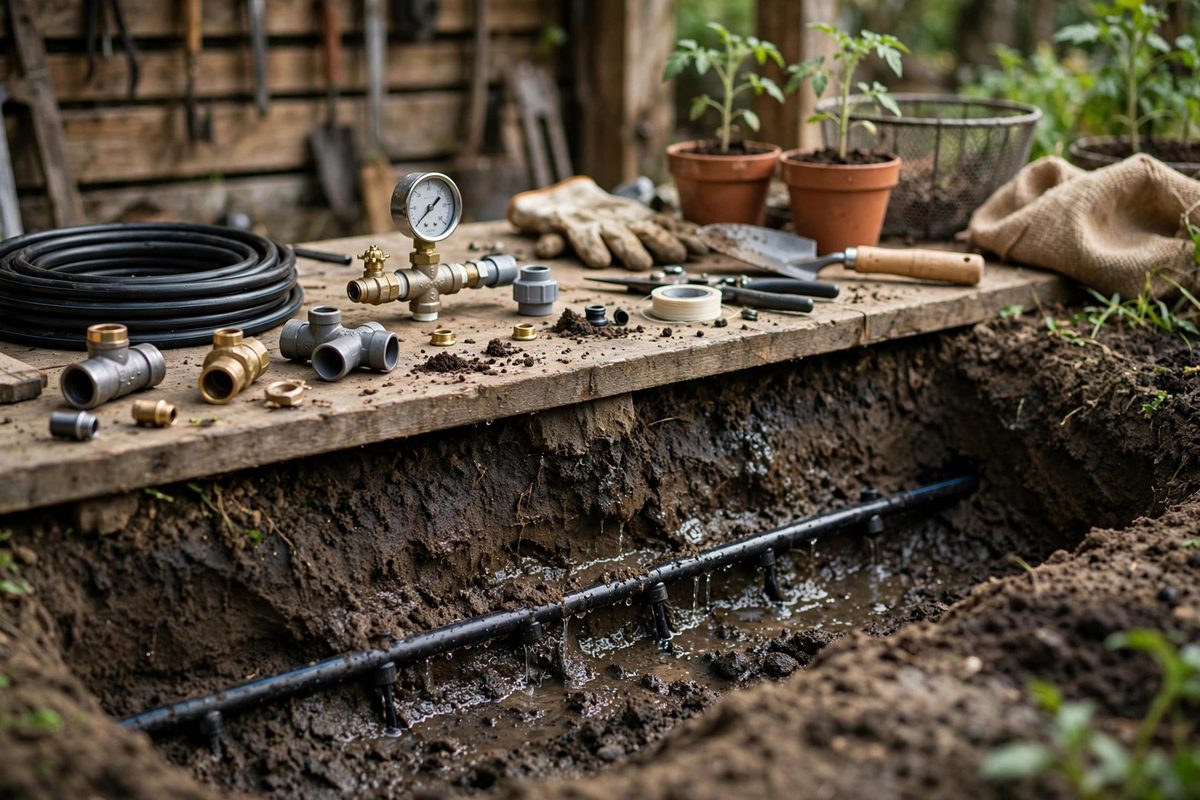
Sub-surface drip lines water from below, putting moisture at the root zone with almost no evaporation loss. But buried emitters cannot be watched, so uniform watering depends entirely on the hydraulics: every emitter along the line must see enough pressure to drip at its rated rate. Pressure drop (friction loss as water travels down the line) is the enemy, and calculating it before you bury the pipe is the difference between an even garden and a soggy near end with a dry far end.
Why Pressure Drop Matters Underground
Water loses pressure to friction with every foot of pipe it travels, and emitter flow rate depends on pressure. If the line loses half its pressure from inlet to end, the far emitters deliver substantially less water than the near ones, and no amount of run-time adjustment fixes the imbalance: longer runs just overwater the near end further. Because the lines are buried, you discover this by watching plants, months later. The calculation exists so you discover it on paper, in ten minutes.
The Inputs You Need
Four numbers drive the calculation: line length, pipe diameter, total flow rate, and emitter spacing. Total flow is the number of emitters times each emitter's rated flow. Pipe diameter matters enormously because friction loss scales roughly with the inverse fifth power of diameter: a small increase in pipe size cuts friction dramatically. This is why experienced installers upsize lateral lines; the extra pipe cost is trivial compared to digging up a failed system.
Doing the Math
The standard tool is the Hazen-Williams equation, which gives friction loss per 100 feet of pipe from flow rate, diameter, and a roughness coefficient (around 150 for smooth polyethylene drip tubing). You do not need to derive it; online calculators and irrigation charts tabulate the results. The design target: keep total friction loss under about 10 to 15 percent of your inlet pressure. So on a 30 psi inlet, lose no more than about 3 to 4 psi along the longest lateral. If the calculation shows more, the fixes are: shorten the lateral, increase the pipe diameter, or split the zone into two shorter runs fed from a manifold.
Emitter Type and Pressure Compensation
Pressure-compensating emitters contain a flexible diaphragm that holds flow nearly constant across a range of pressures (typically 10 to 50 psi), which forgives modest pressure drop along the line. Non-compensating emitters follow the pressure directly, so they demand tighter hydraulic design. For sub-surface installations, pressure-compensating emitters are worth the small premium precisely because you cannot see or easily adjust what is happening underground. They do not fix grossly bad hydraulics, but they absorb the normal variation of a well-designed line.
Elevation Changes Count Too
Friction is only half the story; elevation adds or subtracts about 0.43 psi per foot of rise or fall. A lateral running downhill gains pressure at the far end (which can overwater and even blow emitters), while one running uphill loses it. On sloped ground, account for elevation in the same calculation as friction, and consider pressure-regulating valves or check valves at zone inlets to keep the system behaved. This is the detail most DIY designs miss, and it is the one that shows up as a mysteriously lush low spot.
Verify Before You Bury
Run the system on the surface before backfilling. Cap the ends, pressurize, and measure flow at the farthest emitter with a bucket and a stopwatch; compare it to the rated flow and to the nearest emitter. If the numbers are within about 10 percent, bury with confidence. Install flush valves at the low ends of each lateral while everything is still exposed, because sub-surface lines need periodic flushing to clear sediment, and a buried line with no flush point is a line you will eventually abandon.
Sub-surface drip is wonderfully efficient and completely unforgiving of bad hydraulics. Calculate the pressure drop, keep it under 15 percent of inlet pressure, use pressure-compensating emitters, account for elevation, and test before you bury. Do that and the system waters evenly for years with nothing visible but healthy plants.
Related Guides
- Pressure Drop Compensating Valves in Raised Drip Runs: A drip run climbing a slope delivers uneven water: the emitters at the bottom drown and the emitters at the top barely drip. Pressure-compensating
- Drying Sub-Surface Fire Logs to Prevent Flare-Ups: Burying wood in garden beds, the practice behind hugelkultur mounds and woody sub-surface layers, builds long-term fertility as the logs slowly
- Sizing Siphon Relief Valves in Gravity Drip Systems: Gravity drip systems are beautifully simple: an elevated tank, some tubing, and emitters, with no pump. But gravity creates a siphon problem: when
- Pressure Compensating Emitter Spacing for Terraces: Terraced gardens defeat ordinary drip irrigation: water pressure changes with elevation, so emitters at the bottom of a slope deliver far more water