
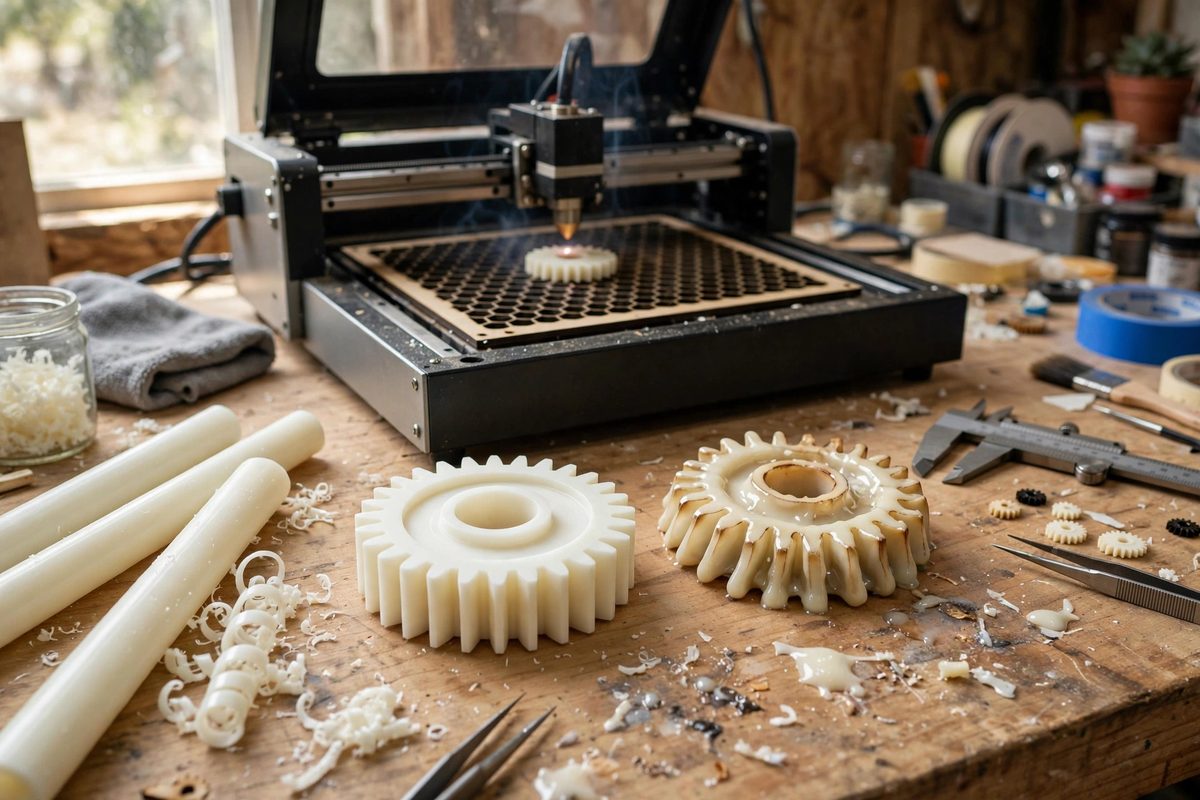
Delrin, the acetal homopolymer prized for gears, cuts on a laser with a personality: it machines beautifully but melts readily, and the line between a crisp gear tooth and a gummy mess is the pulse frequency. Pulsed laser operation, firing the beam in rapid bursts rather than a continuous stream, controls how heat accumulates in the cut. Get the frequency right and the teeth come out sharp with smooth flanks; get it wrong and the Delrin melts, reflows, and loses the dimensional accuracy that makes it worth cutting in the first place.
Why Delrin Needs Pulsing
Delrin has a low melting point relative to the laser's energy and poor thermal conductivity, which means heat deposited by the beam stays local instead of spreading away. A continuous beam pours energy into the cut faster than the material can carry it off, so the zone around the cut melts, and molten Delrin does two bad things: it reflows into the tooth profile, rounding the crisp edges gears need, and it can ignite, since acetal burns readily once molten. Pulsing breaks the energy delivery into bursts separated by cooling intervals. During each off-interval, heat conducts away from the cut zone into the surrounding material and the assist gas carries heat off. The material still vaporizes during the pulses, which is the cutting action, but the average heat input drops, and the melt zone shrinks to a thin skin instead of a deep puddle.
Frequency, Power, and the Heat Balance
Pulse frequency and power interact to set the average energy delivery. Higher frequency at the same peak power means more pulses per second, more average power, more heat. Lower frequency means longer cooling intervals but also longer individual pulses if the duty cycle stays constant, which can dump too much energy per pulse. The practical tuning approach is to think in terms of energy per unit length of cut: the combination of frequency, pulse energy, and cutting speed that vaporizes the material in the kerf without overheating the surroundings. For thin Delrin gear stock, moderate frequencies with moderate speeds usually win: enough pulses to keep the cut continuous, enough off-time to keep the teeth crisp. Thick stock needs more total energy, which usually means slowing down rather than cranking frequency, because slowing down preserves the cooling intervals that protect the tooth profile.
Tooth Profile Accuracy
Gears live or die on tooth geometry: the involute flanks must mesh with their mates, and even small distortions cause binding, noise, and rapid wear. Laser cutting introduces two profile errors to manage. First, the kerf has width, so the cut edge sits offset from the drawn line; compensate with kerf offset in the design, cutting slightly outside the nominal profile so the finished tooth matches dimension. Second, heat distortion rounds sharp features: the tooth tips and roots, where the laser dwells slightly longer during direction changes, see extra heat and melt more. Higher pulse frequency with lower energy per pulse reduces dwell overheating at corners, because the cooling intervals persist even when the head slows. Test with a small gear section, measure the teeth with calipers, and mesh it with its mate before cutting the full gear: a gear that looks right but does not turn smoothly is scrap.
Edge Finish and Post-Processing
A well-tuned pulsed cut leaves Delrin edges that are smooth, slightly glossy, and dimensionally true, often good enough to use as-cut for the tooth flanks. The cut surface will have a thin heat-affected layer; in Delrin this is usually cosmetic rather than structural at gear scales, but heavy melting leaves a weakened, discolored skin that wears faster. If the edges show excessive melting, the frequency is too high or the speed too slow: adjust one variable at a time. Light cleanup with fine abrasive can true up minor imperfections, but sanding gear teeth changes their profile, so treat post-processing as defect removal, not as a shaping step. The bore, where the gear mounts to its shaft, deserves special attention: a melted or oversized bore means a sloppy fit and a wobbling gear, so cut bores conservatively and ream to final size if precision matters.
Safety: Acetal Fumes
Laser-cutting Delrin produces formaldehyde among its decomposition products, which is a serious respiratory hazard. This is not a material to cut without proper fume extraction: a well-sealed exhaust system venting outdoors, not a room air filter, is the requirement. The fire risk is also real: Delrin ignites readily and burns hot, so never leave the laser unattended during Delrin cuts, keep the cutting area clean of debris, and know where the fire extinguisher is. These are not footnotes; they are the conditions under which Delrin cutting is acceptable at all. A gear is never worth a lungful of formaldehyde or a shop fire.
Delrin gears reward pulsed cutting: bursts of energy separated by cooling time, tuned so the kerf vaporizes cleanly without melting the teeth. Compensate for kerf, protect the tooth profile at corners, extract the fumes properly, and test-mesh before committing. The result is gears that turn like they were machined, because thermally, they nearly were.
Related Guides
- Nitrogen Assist Pressure Settings for Thin Delrin: Delrin, the acetal homopolymer sold under that trade name, cuts beautifully on a laser and punishes sloppy assist gas settings without mercy. Thin
- Air Assist Pressure Tuning on Acrylic Cuts: Air assist, the jet of air blown through the nozzle along the beam path, is the difference between a flame-polished acrylic edge and a sooty melted
- Focal Length Lens Selection for Thin Wood Piercing: Laser piercing of thin wood, cutting delicate fretwork, inlays, and fine details in material a few millimeters thick, is a focus problem before it is
- Nitrogen Assist Pressure for Clean Stainless Cuts: Stainless steel cut with oxygen assist comes out with a dark, oxidized edge that needs cleanup; cut with nitrogen, it comes out bright, clean, and