
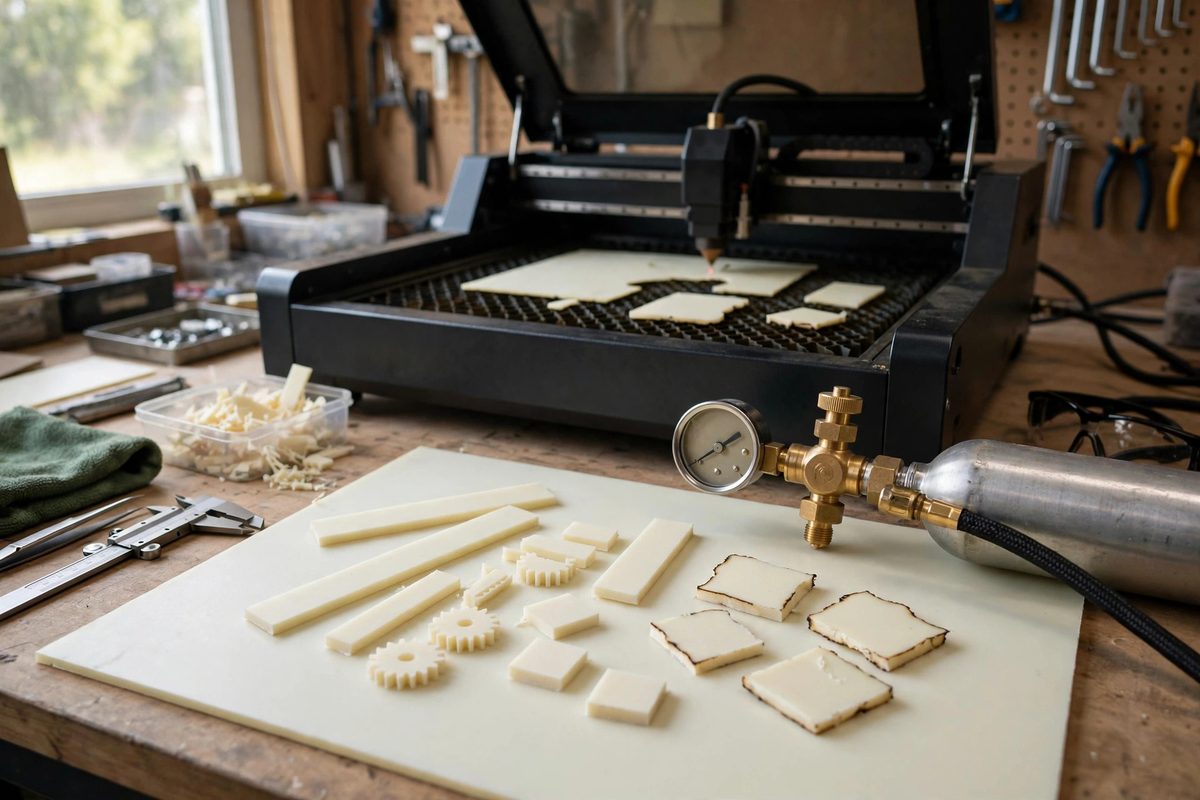
Delrin, the acetal homopolymer sold under that trade name, cuts beautifully on a laser and punishes sloppy assist gas settings without mercy. Thin Delrin sheet wants nitrogen as the assist gas rather than air or oxygen, because nitrogen's inertness prevents the edge oxidation and discoloration that oxygen-rich assist causes, and its clean blow keeps the narrow kerf clear of re-deposited melt. The pressure setting is the variable that decides between a crisp edge and a scorched, warped mess.
Why nitrogen for Delrin
Laser cutting is part thermal process, part chemistry. Oxygen assist feeds an exothermic reaction that adds heat to the cut, which helps with steel but is exactly wrong for an engineering plastic: the extra heat chars the Delrin edge, yellows it, and can ignite thin sections. Air is mostly nitrogen but carries enough oxygen to cause edge discoloration on Delrin's famously clean-cutting formulation. Pure nitrogen supplies the mechanical job of the assist gas, blowing molten material out of the kerf and shielding the cut zone, without contributing any chemistry.
The result, when the pressure is right, is the edge Delrin is known for: smooth, nearly polished, dimensionally accurate, with no discoloration. That edge quality is why people laser Delrin for gears, jigs, and mechanical parts in the first place, so the assist gas setting is protecting the entire reason for choosing the material.
Pressure's two jobs
Assist pressure does two things simultaneously: it ejects molten material from the kerf, and it cools the surrounding material. Too little pressure and the melt is not cleared; it re-solidifies in the kerf, welding the cut shut behind the beam or leaving a rough, dribbly edge. Too much pressure and the gas jet cools the cut zone excessively, wastes gas, and, on thin sheet, can physically deflect the material or blow small cut parts out of the sheet before the cut finishes.
Thin Delrin narrows this window because there is little material to absorb excess cooling and little stiffness to resist the gas jet's mechanical force. The pressure that works for quarter-inch Delrin will be too aggressive for sixteenth-inch sheet. Treat every thickness as its own setup.
Finding the pressure for thin sheet
Start from the laser manufacturer's baseline for thin plastics and adjust by test cuts, since the right pressure depends on the nozzle diameter, the focal length, and the specific machine's gas delivery. Cut a test pattern, a small grid of squares or circles, at several pressures, and inspect the edges: the correct pressure leaves edges that are smooth, clear or very slightly frosted, with no yellowing, no melt beads along the cut line, and no taper beyond what the beam's focus naturally produces.
Signs of too little pressure include rough edges, visible re-solidified droplets, cuts that do not separate cleanly, and a wider heat-affected zone. Signs of too much include parts shifting or lifting during the cut, excessive frosting from over-cooling, and in extreme cases, warping of the thin sheet from the gas jet's force. Adjust in small steps; the window for thin Delrin is narrower than intuition suggests.
Nozzle standoff and gas flow geometry
Pressure at the regulator is only half the story; what matters is the gas velocity at the cut, which depends on nozzle diameter and standoff distance. A smaller nozzle orifice concentrates the same pressure into a faster, more forceful jet, which can overdrive thin sheet even at modest regulator settings. Keep the standoff consistent, since the jet spreads and slows with distance, and a standoff that drifts during the cut changes the effective assist mid-job.
Check that the nozzle is centered on the beam. An off-center nozzle blows the assist jet asymmetrically, clearing one side of the kerf well and leaving melt on the other, which produces edges that are clean on one side and rough on the other. This misalignment masquerades as a pressure problem and wastes a lot of test material before it is caught.
Ventilation and material safety
Laser cutting Delrin releases formaldehyde gas, which is a genuine health hazard, not a theoretical one. Cut only with proper exhaust ventilation that captures fumes at the machine, and never leave the laser unattended while cutting Delrin; the material can ignite if the settings go wrong, and thin sheet ignites more readily than thick. Keep a fire watch routine for every job, and know where the extinguisher is before pressing start.
Dial in the nitrogen pressure with test cuts, keep the nozzle geometry consistent, and ventilate properly. Thin Delrin rewards precision with edges that need no finishing, which is the entire point of putting it on the laser.
Related Guides
- Nitrogen Assist Pressure for Clean Stainless Cuts: Stainless steel cut with oxygen assist comes out with a dark, oxidized edge that needs cleanup; cut with nitrogen, it comes out bright, clean, and
- Air Assist Pressure Tuning on Acrylic Cuts: Air assist, the jet of air blown through the nozzle along the beam path, is the difference between a flame-polished acrylic edge and a sooty melted
- Dual Laser Pulse Frequency for Delrin Gears: Delrin, the acetal homopolymer prized for gears, cuts on a laser with a personality: it machines beautifully but melts readily, and the line between
- Focal Length Lens Selection for Thin Wood Piercing: Laser piercing of thin wood, cutting delicate fretwork, inlays, and fine details in material a few millimeters thick, is a focus problem before it is