
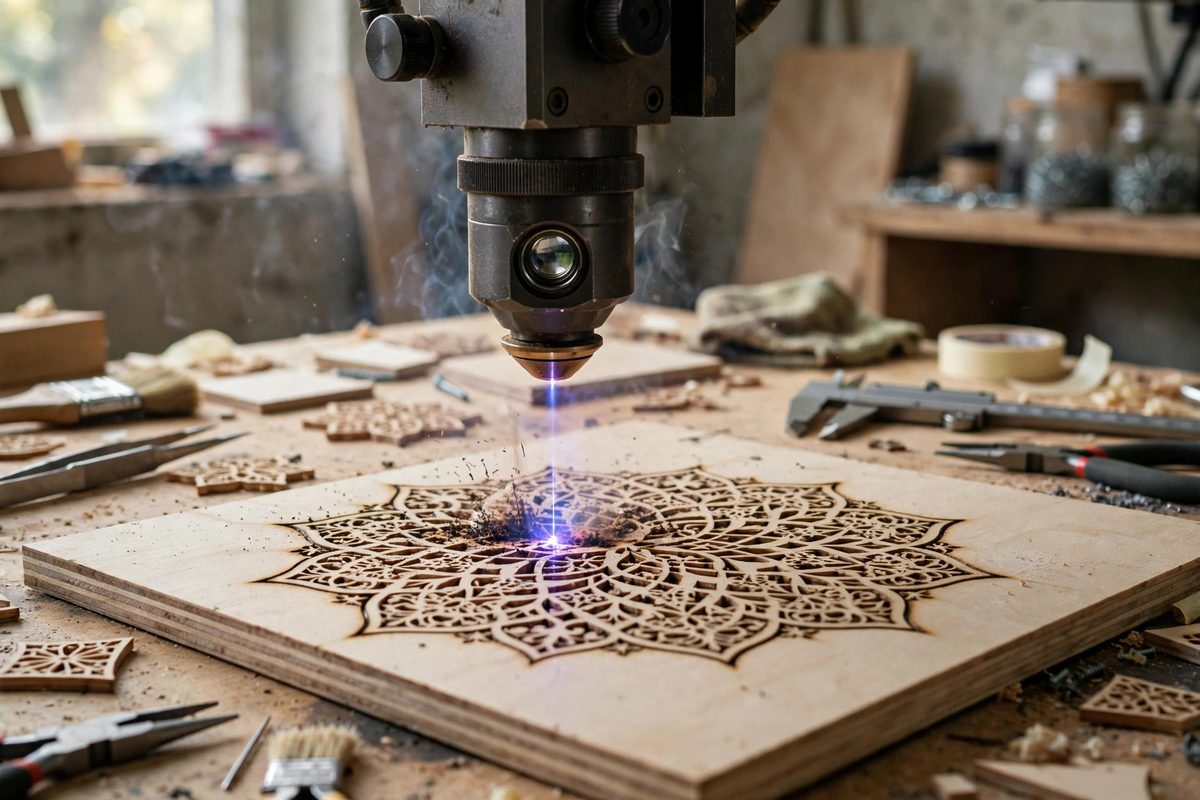
Laser piercing of thin wood, cutting delicate fretwork, inlays, and fine details in material a few millimeters thick, is a focus problem before it is a power problem. The lens's focal length determines the spot size and the depth of focus: the tightness of the beam's waist and how far that tightness extends above and below the focal point. Choose wrong and the beam is either too blunt to pierce cleanly or too shallow-focused to cut through evenly. For thin wood, the lens choice shapes every cut.
What Focal Length Controls
A shorter focal length lens focuses the beam to a smaller spot: more energy concentrated in a tinier area, which vaporizes wood aggressively and cuts fine details crisply. The trade is depth of focus: the short lens's tight spot exists only in a narrow zone, so material even slightly above or below the focus sees a widening beam and a wider, less clean cut. A longer focal length gives a larger spot but a deeper focus zone, cutting more forgivingly through thickness variations at the cost of fine detail.
For thin wood, this trade favors the short lens. The material is thin enough that the shallow depth of focus still spans the full thickness, so you get the small spot's crispness without paying the depth penalty. The short lens is thin wood's natural partner.
Matching Lens to Material Thickness
The practical pairing: for wood up to about 3mm, a short focal length lens (in the roughly 1.5 to 2 inch range, depending on the machine's optics) delivers the finest piercing with clean edges. The beam's tight waist spans the material thickness, cutting top and bottom with nearly equal precision. Thicker wood, moving toward 6mm and beyond, starts to exceed the short lens's focus depth; the bottom of the cut widens and chars, and a longer lens becomes the better choice despite its larger spot.
These are ranges, not rules carved in stone. The wood species matters: dense hardwoods need the energy concentration of the short lens more than soft woods do, while resinous softwoods may cut cleaner with slightly less aggressive focus. Test on the actual material; the lens that pierces your birch ply beautifully may scorch your cedar.
Focus Position Within the Material
With the lens chosen, focus position fine-tunes the cut. For piercing thin wood, focusing at or slightly below the material's top surface generally gives the cleanest entry with adequate penetration; focusing exactly at the mid-thickness balances top and bottom quality. Focusing above the surface defocuses the cut intentionally, which widens the kerf: occasionally useful for clearance fits, but not for fine piercing.
- Verify focus with a ramp test on scrap; the narrowest line marks true focus.
- Re-check focus when changing material thickness; the focal point is absolute, the material moves.
- Keep the lens clean; a dirty lens scatters the beam and effectively lengthens the focal spot.
- Secure thin wood flat; warp lifts the material out of the focus zone mid-cut.
Kerf Width and Detail Limits
The focused spot size sets the kerf width, which sets the minimum detail the piercing can resolve. Fine fretwork with delicate bridges between cutouts needs a kerf narrow enough that the bridges survive; a lens producing a wide kerf eats the fine features. When the design's thinnest elements approach the kerf width, either the lens must change or the design must scale.
Measure the actual kerf on the actual material with the chosen lens: cut a test square of known dimension and measure the resulting piece. The difference is twice the kerf (one kerf per side). Design offsets and fit tolerances derive from this measurement, not from the lens's theoretical spot size.
Air Assist and Lens Protection
Piercing thin wood generates smoke and fine debris that coat the lens; a coated lens loses focus quality rapidly. Air assist, a stream of air directed at the cut point, blows debris clear and also suppresses flaming, which matters enormously with thin wood's tendency to ignite. Keep the air assist clean and dry; moisture in the air stream spots the lens worse than the smoke would.
Inspect the lens regularly during piercing sessions. The fine work that demands the short lens also demands its pristine condition; a lens that is merely dusty when cutting thick stock is unacceptably degraded for fine piercing. Clean with appropriate lens tissue and fluid, never with shop rags.
Short lens for thin stock, focus verified on scrap, kerf measured not assumed, and air assist keeping the optics clean. Piercing is the laser's finest work, and the lens is what makes it fine.
Related Guides
- Nitrogen Assist Pressure Settings for Thin Delrin: Delrin, the acetal homopolymer sold under that trade name, cuts beautifully on a laser and punishes sloppy assist gas settings without mercy. Thin
- Air Assist Pressure Tuning on Acrylic Cuts: Air assist, the jet of air blown through the nozzle along the beam path, is the difference between a flame-polished acrylic edge and a sooty melted
- Dual Laser Pulse Frequency for Delrin Gears: Delrin, the acetal homopolymer prized for gears, cuts on a laser with a personality: it machines beautifully but melts readily, and the line between
- Nitrogen Assist Pressure for Clean Stainless Cuts: Stainless steel cut with oxygen assist comes out with a dark, oxidized edge that needs cleanup; cut with nitrogen, it comes out bright, clean, and