
A dual shower setup, two heads or a head plus a handheld on one valve loop, has a failure mode that shows up the moment someone flushes a toilet: one outlet robs the other, temperatures swing, and the shower experience falls apart. The problem is dynamic pressure imbalance. Both outlets share a supply, and when demand changes anywhere in the house, the pressure each outlet sees changes too, but not equally. Balancing a dual loop means designing the piping so both outlets see the same pressure under changing conditions, and protecting the temperature when they do not. It is part pipe sizing, part valve selection, and part understanding how water actually behaves in a loop.
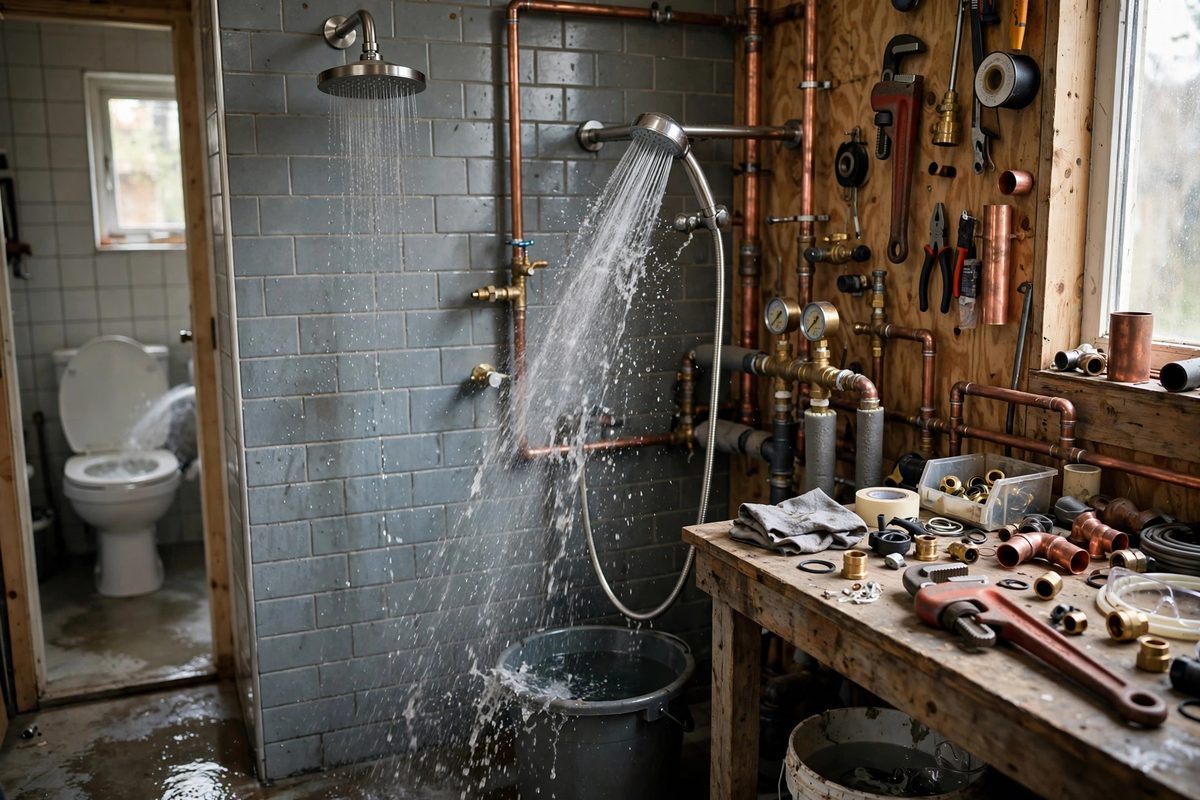
Why two outlets fight each other
Water takes the path of least resistance, and in a dual shower loop the two outlets are parallel paths from the same supply. If one path has lower resistance, because it is shorter, has fewer fittings, or its valve is opened wider, it hogs the flow and starves the other. Worse, the imbalance is dynamic: opening the handheld changes the pressure available at the main head instantly, and any pressure change in the house supply, a toilet filling, a washing machine cycling, shifts the operating point of the whole loop. Temperature makes it personal, because the hot and cold supplies rarely change pressure together. A cold-side pressure dip with steady hot pressure does not just reduce flow; it sends the mixed temperature soaring. That scalding spike is the symptom that gets attention, but the underlying disease is unbalanced pressure.
Sizing the loop for equal resistance
The foundation of balance is symmetric plumbing. Run the hot and cold supplies to a central point and branch to the two outlets with equal lengths of equal-sized pipe and matching fitting counts. Every elbow adds resistance equivalent to several feet of straight pipe, so count fittings, not just footage; a branch with three elbows is not equal to a branch with one, even if the tape measure says the lengths match. Size the supply piping generously, because pressure drop in a pipe grows with the square of the flow velocity, and a dual loop at full demand moves a lot of water. A supply that is merely adequate for one outlet becomes the bottleneck that makes two outlets fight. When in doubt, go one size up on the loop supplies. The cost difference in pipe is trivial compared with the cost of opening a finished wall to fix a balance problem.
Valve selection: pressure balancing and thermostatic
Pipe symmetry handles the static case, but only a valve can handle the dynamic one. Pressure-balancing valves sense the hot and cold inlet pressures and continuously adjust the mix to hold the temperature ratio steady as supply pressures change. They are the minimum protection for any shower, and they are essential in a dual loop where the outlets constantly perturb each other. Thermostatic valves go further, sensing the actual mixed water temperature and adjusting to hold it, which handles both pressure changes and temperature changes in the supply. For a dual shower, a thermostatic valve feeding both outlets, or a pressure-balancing valve with careful loop design, keeps the temperature stable when the handheld opens or the toilet flushes. Match the valve's flow capacity to the combined demand of both outlets at full open; an undersized valve becomes the imbalance it was meant to cure.
Loop layout details
Beyond symmetry, a few layout details pay off. Feed the loop so both outlets draw from a common manifold point rather than daisy-chaining one outlet off the other's branch; daisy-chaining guarantees the downstream outlet sees whatever pressure the upstream one leaves behind. Keep the manifold accessible, because valves and checks occasionally need service and a tiled-over manifold is a demolition job. Install individual shutoffs for each outlet at the manifold so one can be serviced without killing the whole bathroom. If the design includes a diverter between outlets rather than running both simultaneously, the balance problem simplifies enormously, but size for the worst case anyway, since diverters leak by and users find ways to open everything at once.
Testing before the tile goes up
The time to verify balance is when the pipes are still visible. Cap the outlets with test gauges or flow bags and run the loop through its paces: both outlets full open, one open while the other is throttled, and the whole thing while someone flushes every toilet and runs every faucet in the house. Measure temperature stability at the outlets during those disturbances, not just flow. A loop that holds temperature within a few degrees through a toilet flush is balanced; one that spikes is telling you to fix the piping or the valve now, when the fix is a fitting change rather than a tile demolition. Document the test with the inspector-style rigor it deserves, because once the wall is closed, this evidence is the only proof the system was ever right.
Maintenance and long-term behavior
Balance degrades over time as valves wear and supplies change. Pressure-balancing spools can stick with mineral buildup, especially in hard water, turning a valve that once compensated into one that does not. Thermostatic cartridges have service intervals; follow them. If a previously stable dual shower starts swinging temperature, the valve cartridge is the first suspect, not the piping, which does not change. Keep the valve manufacturer's service kit information with the house records, and make sure the access panel actually allows the cartridge to be removed. A beautifully balanced loop with an unserviceable valve is a future problem wearing a present disguise.
Dual shower loops behave when the piping is symmetric, the supplies are generous, the valve actively compensates for pressure changes, and the whole thing is tested under real household disturbances before the wall closes. Balance is designed in, not adjusted later. Get the loop right and both outlets simply work, no matter what the rest of the house is doing.
Related Guides
- Thermostatic Mixing Valve Flow Balancing for Showers: A shower that swings hot and cold when a toilet flushes is not just annoying; it is a failure of the mixing valve to do its job. Thermostatic mixing
- Pressure Balanced Cartridge Spool Valve Friction Limits: The pressure-balanced cartridge is the heart of the modern shower valve: a spool that slides to keep the hot-cold mix constant when someone flushes a
- Water Hammer Arrestor Sizing for Fast Valves: Water hammer is the bang that shudders pipes when a fast-closing valve, a dishwasher solenoid, a washing machine valve, a single-lever faucet snapped
- Ceramic Disc Cartridge Friction in High-Mineral Water: A faucet that used to glide now grinds, sticks, or needs real muscle to turn. If the faucet uses a ceramic disc cartridge, the culprit is usually not