
A shower that swings hot and cold when a toilet flushes is not just annoying; it is a failure of the mixing valve to do its job. Thermostatic mixing valves hold the outlet temperature steady by constantly rebalancing hot and cold flows. Getting them installed and adjusted right is the difference between a shower that behaves and one that punishes you.
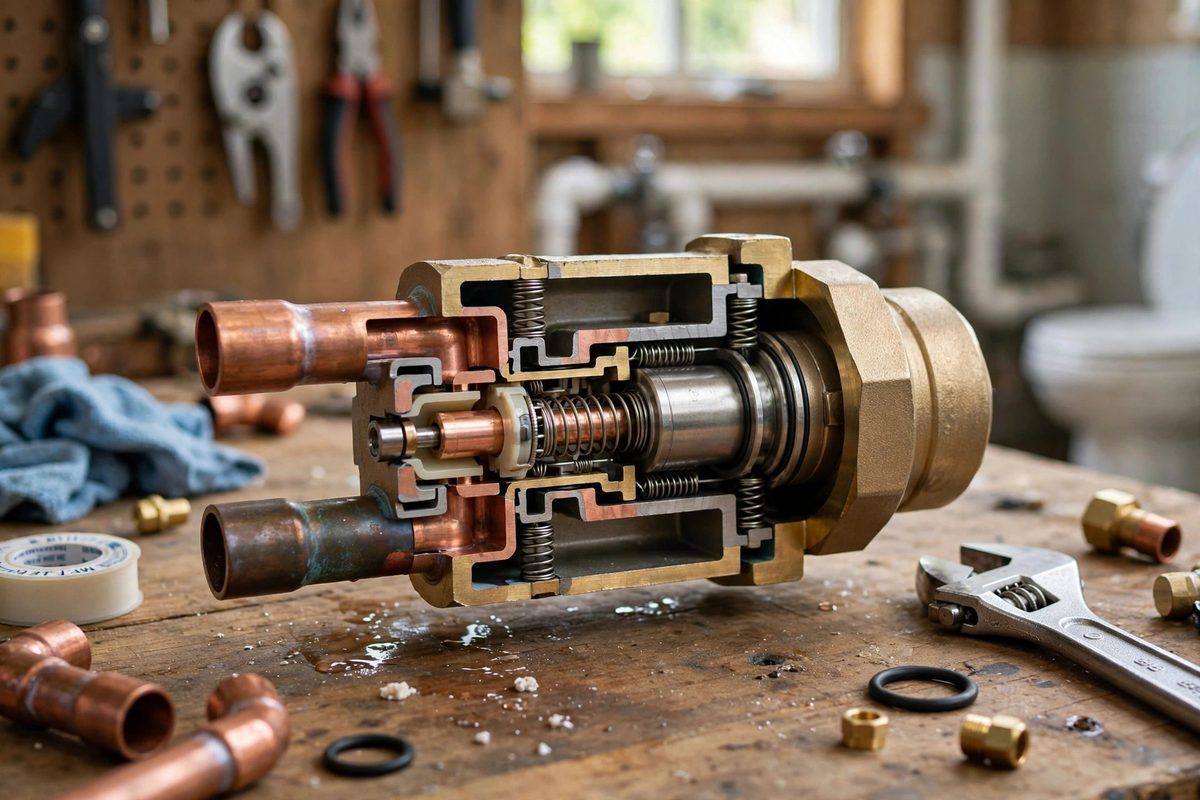
Thermostatic versus pressure-balance valves
Two valve types solve the temperature-swing problem differently. A pressure-balance valve keeps the ratio of hot to cold constant, so it survives pressure drops but can still drift in temperature if the hot supply itself cools, like when a water heater is exhausted. A thermostatic valve directly senses the mixed outlet temperature and moves its internal element to hold it, so it compensates for both pressure and supply-temperature changes. Thermostatic valves cost more and have more parts to maintain, but they deliver the steadier shower, which is the point.
Setting the maximum temperature stop
Every thermostatic valve has a temperature limit stop that caps how hot the outlet can go. This is the anti-scald device, and it needs to be set deliberately, not left at the factory default. With the water running, measure the outlet temperature with a thermometer while the handle is at full hot, then adjust the limit mechanism so the maximum lands around 120 degrees Fahrenheit. This protects children and elderly users and is a code expectation in most jurisdictions. Test it with the thermometer, not your hand; skin adapts quickly and misleads.
Balancing the hot and cold supplies
Thermostatic cartridges assume reasonable supply conditions. If the hot side arrives at much higher pressure than the cold, or the flow is badly mismatched, the valve works at the edge of its range and responds sluggishly. Check that both supplies are fully open at their stops and that there is no kinked line or half-closed isolation valve starving one side. On well systems or long runs, verify that static pressures are in the same neighborhood. The valve can only balance what it is given; garbage in, garbage out applies to water too.
Multiple outlets and volume demands
A shower with a body-spray tree, a rain head, and a handheld wand can outrun the valve's capacity. Thermostatic valves are rated for flow; stacking outlets beyond that rating means the valve cannot hold temperature when everything runs at once, because it cannot deliver the volume. Read the valve's rated flow and total up the outlets' demands before roughing in. When the numbers are close, plan the plumbing so only one group runs at a time, or step up to a larger valve body. Discovering the mismatch after tile is a bad day.
Cartridge maintenance over time
Mineral deposits and debris eventually make a thermostatic cartridge sluggish or sticky. Symptoms are slow response to handle changes, drift from the set temperature, or the handle feeling gritty. Most cartridges are serviceable: shut off the water, pull the cartridge, clean it per the manufacturer's guidance, and check the inlet screens for debris. Keep the original documentation so you know which cartridge fits years later, when memory has faded. Regular maintenance every few years in hard water areas prevents the slow degradation that users notice only once it is bad.
Testing the finished shower
Before closing up the wall, test the valve under stress. Run the shower at a comfortable setting, then flush a toilet or start another fixture; the temperature should hold within a degree or two. Check the maximum-stop temperature again with a thermometer. Verify that shutting the shower off and back on returns to the same setting. These tests take twenty minutes at rough-in and save a wall demolition later.
A thermostatic mixing valve works when you give it balanced supplies, size it for the outlets it feeds, set the scald limit with a thermometer, and keep the cartridge clean. Do that, and the shower simply behaves, which is all anyone asks of it.
Related Guides
- Dynamic Pressure Balancing in Dual Shower Valve Loops: A dual shower setup, two heads or a head plus a handheld on one valve loop, has a failure mode that shows up the moment someone flushes a toilet: one
- Pressure Balanced Cartridge Spool Valve Friction Limits: The pressure-balanced cartridge is the heart of the modern shower valve: a spool that slides to keep the hot-cold mix constant when someone flushes a
- Water Hammer Arrestor Sizing for Fast Valves: Water hammer is the bang that shudders pipes when a fast-closing valve, a dishwasher solenoid, a washing machine valve, a single-lever faucet snapped
- Ceramic Disc Cartridge Friction in High-Mineral Water: A faucet that used to glide now grinds, sticks, or needs real muscle to turn. If the faucet uses a ceramic disc cartridge, the culprit is usually not